
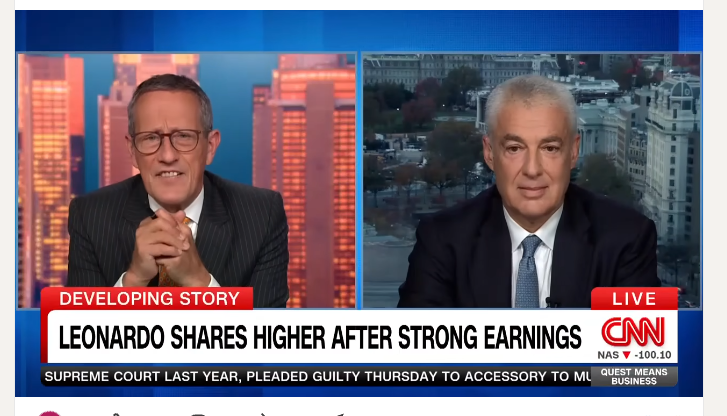
In a recent interview on CNN International, Leonardo CEO and General Manager Lorenzo Mariani laid out a clear roadmap for Europe’s defense and aerospace competitiveness, emphasizing that true strategic autonomy requires moving past national fragmentation to build unified industrial champions.
The big picture: A 3-to-10-year horizon for European sovereignty. Reflecting on Leonardo’s robust financial performance — with a surging order backlog surpassing €60 billion — Mariani stressed that technological sovereignty is not born from a single administrative decree. Instead, it requires sustained political cohesion and long-term capital commitments spanning three to ten years.
- Existing strengths: Europe already boasts world-class capabilities in advanced sectors, notably in radar technologies and missile systems—exemplified by the successful 25-year track record of the multinational joint venture MBDA, which stands on equal footing with global competitors.
- The AI and emerging tech gap: The path is more complex in fast-moving fields like artificial intelligence, where heavy past investments by the United States and China require Europe to step up targeted, decisive funding.
The take: “Only a stronger and more integrated European industry can guarantee the competitiveness needed to face future challenges,” said Mariani.
Between the lines: The case for European industrial champions. To maximize efficiency and avoid redundant spending, Mariani argued against the traditional model where every European nation attempts to maintain its own domestic champion across every domain (naval, aerospace, land, cyber, and space).
- Rationalizing capabilities: True industrial integration means selecting dedicated European champions for specific technological sectors at a continental scale.
- Bridging policy and execution: As European defense spending rises in alignment with NATO frameworks, aligning political will with industrial output is essential to safeguard civil infrastructure and secure the continent’s strategic independence.
Why it matters: As European capitals grapple with prolonged hybrid pressures, supply chain vulnerabilities, and the demand for joint defense procurement, Leonardo’s leadership is signaling that Europe’s security architecture depends less on fragmented national efforts and more on a cohesive, production-first industrial ecosystem.