
From ETS distortions to Arctic routes, from Trieste’s rail connectivity to relations with India, Egypt and the Gulf, Rixi outlines a strategy that treats maritime power as a pillar of national growth and geopolitical resilience.
The big picture: Italy is attempting to redefine its economic and strategic identity as a fully maritime nation, no longer tied solely to continental Europe. Rixi’s vision links port infrastructure, rail connectivity, uniform national governance, and outward projection toward Africa, the Gulf and India.
- At the same time, Rome is confronting significant systemic risks:
- the distortive effects of the EU’s ETS on maritime transport,
- the potential geopolitical shock of Arctic routes dominated by Russia and China,
- and the vulnerability of Suez as a critical chokepoint.
- Trieste, with its rail access to Central Europe, emerges as a gateway connecting the Mediterranean to Germany, Austria, Poland, Hungary, and Slovakia — positioning Italy not only as a national logistics platform but also as a European one.
Why he matters: Rixi’s portfolio sits at the intersection of infrastructure, trade, maritime security and geopolitics. His agenda reflects three broader shifts in Italy’s strategic posture:
- Re-centring Italy on the Mediterranean–Indo-Pacific axis, where growth is concentrated in Africa, India and the Gulf.
- Challenging EU regulatory rigidity, especially on ETS and maritime decarbonisation, which Italy sees as a competitiveness risk.
- Rebuilding extra-European partnerships, including Egypt and India, after years of diplomatic and commercial contraction.
- His push for a new public–private national coordination tool for ports and logistics also mirrors a deeper effort to overcome Italy’s historical fragmentation in infrastructure governance.
Q: The Mediterranean is changing rapidly. What is the government’s vision for Italy’s ports?
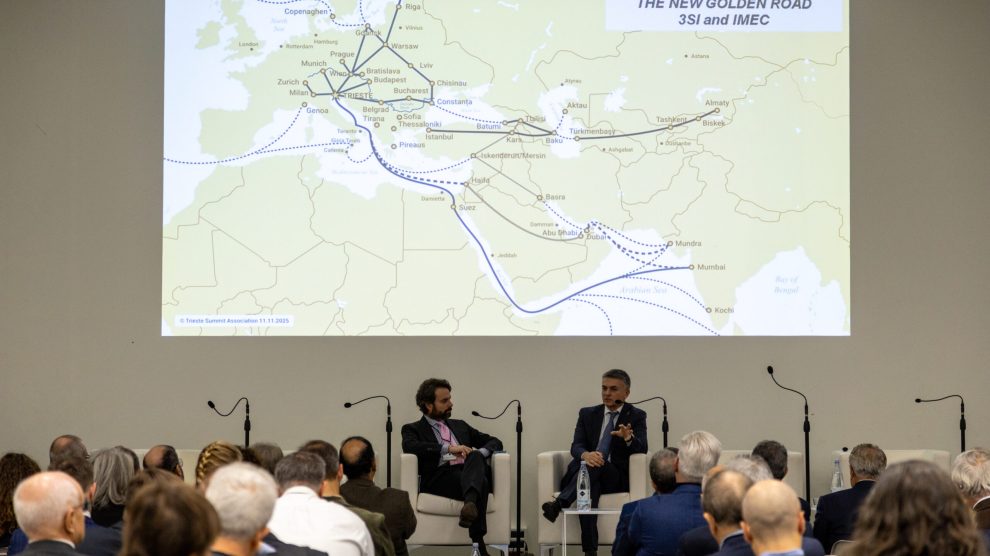
A: The Mediterranean is becoming a global strategic hub. North Africa, the Gulf and India are developing impressive logistics capacities, now reflected in corridors like IMEC. Italy must be part of this transformation.
- We need to strengthen ports that also have real rail capacity, like Trieste, and build European-level alliances. Italy is the only major continental country with all its ports on the Mediterranean — and we must turn them into European hubs serving Austria, Germany, Hungary, Poland and beyond.
Q: Does this require a new governance model for the port system?
A: Italy’s port system is extremely rich in expertise but remains fragmented. We need national coordination and uniform services — from customs to taxation and health controls.
- The Ministry alone does not have all the levers. We need a flexible, public–private instrument that can also operate abroad, attract expertise and accompany new countries in integrated logistics. China already manages dozens of ports worldwide. Italy could offer similar services to Europe and compete globally.
Q: You often speak about the need for a “common Mediterranean language.” Is Europe ready?
A: Europe was born with a continental vision, not a maritime one. But Mediterranean countries live in a completely different scenario.
- Africa is set to double its population and become the main demographic and economic engine of the coming decades. Rules designed for the Baltic or the North Sea cannot remain unchanged while 30% of global trade will pass through the Mediterranean.
- Turning the Mediterranean into a sea of wealth, stability, and integration is essential for Europe’s growth.
Q: What are the risks linked to ETS and the Arctic route?
A: ETS, as designed today, generates significant competitive distortions. After the IMO postponed global taxation, Europe risks isolating itself.
- Fleets do not yet have the technology or fuels to meet these targets. The result could be a diversion of traffic toward alternative routes — especially the Arctic, which would benefit Russia and China.
- Within five to ten years, Moscow could build a massive Arctic port hub. That would bypass the Suez Canal, avoid the ETS, and marginalise European ports. Can we really afford regulatory choices that push Europe out of global trade corridors?
Q: Is this also why Italy is rebuilding extra-European partnerships?
A: Absolutely. Over time, for political and diplomatic reasons, we reduced relations with key partners — Egypt is a clear example. We went from being its first trade partner to the twenty-eighth.
- Growth today is outside Europe. We must relaunch those ties without abandoning Europe. This is also why we are working on a ports and logistics agreement with India, which could be formalised soon with the visit of Ports Minister Sarbananda Sonowal.
Q: What did recent crises teach Italy about logistics resilience?
A: In a nutshell:
- Maritime transport is the most resilient system.
- Ukraine blocked land routes. Energy costs exploded. Trade was disrupted.
- Suez was destabilised by Houthi attacks, forcing ships to reroute around Africa — yet Europe saw no inflationary shock.
This demonstrates that, in a geopolitically unstable world, maritime transport remains the safest and most flexible means of transportation. Italy must utilise its position to act as a central hub between Europe, the Mediterranean, and the Indo-Pacific — thereby strengthening resilience and reducing conflict risks.
The bottom line: Italy is repositioning itself as a Mediterranean and Indo-Mediterranean logistics power, not just a European one. Under Rixi’s strategic framing, ports are no longer just infrastructure assets, but geopolitical tools.
- ETS risks undermining Europe’s maritime competitiveness.
- The Arctic route could redraw global trade in Russia and China’s favour.
- Africa, India and the Gulf are the true centres of future growth.
- Trieste is emerging as Italy’s main bridge to Central Europe.
The core message is clear: without a full maritime turn — in governance, infrastructure and diplomacy — Italy risks being bypassed in the next phase of global economic geography.