
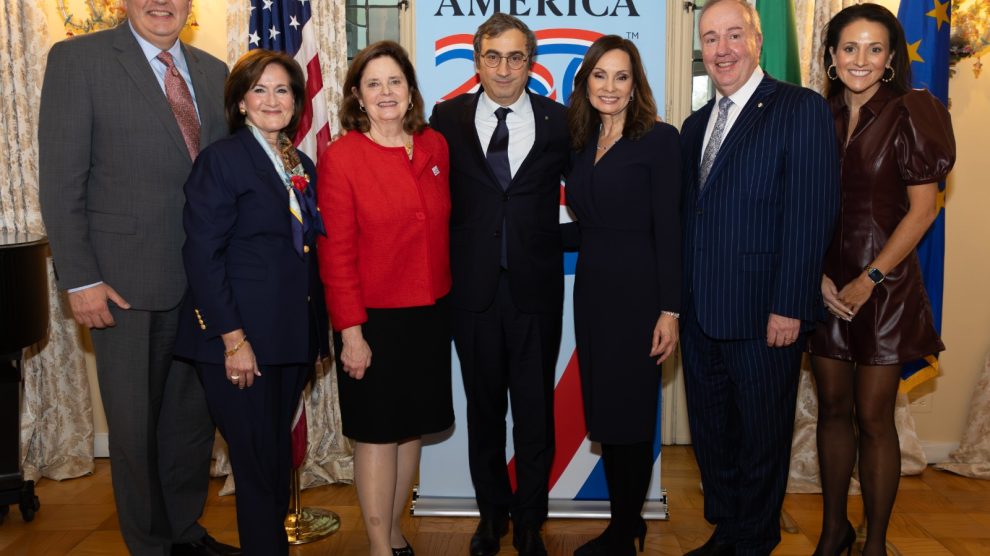
Italian Ambassador Marco Peronaci on Wednesday called the signing of the Memorandum with America250 “an opportunity to celebrate the deep friendship that unites Italy and the United States and the contribution our country has made to shaping American identity — from migration to culture, science and society.
The MoU, he said, will translate into “a true Italian program for 2026,” a year in which the U.S. will host both the FIFA World Cup and the G20. The ceremony at Villa Firenze formalised cooperation between Rome and Washington ahead of the 250th anniversary of the Declaration of Independence.
Why it matters: The agreement connects America’s Semiquincentennial to the 165th anniversary of Italy–US diplomatic relations, linking the 2026 calendar to a shared historical narrative.
- It also comes as the U.S. redefines its strategic priorities.
- Italy is reaffirmed as a stable component of the Western strategic architecture, with a role that stretches from the Mediterranean to Africa and intersects with Washington’s thinking on economic, industrial, and energy security.
State of play: Peronaci’s Italian program will launch in January with an event marking the 25th anniversary of the bilateral MoU on cultural property protection, renewed on December 5 in Rome by Culture Minister Alessandro Giuli and Deputy Secretary of State Sarah Rogers.
- The embassy is preparing a dense roster of initiatives across music, cinema, science and historical reflection.
- Maestro Gianandrea Noseda will take a central role, alongside events highlighting figures such as Filippo Mazzei, developed in collaboration with the National Italian American Foundation — reinforcing the 250/165 formula established by the Italian-American community.
- The signature moment will be an exhibition of Roman statues dedicated to Emperor Trajan, designed to highlight the enduring influence of Roman civilisation on Western political culture.
Zoom in: The ceremony underscored how the Italy–US relationship now moves across multiple layers.
- Senior institutional and cultural figures — including Assistant Secretary for Cultural Affairs Darren Beattie, NIAF President Robert Allegrini, NIAF Chairman John Calvelli, National Symphony Orchestra Director Jean Davidson, and Kennedy Centre board member Paolo Zampolli — attended the event, signalling the breadth of engagement supporting the 2026 initiatives.
- The post-signing discussion, moderated by Anita McBride (NIAF and White House Historical Association) with contributions from Barbara Faedda (Columbia University) and Lisa Sasaki (Smithsonian Institution), broadened the lens on what continues to make the Italy–US friendship unique.
McBride emphasised the institutional significance of the agreement:
- “The MOU is important because it establishes a formal relationship to promote the crucial bilateral relationship between the US and Italy during a significant anniversary in US history.”
- “The Italian government, specifically through its Embassy and consulates here in the US, have robust programming planned to showcase the significant multi-sector collaborations between our countries.”
- ”NIAF is also honoured to be included in the MOU as the only cultural and historic institutional partner to support these programming efforts.”
- She also underscored the strategic value of cultural diplomacy: “Soft power and cultural diplomacy are significant to furthering the understanding of the undisputed strong Italian connection to the founding of the United States to today.“
- “The Italian Age of Enlightenment had a profound influence on our country’s founders, and its legacy resonates today.”
- “Educational and cultural programming being planned by the Italian Embassy as well as NIAF will amplify this history and promote its relevance to today.”