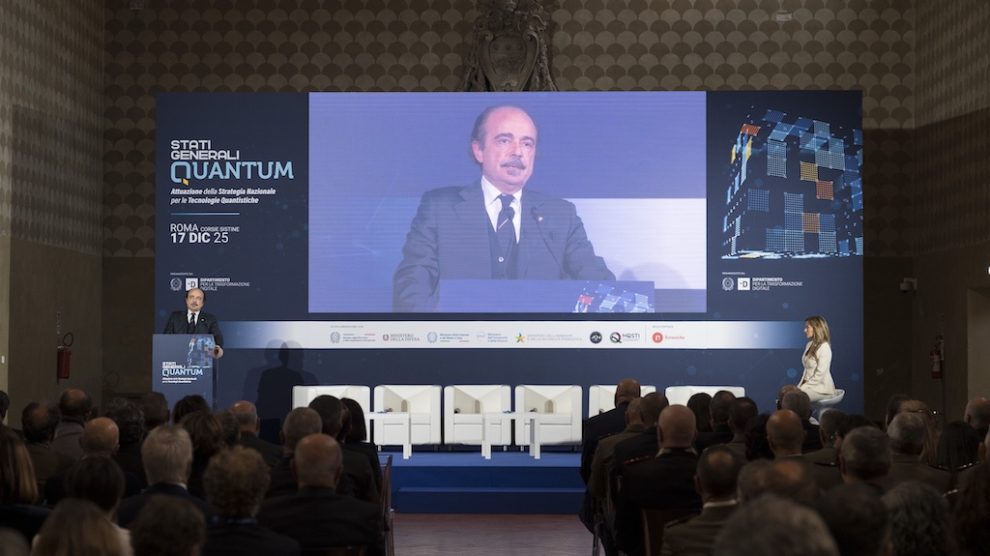
Decode39 and Formiche, media partners of the Quantum States General, organized by Department for Digital Transformation of the Presidency of the Council, spoke with Undersecretary Alessio Butti on the sidelines of the event to assess Italy’s current position following the publication of its National Quantum Strategy and what comes next in the transition from vision to implementation.
Why he matters: As Undersecretary to the Presidency of the Council with responsibility for digital transformation, Alessio Butti oversees the strategic coordination of Italy’s digital and technological agenda.
- He plays a central role in translating national strategies — from digital public services to emerging technologies such as quantum — into operational policies, governance frameworks, and public-private ecosystems.
- His position places him at the intersection of industrial policy, innovation, and state capacity, making him a key institutional actor in Italy’s effort to turn technological ambition into systemic competitiveness.
Q: The first edition of the States General of Quantum marked a turning point in Italy’s approach to this strategic technology. Despite the limited number of industrial quantum players globally, Europe, and Italy, in particular, appear to be well-positioned. What are the next steps?
A: The first edition of the States General of Quantum was an extraordinary success, with four ministers, in addition to myself, and more than 450 stakeholders in attendance. I would like to sincerely thank Ministers Antonio Tajani, Guido Crosetto, Adolfo Urso, Gilberto Pichetto Fratin, and Anna Maria Bernini for their fundamental contribution to this moment of shared reflection.
- We are moving from “talking about quantum” to “putting the National Strategy into practice,” with institutions, research, and industry operating within the same framework. The following steps must be highly concrete:
- The first step is to ensure the governance outlined in the Strategy is stable and fully operational, enabling it to translate objectives into actions across the entire value chain — from researchers to businesses, and all the way to public administrations and citizens.
- The second step is to accelerate the transfer of technology. The issue is not a lack of research — Italy’s research base is strong — but instead transferring it into the industrial and economic sphere through projects that genuinely support our production chains.
Q: Under what conditions can quantum technologies become a strategic infrastructure for Italian companies?
A: For Italian companies, quantum will become a strategic infrastructure when it is accessible, reliable, and integrated into real processes — not when it remains confined to a handful of laboratories. This is precisely why an integrated ecosystem is needed, rather than isolated initiatives.
- Value for businesses emerges when the infrastructure operates at a system level, creating markets, skills, and shared standards that drive growth.
Q: What role should the State play in coordinating the academic, industrial, and institutional dimensions — including the idea of a National Quantum Hub?
A: The State must act as an architect and coordinator, not as a substitute. From this perspective, the idea of a National Hub makes sense if it is conceived as an enabling platform. In this place, skills and infrastructure are aggregated, public-private partnerships are facilitated, and strategic objectives are pursued.
- When a credible strategic framework exists, private actors are also more willing to build the right synergies. A clear example is the agreement between IonQ and D-Wave for the Q-Alliance, announced at the recent Innovation Forum in Cernobbio, which will involve up to one hundred researchers.
Q: What role will funding and private capital play in the development of the quantum ecosystem?
A: Quantum technologies require scalable investments. The public sector must act as an enabler, while the private sector must bring speed and market capability.
- The Strategy accurately reflects the starting point: strong scientific excellence, but still a limited presence of startups. However, we started from a challenging position in other areas as well — such as digital public services — and within three years we managed to catch up and overtake countries like France and Germany.
- We must be very clear on one principle: implementing a strategy stably and permanently certainly helps attract players and investments, while remaining fully compliant with our regulatory framework. The facts are proving us right.
The bottom line: Italy’s quantum strategy is entering its decisive phase: execution. According to Alessio Butti, the success of quantum technologies will depend less on scientific breakthroughs and more on governance, ecosystem integration, and industrial adoption.
- The goal is not to create isolated centres of excellence, but a system-level infrastructure capable of generating competitiveness, investment, and long-term strategic value for the country.