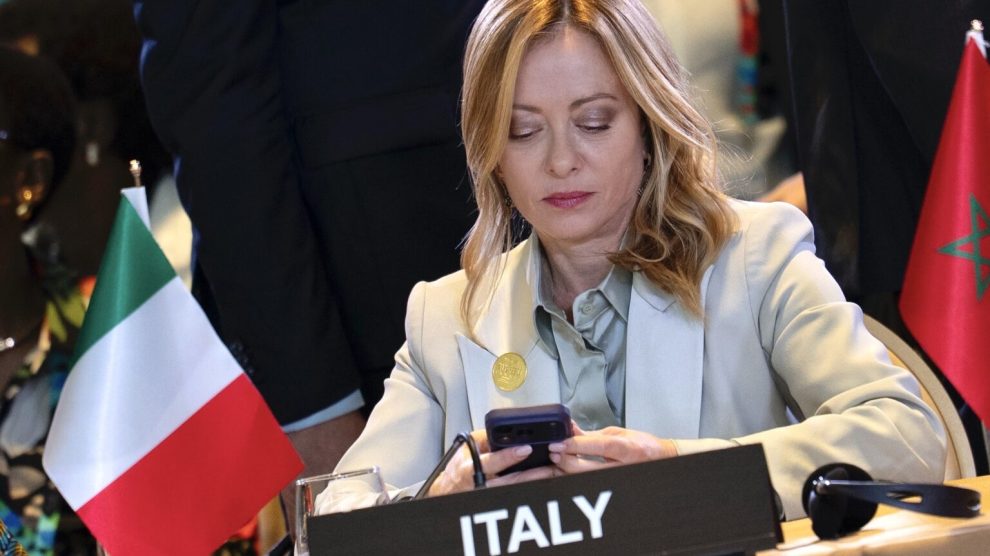
Decoding the news. Giorgia Meloni’s upcoming Indo-Pacific trip, postponed but not cancelled last summer, confirms the region’s growing relevance in Italy’s foreign-policy outlook.
- The decision to reschedule rather than abandon the tour signals Rome’s intention to remain engaged in one of the world’s key geopolitical and economic theaters, at a time of heightened global uncertainty.
- As Brian Katulis notes, Italy is pursuing a pragmatic strategy aimed at diversifying its global role and positioning itself not merely as a consumer of security, but increasingly as a contributor to stability.
Transatlantic-aligned. Italy’s Indo-Pacific engagement broadly aligns with the United States’ strategic posture in the region and is best understood as a functional complement rather than a symbolic political move.
- The U.S. National Security Strategy of 2025 identifies the Indo-Pacific as a central arena of economic and geopolitical competition, and Rome’s approach fits within this framework by reinforcing a “free and open” regional order.
- Meloni’s strategy seeks to be proactive rather than reactive, while maintaining close coordination with Washington.
Trend-Setter for Brussels. From a European perspective, Italy’s outreach to the Indo-Pacific offers an opportunity for greater coordination rather than fragmentation.
- Rome’s engagement is consistent with the EU’s 2025 Indo-Pacific framework, which prioritises security and defence, green and digital transitions, and economic resilience. Deepening partnerships with countries such as Japan and South Korea could strengthen the EU’s overall security posture and provide a model for other member states to follow.
Neutral (?) stance toward China: Italy’s posture should not be read as an explicitly anti-China pivot. Instead, Rome appears to be pursuing a calibrated balance between competition and selective engagement.
- While cooperation with Beijing continues through EU channels and economic frameworks, Italy also views China as a strategic competitor, particularly in regions such as Africa.
- By focusing on safeguarding maritime routes and the rules-based international order, Rome aims to manage competition with China without sliding into Cold War dynamics.
- That decision alone signalled the strategic weight of the initiative within Rome’s foreign-policy outlook: Italy does not intend to decouple from one of the world’s most consequential geopolitical theatres.