Decoding the news: Italy is strengthening its economic and strategic footprint in Libya through a high-profile port expansion in Misrata, backed by Italian and Qatari capital. The project highlights Rome’s ambition to position itself as a key Euro-African connector—while navigating Libya’s persistent political and security complexities.
What’s happening:
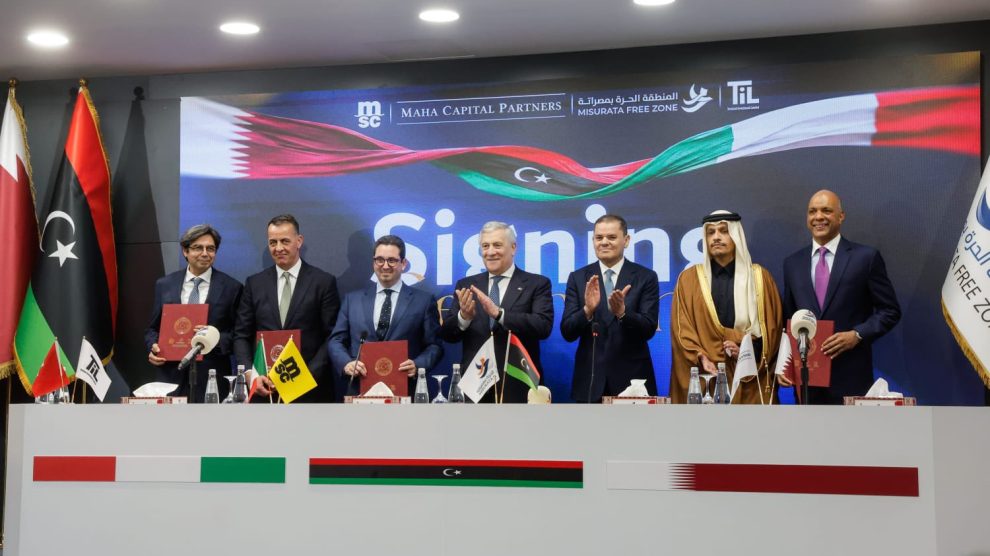
- On Sunday, officials laid the foundation stone for a new container terminal in the Misrata Free Zone, with the participation of Qatar’s prime minister and foreign minister, Mohammed bin Abdulrahman Al Thani.
- The expansion involves Mediterranean Shipping Company (MSC) and Qatar’s Al Maha company, combining Italian logistics expertise with Gulf capital.
- According to preliminary estimates, investments in the Misrata port and free zone could reach $2.7 billion over three years, making it one of the most significant port infrastructure projects currently underway in North Africa.
The bigger picture: Misrata sits on Libya’s central-northern coast and has long been regarded as a natural hinge between the Mediterranean and sub-Saharan Africa. Its commercial port, strong mercantile tradition, and land routes toward the Fezzan and the Sahel give it strategic depth well beyond Libya’s coastline.
- For Italy, the project fits squarely within the Mattei Plan for Africa, Rome’s framework for coupling development, infrastructure, and stability across the southern Mediterranean and Africa.
- If paired with digital and logistics upgrades, the Misrata expansion could support trade growth, employment, and reconstruction—while reinforcing Libya’s role as a Euro-African platform rather than a peripheral transit zone.
By the numbers:
- Container traffic in Misrata rose by more than 22% in 2025, underscoring rising demand linked to reconstruction and imports.
- The new terminal aims to expand capacity and create dedicated cargo areas to accommodate growing regional and international flows.
What Italian officials are saying: Italian foreign minister Antonio Tajani, speaking at the ceremony, described MSC’s presence as “fundamental” for Libya.
- He stressed that the project is not an alternative to Italy’s Gioia Tauro hub, but rather a way to deepen Italy’s maritime reach across the southern Mediterranean.
- Tajani also framed Misrata as Libya’s “economic capital,” signalling Rome’s intent to encourage Italian companies to scale up their local engagement.
Diplomacy alongside business: On the sidelines, Tajani held talks with Libyan Prime Minister Abdul Hamid Dabaiba, focusing on:
- Italy-Libya economic relations and opportunities linked to the Free Zone
- Migration management and the fight against human trafficking
- Support for the UN-led national reconciliation process and Libya’s unity
Energy also featured prominently, with Tajani reaffirming ENI’s central role in Libya’s economy—another pillar of Italy’s long-term presence in the country.
Migration and security context: Italian officials acknowledge that Libya remains both a transit country and a pressure point.
- Recent increases in departures toward Europe have renewed Rome’s push for cooperation on training Libyan police forces, working with countries of origin such as Bangladesh, and coordinating with transit partners—including Qatar.
- Tajani also flagged broader instability in sub-Saharan Africa and the ongoing war in Sudan as interconnected drivers of migration and insecurity.
Between opportunity and risk: The Misrata project unfolds against a backdrop of Libya’s unresolved political fragmentation and periodic human-rights concerns.
- Yet Rome appears to be betting that economic anchoring—via ports, energy, and logistics—can support gradual stabilisation, rather than waiting for a comprehensive political settlement.
The bottom line: By backing a flagship port expansion in Misrata alongside Qatar and MSC, Italy is projecting itself as a pragmatic, long-term partner for Libya.
- The move reinforces Rome’s Mediterranean strategy: leverage infrastructure and trade to shape stability, manage migration, and secure Italy’s role as a central node between Europe, Africa, and the Gulf.
(Photo: X, @antonio_tajani)