
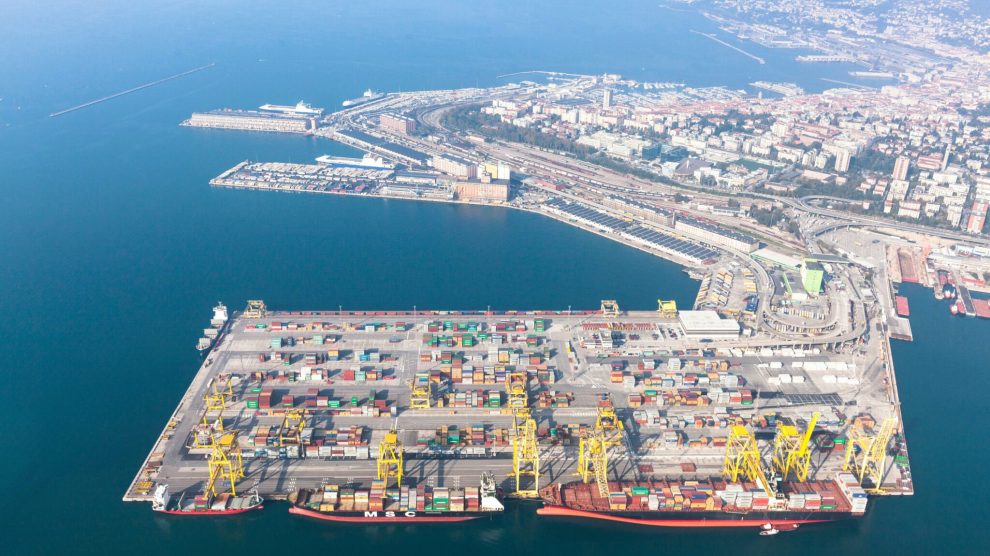
The stable inclusion of the Port of Trieste in MSC’s Dragon service restores a direct maritime link between Asia, the Mediterranean and the U.S. East Coast — at a moment of strain in transatlantic relations. The move strengthens Trieste’s geoeconomic role and improves export access for northern Italy.
The big picture: As political relations across the Atlantic face renewed tension — exacerbated by initiatives from U.S. President Donald Trump, including rhetoric on Greenland, and not-coordinated reaction from some EU’s countries — logistics is moving in the opposite direction.
- From Trieste comes a concrete signal of reconnection between Italy and the United States, driven by shipping routes rather than diplomacy.
What’s happening: In the coming weeks, the container terminal at Molo Settimo will enter the regular rotation of MSC’s Dragon service, the group’s intercontinental route linking Asia, Europe and the U.S. East Coast.
- For Trieste, this marks a return to one of the world’s main oceanic corridors at a sensitive moment for global trade.
The route: According to MSC, the Dragon rotation will run: Busan – Ningbo – Shanghai – Nansha – Yantian – Singapore – Trieste – Gioia Tauro – Genoa – La Spezia – Sines – New York – Boston – Norfolk – Charleston – Freeport – Grand Bahama – Busan.
Why Trieste matters: The service will cut transit times by around five days and provide seamless access not only to Trieste, but also to Koper, Rijeka, Venice, Ravenna and Ancona.
- This reinforces Trieste’s role as a gateway to the Upper Adriatic, the Balkans and parts of Central and Eastern Europe — an asset increasingly discussed in the context of the India–Middle East–Europe Economic Corridor and its potential links with the Three Seas Initiative.
What officials say: Marco Consalvo, newly appointed president of the Eastern Adriatic Port Authority, says the value of Dragon lies in its structure: a fixed weekly call starting in early April.
- The goal, he notes, is a concrete recovery in container volumes after a difficult 2025.
By the numbers:
- In 2025, Trieste handled 681,000 TEUs, down 19% year-on-year.
- Dragon vessels will range from 15,000 to 19,000 TEUs.
- At full capacity, MSC alone could generate 500,000–650,000 TEUs annually.
- That would essentially close the gap with 2024 volumes and set the stage for strong growth in 2026.
Beyond logistics: The service has a precise geopolitical dimension.
- On one side, it strengthens links with Asia; on the other, it restores a direct maritime connection with North America.
- Italy’s North-East offers a faster, more efficient export route to the U.S., aligning with Washington’s emphasis on economic and trade ties as drivers of broader political relations.
What’s next: The first vessel, MSC Thais, will inaugurate the rotation with arrival in Busan on February 18, touching major Asian, Mediterranean and U.S. East Coast hubs.
- The launch coincides with Prime Minister Giorgia Meloni’s visit to Asia, where maritime security and connectivity remain key themes—sometimes by design, sometimes by strategic coincidence.
What operators think: Industry reaction is broadly positive, with caveats.
- Francesco Parisi, head of the Parisi shipping house and president of Trieste Summit, notes that Trieste has regained two of the three direct Asia services, as before the dissolution of the 2M alliance in spring 2025.
- He also highlights the symbolic return of a direct U.S. East Coast link, the first in years, while pointing to a structural constraint: continued circumnavigation of Africa instead of transit through Suez.
- Stefano Visentin, president of Aspt Astra and vice president of Trieste Summit, echoes those concerns. He stresses the need for competitive freight rates versus Northern European ports and hopes for a future return to the Suez route.
- The African circumnavigation, he argues, still penalises the service in both westbound and eastbound directions due to additional transshipments.
The bottom line: While transatlantic politics remains uncertain, logistics is quietly rebuilding bridges.
- With the return of Dragon, Trieste strengthens its bid to become a cornerstone of Italy’s geoeconomic strategy—and a maritime pillar of the Italy–U.S. economic relationship, increasingly shaped by what moves at sea.