Italy has taken a formal parliamentary step toward integrating the Three Seas Initiative (3SI) into its broader connectivity strategy, explicitly linking it to IMEC and the Central European Initiative (CEI).
The parliamentary committee resolution: On January 20, the Foreign Affairs Committee of the Chamber of Deputies approved Resolution 7-00346, promoted by MP Paolo Formentini (League), committing the government to assess Italy’s accession to the Three Seas format and to develop operational synergies between the three frameworks.
Decoding the news: This is not about joining another regional forum — it is about locking Italy into Europe’s emerging connectivity architecture at a moment of intense geopolitical and geo-economic competition.
By bridging: IMEC’s East–West axis (India–Middle East–Europe), and 3SI’s North–South spine (Baltic–Adriatic–Black Sea), Italy aims to position itself as a logistical and strategic hinge between the Indo-Mediterranean, Central and Eastern Europe, and the wider EU market.
What they’re saying:
- “With the approval of our resolution in the Foreign Affairs Committee, we have taken a first concrete step toward Italy’s integration into the Three Seas Initiative,” says Paolo Formentini, vice-chair of the Foreign Affairs Committee.
- “We are committing the government to assess Italy’s accession to this initiative urgently and, consequently, to link it with IMEC and the Central European Initiative. Italy thus becomes an even stronger geographic hinge between East–West and North–South, enhancing the port of Trieste as a key hub and strengthening its global competitiveness. This moves clearly in the direction of Italy’s national interest.”
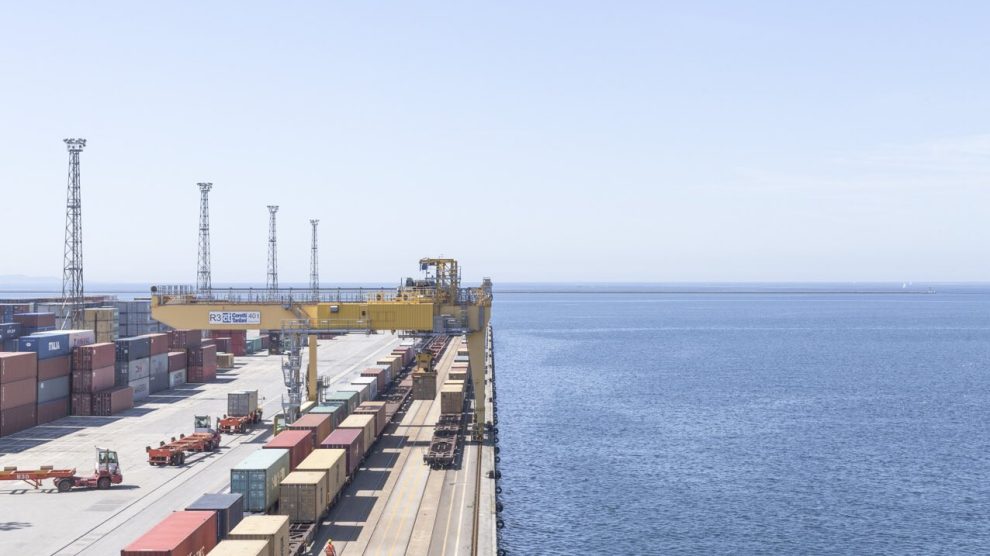
Why it matters: Trieste’s structural advantage. Trieste is not framed as a symbolic choice, but as a structural one.
- The port is already fully integrated into Europe’s industrial value chains, with efficient rail and logistics connections to Germany and Central and Eastern Europe.
- Compared to Mediterranean ports in France or Spain — geographically farther from Europe’s industrial core — and to Greek ports constrained by Balkan infrastructure bottlenecks, Trieste offers direct access to the heart of the EU economy.
- In practical terms, this makes Trieste uniquely positioned to serve as both the European landing point for IMEC and a gateway linking Mediterranean routes to continental Europe via 3SI corridors.
Beyond East: Trieste’s Westward and Southern reach. Italy’s connectivity strategy is not confined to a single axis.
- West: Trieste is now part of MSC’s Dragon service, directly linking the Upper Adriatic with the U.S. East Coast — a rare transatlantic connection for a Mediterranean port.
- South: During Foreign Minister Antonio Tajani’s recent visit to Libya, Italy backed a major expansion of the port of Misrata, alongside Qatari capital and MSC, positioning it as a Euro-African logistics hub aligned with Rome’s broader Mediterranean and Africa strategy.
- Together, these moves underscore a network logic: Trieste as the European node of a wider system stretching from the Indo-Pacific to Africa and the Atlantic.
CEI + 3SI: a dual-track strategy. Rome is also careful to stress continuity, not substitution.
- Italy is a founding member of the Central European Initiative, headquartered in Trieste. The approach emerging from the resolution is explicitly dual-track:
- CEI as a diplomatic and regulatory convergence framework;
- 3SI is an operational, investment-driven platform focused on infrastructure, energy and digital connectivity.
- Rather than competing, the two formats reinforce Italy’s leadership across the Adriatic and Central Europe.
The bottom line: The parliamentary vote signals more than procedural interest. It reflects a strategic calculation: Italy does not want to sit at the margins of the new global corridors taking shape.
- By linking IMEC with the Three Seas Initiative — and anchoring both to Trieste — Rome is betting that geography, infrastructure and political alignment can translate into long-term economic and geopolitical leverage.
- In today’s infrastructure-driven competition, Italy is making clear it intends to be a node, not a terminal.