
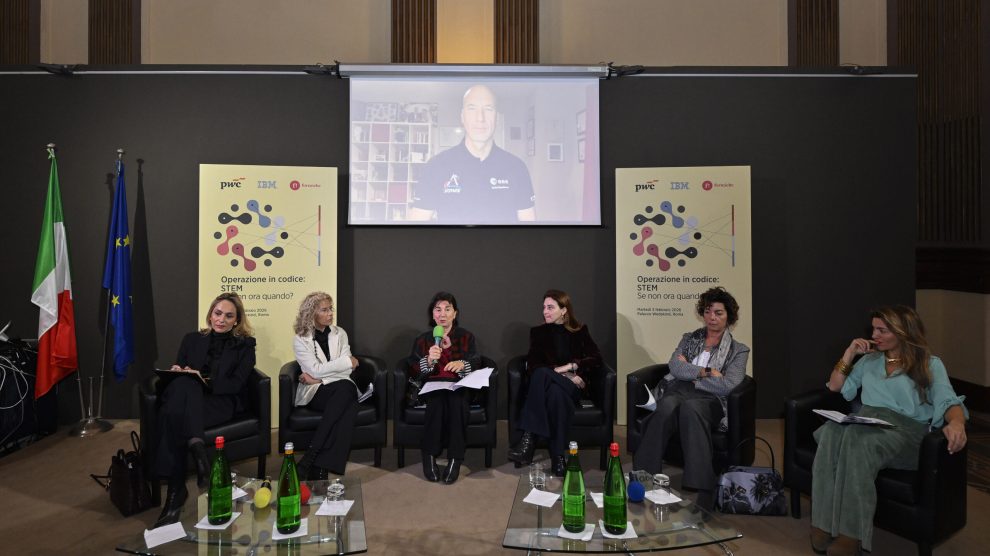
During the “Operazione in codice STEM” forum organized by our sister website Formiche, government officials, academics, industry representatives, and armed forces discussed how STEM competencies intersect with national strategy.
The move: Minister for Family, Natality, and Equal Opportunities Eugenia Maria Roccella highlighted the government’s comprehensive legislation on artificial intelligence, noting that it “covers a little bit of everything, including the risks of violence and image manipulation.”
- Beyond regulation, she emphasized the importance of education, pointing to 24 ministry-funded projects connecting university knowledge with high school teaching and insisting that it is essential for teachers to “convey the beauty of science and be engaging.”
The strategic lens extended to emerging technologies. Undersecretary for Defense Isabella Rauti framed quantum technologies as “a field of competition between states, destined to redefine global balances,” highlighting their role in economic, military, and industrial advantage.
- She stressed that quantum capabilities now underpin national security by protecting information, strengthening critical infrastructure, and enhancing deterrence.
- On artificial intelligence, Rauti warned of the risks to creativity and judgment if poorly governed, advocating for a balanced approach that integrates humanistic disciplines into technology: “One of the risks is the degeneration of creative aspects and judgment… we must safeguard the capacity for judgment and creativity,” she said, calling for a “technological humanism.”
Why it matters: STEM competencies are increasingly treated as strategic assets, akin to raw materials critical for defense, industrial competitiveness, and economic resilience.
- Marta Schifone, member of the Chamber’s Labor Committee, described the stakes plainly: “Skills today are a bit like raw materials… we must cultivate our talents, we cannot afford to lose them or export them.”
- The shortage of STEM-qualified professionals is acute, with two-thirds of companies unable to find the profiles they need. Addressing gender disparities is central: Schifone reminded the audience that girls have historically been discouraged from STEM, asserting, “I want to tell all girls that you can become anything.”
- Barbara Pontecorvo, partner at PwC, reinforced this point with data: only 25% of students choose STEM degrees, and of these, only a quarter are women.
- She noted a persistent paradox: despite early aptitude and interest, girls often do not pursue STEM pathways, creating a “silent barrier” that limits innovation and workforce diversity.
- She concluded that “the issue of equal opportunities is not just a matter of rights, it is a strategic issue for the country’s growth,” emphasizing the economic and creative costs of the gender gap.
Strategic convergence. There is broad agreement among policymakers, defense officials, industry leaders, and educators on the need to strengthen STEM skills as a matter of national priority.
- Alessandra Santacroce, director of institutional relations at IBM Italy, underscored how the labor market is already shifting in response to technological change: “54% of managers say they hired someone this year for a role that did not exist last year.”
- Skills such as AI literacy, ethical reasoning, critical thinking, and collaborative problem-solving are becoming essential, bridging humanistic and technical education to prepare Italy for future challenges.
The bigger picture: Italy’s efforts mirror broader European and global trends where STEM education, AI, and quantum technologies are increasingly linked to sovereignty and strategic autonomy.
- By framing human capital as a critical resource, Italy aims to secure its economic competitiveness and defense readiness in an era of technological rivalry. Gender equity emerges as both a social and strategic imperative, as fully leveraging the country’s talent pool becomes central to national resilience.
Political fault lines: Experts cautioned that ambitious reforms risk remaining theoretical without adequate teacher training and funding. Historical examples, such as England’s delayed implementation of similar reforms, serve as a warning.
- Social and cultural biases continue to dissuade girls from entering STEM fields, creating a structural gap that could undermine Italy’s innovation and security objectives if left unaddressed.
What it signals: Italy is elevating STEM education from a matter of career opportunity to a tool of national strategy.
- The integration of quantum technologies, AI governance, and gender inclusion reflects a comprehensive vision of human capital as a strategic asset.
- Future policies are expected to accelerate technological initiatives, embed humanistic thinking into technical training, and tackle gender disparities as a core element of national competitiveness and security.