
Why it matters: Rome is moving to re-establish a structural presence in Libya — linking migration control, security cooperation and a renewed energy push in the Sirte basin. The strategy combines parallel engagement with both Western and Eastern power centres, as well as a major offshore license for Eni and QatarEnergy.
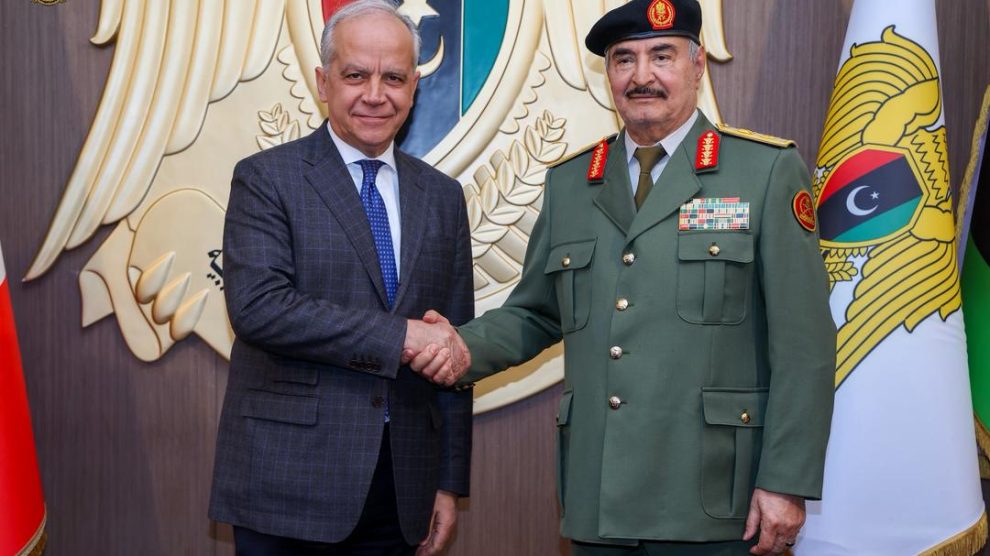
Security diplomacy on both sides of Libya. Italy’s Interior Minister Matteo Piantedosi visited Tripoli and Benghazi within days — his sixth mission to the Libyan capital since taking office — closing the trip with a meeting with Khalifa Haftar.
The big picture: Rome is formalising a strategy of “parallel engagement” with Libya’s dual power structures:
-
- The Government of National Unity in Tripoli, led by Abdulhamid Dabaiba.
- The Eastern Bloc aligned with Khalifa Haftar, his family network and the Tobruk-based parliament.
- The move follows a rocky phase in relations with eastern Libya. In July 2025, an EU delegation, including Piantedosi, was turned away upon arrival in Benghazi — widely seen as a political signal by Haftar to assert leverage.
- Returning now on a bilateral mission, including high-level intelligence components, amounts to recognising Haftar as a key interlocutor on migration and security — without formally acknowledging the parallel government in the east.
Rome’s calculation: Migration management cannot run solely through Tripoli if Haftar-linked forces effectively control key militias and transit nodes.
- For Italy, operational channels must cover the full Libyan arc — especially areas intersecting the Central Mediterranean route and the southern borders with Egypt, Sudan and Chad.
Migrant arrivals drop — but Libya remains central. The visit comes as Italy prepares to implement the rules of the new EU Pact on Migration and Asylum, which will enter into force in June.
- The numbers:
- 1,813 arrivals in Italy between Jan. 1 and Feb. 9, 2026.
- Down 56.38% from 4,156 in the same period in 2025.
- 1,386 migrants — more than three-quarters — departed from Libya.
- Libyan departures down 64.1% year-on-year.
- Despite the decline, Libya remains the backbone of the Central Mediterranean corridor. Alternative routes via Tunisia and Algeria are growing in percentage terms but remain marginal in absolute numbers.
Reality check: While political attention often shifted toward Tunisia in recent years, data from NGOs and EU institutions show Libya has steadily regained its role as the primary departure point toward Italy.
- That explains Rome’s urgency to “cover” both Tripoli and Benghazi with operational cooperation and intelligence-sharing mechanisms.
Beyond the “naval blockade” slogan. Piantedosi has distanced himself from campaign-era rhetoric about a “naval blockade,” calling it a journalistic simplification.
- What’s actually on the table:
- Possible temporary entry restrictions within Italy’s 12-mile territorial waters in exceptional security cases.
- Externalisation of parts of asylum procedures to “safe third countries,” in line with EU Pact provisions.
- Strengthened cooperation with Libyan authorities on voluntary returns and land and maritime border control.
- Symbolism matters — showing the route is “under control.”
- But the Interior Ministry acknowledges that current conditions do not justify extraordinary measures, given relative stability in 2025 and the early 2026 decline.
The controversial part: According to IOM data, 537 people were intercepted and returned to Libya between early January and late January 2026 — raising persistent concerns about conditions incompatible with European protection standards.
- Libyan political analyst Ahmed Zaher argues the visit complements recent economic and energy developments. “Tripoli represents the maritime front and ports, while Benghazi effectively controls the entire southern border,” he says. “To influence the migration file, you need to work on both fronts in parallel.”
- Zaher also notes that Eni has consolidated its reputation as a reliable partner, improving dialogue with Benghazi and facilitating minimal understandings on migration containment.
- But he warns these are “stopgap solutions” in the absence of a cohesive Libyan state governed by constitutional rule of law.
The energy pivot: Eni and QatarEnergy secure offshore O1. Parallel to migration diplomacy, Italy is deepening its energy footprint. Libya’s National Oil Corporation awarded the offshore O1 license to a consortium led by Eni, with QatarEnergy as a partner.
- Key details:
- Offshore block in the Sirte basin.
- Around 29,000 square kilometres.
- Water depths up to 2,000 meters.
- Considered highly prospective, including undeveloped discoveries and unexplored 3D seismic areas.
- Eni holds 60% and acts as operator; QatarEnergy holds 40%.
- Initial five-year exploration phase with 2D/3D seismic campaigns and at least one drilling cycle.
- The deal is part of Libya’s “Bid Round 2025,” the first international exploration round in over 17 years, offering 22 blocks (11 onshore, 11 offshore) across Sirte, Murzuq, Ghadames, Sabratha and offshore Sirte.
- To attract investors after a decade of instability, NOC introduced new fiscal terms: a Production Sharing Agreement with a state take of around 66% and modelled internal rates of return up to 20–35%, more competitive than previous contracts.
- Production context:
- 2025 average output: 1.374 million barrels per day — a 10-year record.
- 501 million barrels produced annually.
- $21.9 billion in oil revenues, up 15% year-on-year.
- Target: 2 million barrels per day by 2030.
Why is pushing: Eni has operated in Libya since 1959 and remains the leading international operator, with equity production around 160,000–170,000 barrels of oil equivalent per day in 2025. Gas flows through the Greenstream pipeline to Italy.
- Strengthening upstream offshore exposure serves multiple goals:
- Securing geographically proximate supplies.
- Reinforcing Italy’s ambition to act as a southern gas gateway to Europe.
- Balancing other external actors active in Libya, including Turkey in the west and Russia and the UAE in the east.
- QatarEnergy’s involvement adds geopolitical weight. Doha is already an LNG supplier to Italy and the EU. Its participation ties Gulf interests more closely to the Italy–Libya energy axis and provides Rome with additional political insulation in the event of local shocks.
Security and energy, intertwined. Put together, Piantedosi’s Benghazi visit and the O1 license award tell the same story: Italy is treating Libya again as an integrated strategic space.
- Security cooperation on migration, counter-trafficking and border control is the political-military counterpart to deeper energy exposure during Libya’s production revival.
The upside:
- Concrete leverage in bilateral negotiations.
- Stronger standing in EU forums, where operational capacity counts.
- Alignment with Gulf partners invested in Libyan stability.
The risk: Libya remains fragmented and vulnerable to regional rivalries and external interference. Actors considered partners today — including Haftar — have previously used migration and institutional access as bargaining tools.
- Italy’s bet is coherent with geography and post-Russia diversification needs. It is backed by tangible production recovery and a competitive new licensing round.
- But it remains a bet on a country where power balances are fluid — and where security, migration and energy are inseparable from politics.