
The second Italy–Africa Summit, scheduled for tomorrow, Friday, 13 February, in Addis Ababa, represents a significant political milestone for Italy’s strategy on the continent. For the first time, the meeting is being held in Africa and in conjunction with the African Union Summit, on the eve of the 39th Assembly of the Heads of State and Government of the AU. This is not merely a logistical choice: it carries a political message.
From Rome. According to Italian sources, the decision — strongly supported by Prime Minister Giorgia Meloni — to hold the summit in the Ethiopian capital, which hosts the African Union headquarters, aims to consolidate Rome’s ambition to act as a privileged bridge between Europe and Africa, moving beyond approaches perceived as paternalistic and promoting a model of “equal-to-equal” cooperation.
- The chosen slogan, “A bridge for a common growth,” encapsulates this approach.
From launch to political stocktaking. The summit marks an assessment of the Mattei Plan, two years after its formal launch. The objective, Italian sources explain, is to review the results achieved so far, gather feedback from African partners and jointly identify operational priorities and working methods for the next phases, reaffirming the Mattei Plan’s nature as an open and evolving platform.
- The Plan currently involves 14 African countries and includes around 100 projects across energy and climate transition, agriculture and food security, physical and digital infrastructure, healthcare, water, education, human capital, artificial intelligence, and space.
- Its sectoral breadth reflects a comprehensive approach: not limited to energy or migration, but conceived as a multi-layered platform integrating economic development, technological innovation and political stabilisation.
Financial architecture as a key pillar. One of the elements most emphasised by Italian sources concerns the construction of a dedicated financial architecture, as already noted by Daniele Fattibene (IAI) in our sister website Formiche.
- Over the past two years, synergies have been strengthened with the African Development Bank and the World Bank, as well as with institutions such as the European Bank for Reconstruction and Development (EBRD) and the European Investment Bank (EIB).
- On the Italian side, more than €1 billion has been mobilised through financing, concessional instruments and guarantees.
- This aspect is politically significant: the Mattei Plan is presented as an operational platform with financial tools already in place. Its credibility — including at the European level — will largely depend on this dimension.
The Africa framework. The summit fits within the broader framework of Africa–Europe dialogue and confirms Italy’s commitment to building concrete, results-oriented partnerships with African partners, based on shared interests, shared responsibility and full alignment with the priorities expressed by African nations and the African Union’s Agenda 2063, in synergy with European and multilateral initiatives.
- In practice, the Mattei Plan is no longer solely an Italian initiative.
- Still, it is increasingly framed as a European and international strategy, supported by structured synergies at multiple levels — with the European Union through the Global Gateway, the G7, the African Union, international institutions and a range of bilateral partners.
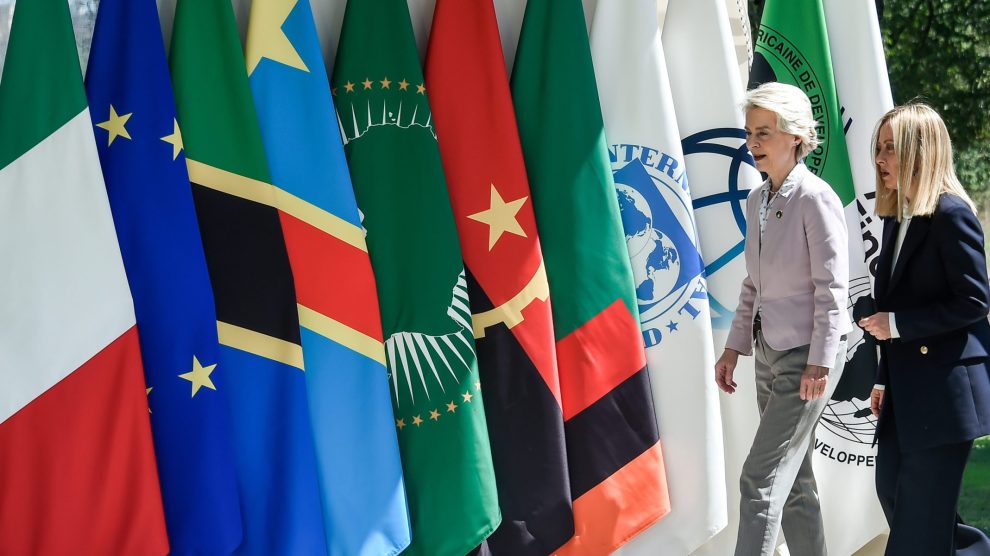
Multilateral dimension and political signal. Participants at the summit will include:
-
- the Chairperson of the African Union Commission, Mohammed Ali Youssouf;
- the Chairperson of the African Union and President of Angola, João Lourenço;
- the Prime Minister of the Federal Democratic Republic of Ethiopia, Abiy Ahmed Ali;
- and numerous Heads of State and Government from across the African continent.
- Also attending, representing international organisations and financial institutions with which Italy has strengthened cooperation and strategic synergies, will be:
- UN Secretary-General António Guterres,
- President of the African Development Bank Sidi Ould Tah,
- World Bank Managing Director of Operations Anna Bjerde.
- Confirming the full involvement of the “Sistema Italia” in the Mattei Plan, representatives of Italian financial institutions, leading companies and civil society organisations engaged in the initiatives will also take part.
- The composition of participants reflects the summit’s political, continental, and multilateral dimensions, as well as the central role of coordination among governments, African institutions, international organisations, and financial institutions.
PM Meloni at the AU Assembly: the symbolic step. The day after the summit, also in Addis Ababa, the Prime Minister will participate as a guest of honour in the opening plenary session of the 39th African Union Assembly. According to Italian sources, the invitation represents a signal of trust and recognition of the cooperation that has been consolidated in recent years.
- In her address, PM Meloni will reiterate Italy’s ambition to serve as a bridge between Europe and Africa, its support for the AU’s Agenda 2063, and its commitment to strengthening a partnership based on shared responsibility and innovative financial instruments.
- By aligning the bilateral summit with participation in the AU plenary, Italy sends a clear message: the Mattei Plan is not conceived as a parallel channel to African priorities, but as an initiative embedded within the African Union’s strategic framework.
The operational dimension: from energy corridors to AI
- The scope of the Plan is also measured by the concrete projects launched. From the ELMED electricity interconnection between Italy and Tunisia to support for the Lobito Corridor in Angola, and from renewable energy investments in Egypt (Abydos II plant) to rural electrification programmes in Mauritania and Mozambique, the focus lies on energy and logistics infrastructure with regional impact.
- Alongside these pillars, initiatives have emerged in agri-food value chains, food sovereignty and technical-vocational training, as well as the launch of an AI Hub for Sustainable Development and digital transformation programmes in several partner countries. The overall design combines physical infrastructure, human capital and technological innovation.
The real test. Beyond its symbolic dimension, the Addis summit represents a political stress test. After the launch and structuring phase, the Mattei Plan now enters a stage in which measurable results, financial sustainability and coherence with African priorities will be decisive.
- For Italy, the stakes are twofold: consolidating a strategic presence in a continent central to emerging geopolitical balances, and strengthening its European role as a credible interlocutor in dialogue with Africa.
- Addis Ababa is not only the seat of the African Union. At this juncture, it also becomes the arena in which Rome seeks to transform a political narrative into a structured, long-term strategy.