In a global economy that remains interconnected, even as it undergoes restructuring and selective realignment, Italy is attempting to combine political dialogue with economic engagement. The central question is whether this approach can support Africa’s long-delayed industrialisation while avoiding the errors of past cooperation models.
Why he matters: Mario Giro is a former Italian Deputy Minister of Foreign Affairs with decades of experience in Africa. His long institutional trajectory and engagement with political and civil actors across the continent position him to evaluate both the methodological innovation and the structural limits of the Mattei Plan.
Q: The Mattei Plan has been described as a novelty in relations between Europe and Africa. Two years after its launch, how do you assess it both in substance and in political perspective, especially given the strong interest shown by the European Union and the United States?
A: From a methodological point of view, it represents an innovation. Attempting to build a more equal relationship with African partners by asking them what they want is not often done within a Western, Eurocentric tradition.
- There has long been a tendency to assume that we already possess the right formulas and to offer lessons rather than to listen. In that respect, the element of listening is a positive one.
- In substantive terms, the initial phase focused on expanding existing programmes, particularly in education and health. The Plan is now addressing the more substantial dimension of large-scale works and investments. In the field of green business, several Italian companies are operating effectively.
Q: What has been the core strategic bet of the Mattei Plan?
A: In the 1970s and 1980s, cooperation was primarily conducted between states. In the 1990s and 2000s, non-governmental organisations became the main actors. The current phase aims to create synergy with the private sector and to bring Italian companies into Africa.
- This is a correct but complex scheme, because Italian firms are often small and therefore require support: they cannot afford to fail an investment. Italy no longer has the large state-owned enterprises that existed until the 1980s.
- The attempt is to build synergy between civil society and NGOs, with state guarantees, and the private sector.
- This represents a new way of supporting African growth: helping African countries develop their own private sectors and integrate more fully into globalisation, with particular attention to green business.
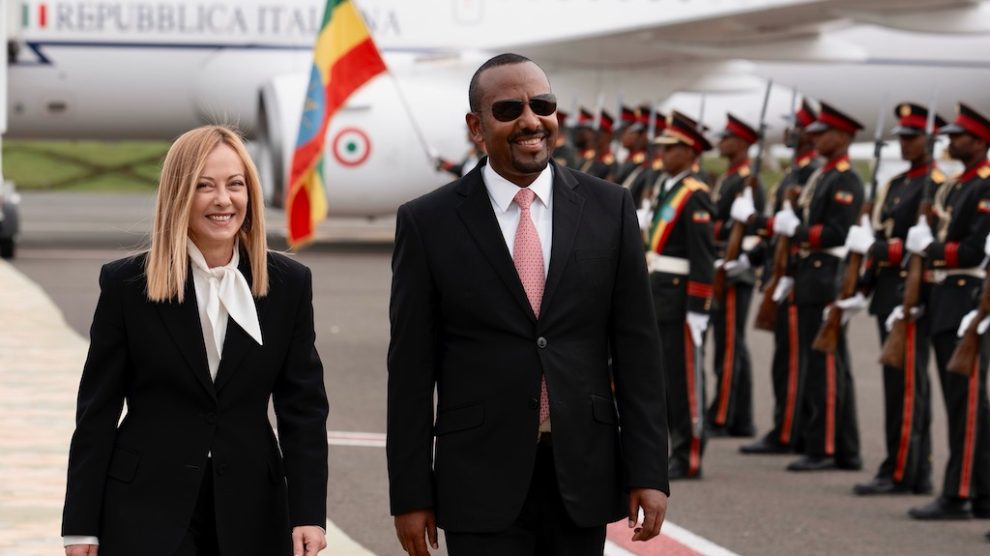
Q: The second Italy-Africa summit will take place in Africa tomorrow, and the number of participating countries has increased from nine to fourteen. What political and strategic significance does this have?
A: The fact that the summit is being held in Africa is consistent with the commitment to listening. When the Plan was presented in Rome in January 2024, African leaders requested a process based on identifying needs, discussing solutions, and then seeking agreement together. Holding the summit on African soil responds to that request.
- The expansion from nine to fourteen partner countries in two years also signals that the initiative is broadening its scope.
Q: How should we interpret the interest shown by the African Union at a time when crises, such as Sudan, continue to multiply?
A: The invitation extended to the Italian Prime Minister to address the Assembly of African heads of state and government is a significant political gesture. It is the first time that an Italian Prime Minister will speak before that body. Previously, Romano Prodi addressed it in his capacity as President of the European Commission.
- At the same time, the African Union faces difficulties similar to those affecting many multilateral organisations today. There are important programmatic ambitions, such as the African Continental Free Trade Area. If implemented effectively, it would be of great importance for the continent.
Q: Could the Italian district model provide an organisational advantage within the framework of the Mattei Plan?
A: The district model has two sides. On the one hand, it offers flexibility, interconnection, and the capacity for rapid adaptation. On the other hand, it reveals fragility in a context of intense global competition, particularly from actors such as China. There is no universally winning model.
- Italy must work with what it has: small and very small enterprises, sometimes organised into districts and sometimes competing with one another. These firms are admired internationally, yet they remain structurally vulnerable compared to large transnational corporations.
Q: What are the main mistakes to avoid in designing cooperation with Africa?
A: The first mistake would be to believe that the era of interconnections is over. The global economy remains interconnected, even if it is being restructured, and cooperation may increasingly take place among selected partners rather than universally.
- The second mistake would be to assume that Europeans possess ready-made formulas for African societies. Cooperation must be built together, through experimentation and gradual adjustment.
- Africa has never been fully in any sector.
- This is precisely the intuition behind the Mattei Plan: the recognition of a new moment of opportunity. Achieving results will require time and patience, but the direction is the correct one.
The bottom line: The Mattei Plan seeks to move beyond past cooperation templates by combining listening, state backing, and private-sector engagement.
- Its credibility will depend on whether this methodological shift translates into sustained industrialisation and long-term economic transformation across partner countries.