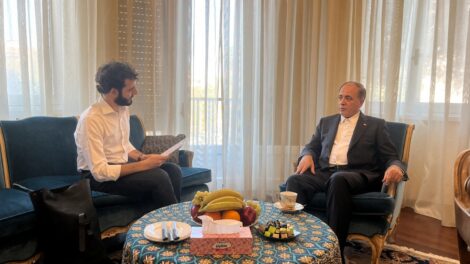

The visit comes amid renewed diplomatic activity along the Rome-Tripoli axis and as Italy intensifies engagement with both western and eastern Libyan actors while backing the U.N.-led political process. The visit was first reported by Agenzia Nova.
Energy remains central politically. But despite renewed European attention on Mediterranean gas supplies after tensions in the Strait of Hormuz, Libya is unlikely to significantly increase exports to Italy in the short term.
Why it matters: Italy remains Libya’s top export market and one of Tripoli’s main European political partners.
- Rome sees Libya as strategic across energy security, migration management and Mediterranean stability.
- The visit coincides with renewed U.S. and U.N. pressure for gradual reunification of Libya’s divided institutions.
- Migration flows across the central Mediterranean may rise again during the summer months.
Zoom in: the Rome visit. PM Abdulhamid nDabaiba is expected to meet Italy’s Giorgia Meloni on Thursday at 12:00 p.m. at Palazzo Chigi.
- The Libyan delegation includes Minister of State for Communication and Political Affairs Walid al Lafi and newly appointed Minister of State for Cabinet Affairs Mohamed Omar Ben Ghalboun.
- Four deputy ministers are also accompanying the Libyan premier.
- The size and political profile of the delegation reflects Tripoli’s attempt to strengthen coordination with Rome across multiple strategic files while reinforcing its international legitimacy during a renewed U.N.-backed political process.
- That process has also received support from Washington, which has pushed for gradual institutional reunification on the economic, military and political levels. Recent signals include Libya’s first unified budget approval and limited east-west coordination during the Flintlock military exercises.
Energy first. The energy file remains central to Italy-Libya relations, but structural constraints continue to limit Libya’s export capacity.
- Libya currently produces around 11-13 billion cubic meters of gas annually, down from roughly 15 bcm in previous years. Most of that production is consumed domestically.
- The National Oil Corporation says around 24 million cubic meters per day are used to supply power plants operated by the General Electricity Company of Libya, reflecting the country’s chronic electricity shortages and growing summer demand.
- By comparison, flows to Italy through the Greenstream pipeline — Libya’s only direct gas export route to Europe — have averaged only 2-3 million cubic meters per day in 2025, down from roughly 6 million previously.
- Italy imported less than 1 bcm of Libyan gas in 2025, well below the pipeline’s theoretical annual capacity of 8-10 bcm.
- The decline reflects rising domestic demand, infrastructure bottlenecks and Libya’s heavy dependence on gas-fired electricity generation.
Zoom in: the Ravenna connection. A key industrial development linked to the visit is set to begin Thursday from Ravenna, where a major module for the “Bouri Gas Recovery” project will depart for Libya.
- The project, developed by Saipem and Rosetti Marino for Mellitah Oil & Gas — a joint venture between Eni and Libya’s NOC — aims to recover gas currently lost through flaring at offshore and onshore oil fields.
- Once operational, the system could recover up to 3 million cubic meters of gas per day, or more than 1 bcm annually.
- Italian and Libyan officials see the project as a way to reduce flaring and increase gas availability for Libya’s domestic market.
- Still, any meaningful increase in exports to Europe would require additional upstream discoveries, energy sector modernization and broader improvements in efficiency and renewable generation.
- Recent discoveries, including Eni and NOC’s offshore find estimated at around 28 bcm of gas in place, are viewed as strategically important but insufficient to alter export dynamics in the near term.
Follow the money Economic cooperation is another core pillar of the visit. Italy remains Libya’s top export destination, absorbing roughly 22.5% of Libyan exports, driven overwhelmingly by oil and gas. Bilateral trade reached around €8 billion in 2025, although heavily imbalanced in Libya’s favor due to hydrocarbon imports.
- At the same time, Italian companies continue to face major operational obstacles in Libya.
- According to documents reviewed by Agenzia Nova, businesses report structural problems rather than isolated difficulties, including unreliable payment systems, legal uncertainty, complex customs procedures and weak financial instruments.
- Many companies rely on third-country intermediaries to complete transactions, increasing costs and risks.
- The Italian-Libyan Chamber of Commerce has proposed a bilateral technical working group focused on payments, compliance and legal protections aimed at making operations more transparent and “bankable.” Outstanding Italian credits worth hundreds of millions of euros remain another sensitive issue.
Beyond hydrocarbons. Despite the obstacles, Italian businesses continue to maintain a significant presence in Libya.
- More than 50 Italian companies recently participated in the Libya Build fair in Benghazi, underscoring the depth of Italy’s commercial footprint in the country.
- The cooperation highlights Rome’s broader attempt to expand engagement beyond energy into infrastructure, services and cultural restoration.
The big picture. Dabaiba’s visit comes as Libya remains politically divided between eastern and western power centers.
- Italy has increasingly pursued a pragmatic strategy aimed at maintaining dialogue with all major Libyan actors. That approach was reflected in the recent visit by Italy’s parliamentary intelligence oversight committee, Copasir, to both Tripoli and Cyrenaica — an unusually broad mission focused on security, energy and migration issues.
- Rome also continues to support the U.N.-backed “4+4” format, which brings together representatives from eastern and western Libya in an effort to break the country’s institutional deadlock and advance discussions on governance and elections.
Migration watch. Migration remains one of the central drivers of Italy-Libya coordination. Arrivals in Italy during the first months of 2026 fell by more than 50% compared to the previous year, according to the latest available data.
- Still, Libya remains the main departure route, accounting for roughly 85% of arrivals. Flows have begun rising again in recent weeks as weather conditions improve ahead of summer.
- The humanitarian toll also remains severe. According to the International Organization for Migration, at least 819 people have died or gone missing in the central Mediterranean since the start of the year.
- Italian officials are also increasingly concerned about instability across the Sahel, particularly in Mali, and the potential impact on migration routes toward North Africa.
The bottom line: Dabaiba’s Rome visit underscores Italy’s effort to position itself as Libya’s key European partner across energy, migration and regional diplomacy — even as Libya’s internal divisions and structural constraints continue to limit the prospects for rapid breakthroughs.
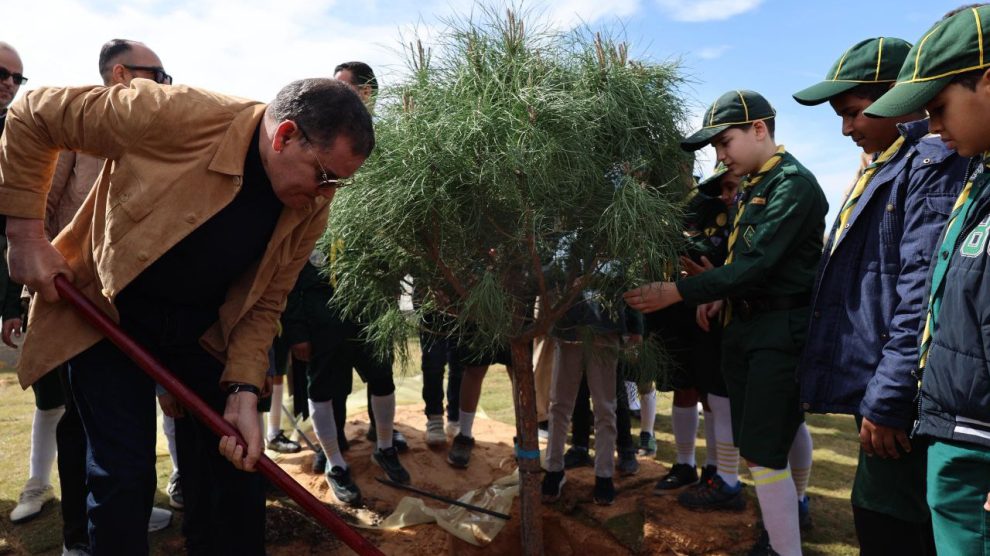
(Photo: X, @Dabaibahamid)