The timing matters: the EU FAC convened on the eve of the fourth anniversary of Russia’s invasion of Ukraine, days after the first formal session of the U.S.-led “Board of Peace” on Gaza, and amid uncertainty following a U.S. Supreme Court ruling that struck down a pillar of Washington’s tariff policy.
Decoding the news: For export‑oriented economies like Italy, the Brussels agenda links security exposure (Ukraine and the Middle East) with trade exposure (U.S. tariffs), both heavily shaped by U.S. decisions.
Ukraine focus: According to a statement from Italy’s Foreign Ministry, ministers concentrated on support for Kyiv — especially in the energy sector — diplomatic efforts, European contributions to security guarantees and increased sanctions pressure on Russia, including action against the “shadow fleet.”
- For Italy, the discussion carries implications for energy security and sanctions enforcement.
Middle East track: EU ministers also discussed Gaza following the first formal meeting of the U.S.-led “Board of Peace,” chaired by President Donald Trump, in which FM Tajani participated as an observer representing Italy.
- Talks centered on Europe’s contribution to “phase two” of the U.S. plan — demilitarization and reconstruction of Gaza and a proposed International Stabilization Force — and included a meeting with the High Representative for Gaza, Nikolay Mladenov.
- The file intersects with risks of wider regional escalation, including the Iran dimension.
Iran file: The Council reviewed the situation in Iran and progress in negotiations on the nuclear program, a dossier closely tied to regional stability and energy markets.
Rome’s message on Washington. Tajani’s public messaging focused on the need for predictability in relations with the United States — across both security and trade — as Washington’s moves shape European planning on Iran and Middle East, global powers competition and tariffs.
- He said the U.S. reassured G7 partners it does not intend to trigger instability after the Supreme Court decision on tariffs.
- “We received assurances from the American side of their intention not to create instability for our companies,” he wrote on X after the G7 trade ministers’ meeting, adding that both sides share a goal of predictability for businesses and a stronger transatlantic economic partnership.
- In an interview with Italian newspaper Corriere della Sera, Tajani outlined a cautious line toward Washington, ruling out a trade war and stressing that Italian companies would not benefit from one.
- He urged against impulsive reactions — “this is not the time to lose our heads” — noting that, despite tariffs, Italian exports still grew over the past year.
- He argued for EU unity in seeking clarity from the United States rather than threatening countermeasures, while reaffirming the structural nature of the transatlantic relationship regardless of who sits in the White House, with dialogue framed as the preferred course.
The bottom line: The meetings left EU ministers balancing Ukraine policy, Gaza stabilization and Iran diplomacy while seeking clarity on U.S. trade moves — a priority for export‑heavy countries such as Italy.
- Rome is trying to balance its position between its historic U.S. alliance and its role within the EU, as a new 15% global tariff imposed unilaterally by Donald Trump following the Supreme Court decision — seen as harmful to Europe and potentially breaching the agreement reached in Scotland in July 2025 — add pressure on that dual alignment.
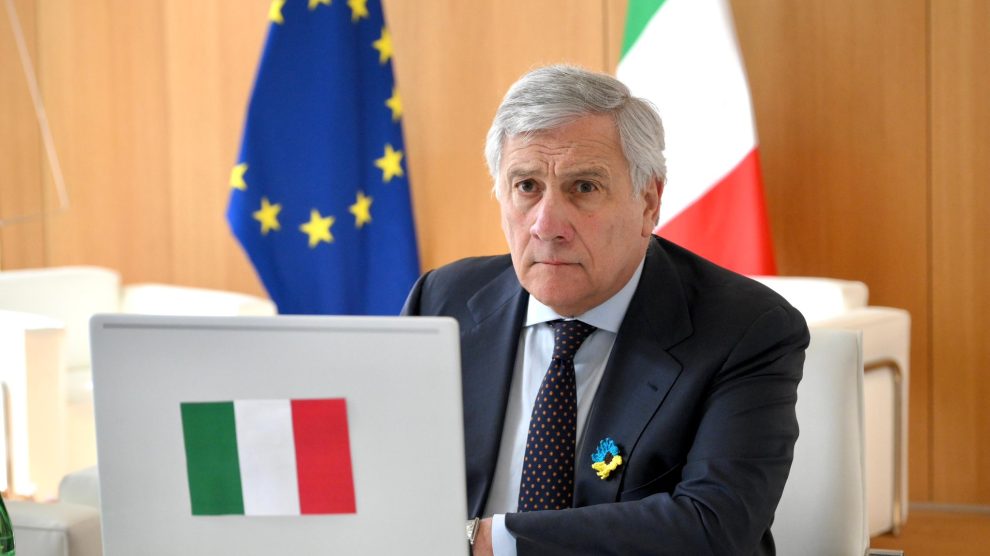
(Photo: X, @antonio_tajani)