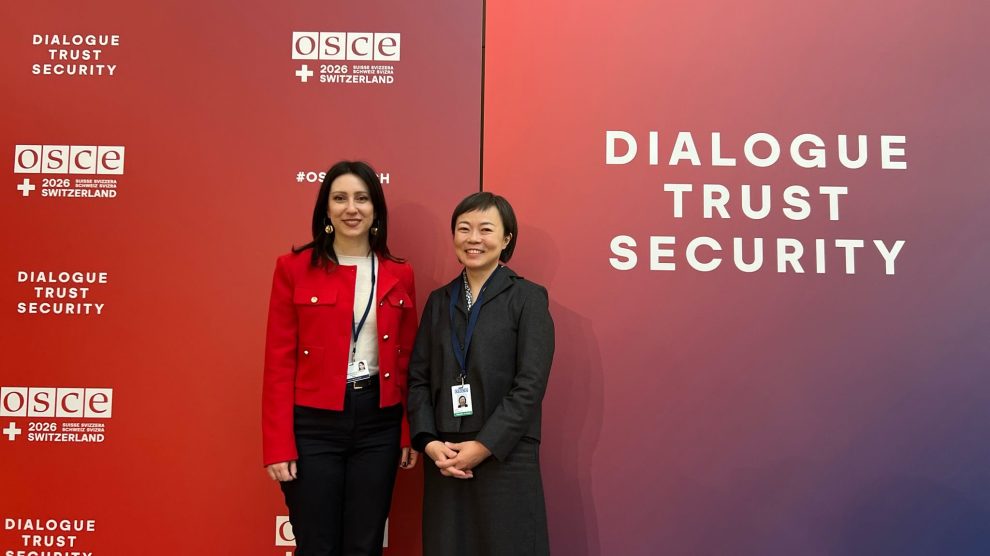
At a conference on artificial intelligence held last week at Sapienza University of Rome, Italian MP Federica Onori — OSCE Parliamentary Assembly Special Representative on Artificial Intelligence — outlined a vision of AI governance that seeks to reconcile regulation, democratic safeguards and economic competitiveness, reflecting a broader effort to shape international standards for emerging technologies.
Decoding the news: Onori intervention comes at a time when governments worldwide are struggling to balance innovation with mounting concerns over social disruption, labour displacement and algorithmic risks. Onori argued that the debate should move beyond a binary choice between strict regulation and laissez-faire approaches.
- “We must not drift into a free-for-all on artificial intelligence,” she said, calling for “smart and effective” rules capable of protecting citizens without stifling innovation in a rapidly evolving technological environment.
- Effective governance, she added, must focus in particular on those most exposed to social and economic disruption.
Protecting the vulnerable while enabling growth. Onori highlighted how AI’s impact is uneven across societies, warning that existing inequalities could widen if governments fail to intervene.
- Women, young people and workers in vulnerable sectors are likely to face the most immediate effects of automation and algorithmic decision-making, she noted.
- Yet the same technologies could also expand opportunities — provided they are accompanied by targeted public policies, algorithmic transparency and clear regulatory frameworks.
- Her remarks echoed a growing consensus that competitiveness and social protection are not mutually exclusive in the AI era.
Public-private cooperation as a governance pillar. A recurring theme in Onori’s address was the need for structured dialogue between governments, international organisations, and the technology industry. Responsible AI development, she argued, cannot rely solely on national regulation but requires coordination across sectors and borders.
- The panel included representatives from major technology companies — Google, Meta and TikTok — alongside Italy’s Treccani Institute, underscoring the multi-stakeholder nature of the debate.
- The Special Representative also highlighted the importance of parliamentary diplomacy in shaping AI governance, emphasising that elected institutions must play a central role in setting ethical and legal boundaries for emerging technologies.
OSCE’s expanding role in AI governance. The intervention reflects the OSCE Parliamentary Assembly’s growing engagement with artificial intelligence as a security and governance issue across its member states.
- In September 2025, OSCE PA President Pere Joan Pons appointed a Special Representative on Artificial Intelligence, tasked with coordinating parliamentary dialogue, monitoring technological developments, and proposing policy guidelines for the organisation.
- The mandate spans issues ranging from human rights and democratic resilience to the security implications of AI systems, highlighting how technological governance is increasingly viewed as part of broader geopolitical competition.
- Beyond multilateral forums, the OSCE PA has also sought to strengthen bilateral cooperation on AI policy, including exchanges with partners such as the Permanent Mission of the Republic of Korea, focused on developments in the global AI landscape and the role of parliamentary dialogue in supporting responsible innovation.
A multilateral approach is taking shape. The profile of the Special Representative reflects the technocratic expertise increasingly shaping policymaking in this field.
- More broadly, the position illustrates how international parliamentary bodies are attempting to carve out a role in technology governance, an area traditionally dominated by national governments and private companies.
- As artificial intelligence becomes a central arena of economic competition and political influence, the OSCE’s involvement signals that the debate is no longer confined to technology policy but has become a core issue of security, governance and international cooperation.