India is overhauling its defense procurement framework through the Defence Acquisition Procedure (DAP) 2026, shifting from reliance on foreign systems to domestic production with full technology ownership.
The move: The rules now favor partners willing to transfer knowledge, co-develop technologies, and embed production locally, rather than simply supplying complete systems. Italian firms, highly specialized in propulsion, avionics, naval systems, helicopters, and space technologies, are viewed as natural collaborators.
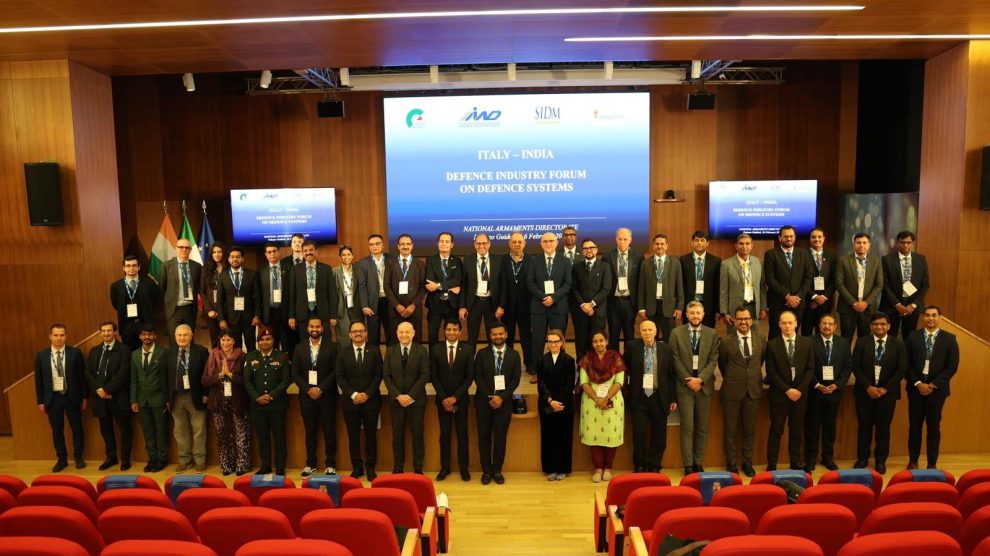
- The Industry Forum Italia-India, jointly organized by Italy’s Directorate of Armaments (DNA) and India’s SIDM, has brought government and industry leaders together to formalize cooperation.
- Participation of Italian Rear Admiral Giacinto Ottaviani and his Indian counterpart, Secretary for Defence Production, Sanjeev Kumar, demonstrates institutional commitment at the highest level.
- “Initiatives like this are fundamental to promote structured and concrete dialogue between industry and institutions,” said Giuseppe Cossiga, president of Italian Industries Federation for Aerospace, Defence and Security (AIAD).
Why it matters: For decades, India’s defense procurement relied on Russian systems, valued for affordability and low political strings.
- The Ukraine war exposed vulnerabilities: supply delays, lack of spare parts, and inaccessible software updates.
- By fostering local production with technology control, India seeks resilience and autonomy.
- For Italy, the opportunity is dual: access to one of the fastest-growing defense markets and strategic positioning in the Indo-Pacific.
- Engagement strengthens Italy’s influence over key maritime routes, including Suez, while inserting Italian industry into emerging high-tech supply chains.
Strategic convergence: Rome and New Delhi share complementary interests. Italy brings technology, credibility, and experience in niche sectors; India seeks diversification from Russian dependence and rapid development of domestic capabilities.
- Naval exercises, joint strategic partnerships signed in 2023, and structured industrial forums signal a growing cross-national alignment in both political and industrial spheres.
The bigger picture: India’s Atmanirbhar Bharat policy exemplifies a global trend: emerging powers transforming from import-dependent militaries into innovation-driven industrial hubs.
- Italy’s participation reflects Europe’s selective approach to industrial diplomacy—partnering where technological depth meets strategic necessity.
- The Indo-Pacific is increasingly the theater where European defense influence, market access, and geopolitical leverage converge.
Zoom in: While the outlook is positive, there are opportunities to further refine the framework.
- A balanced approach in the DAP 2026 regarding local autonomy and technology transfer will be key to ensuring continued interest from Italy and other international partners.
- By aligning these policies with the needs of global investors, India can successfully foster high-tech partnerships that complement its vision for self-reliance.
What it signals: Italy’s engagement is more than a commercial venture: it is a strategic foothold in a region where Europe’s influence has been limited.
- By embedding expertise and establishing durable industrial partnerships, Italian firms can help shape the evolution of India’s defense sector.
- This approach may set a blueprint for European actors seeking to combine technological cooperation with geopolitical presence in the Indo-Pacific, turning industrial collaboration into a lever of strategic influence.
(Photo: X, @IndiainItaly)