
As tensions between Iran, the United States and Israel continue to reshape the security landscape of the Middle East and affect global energy markets, Tehran is seeking to clarify its position and the conditions under which it believes the conflict could come to an end.
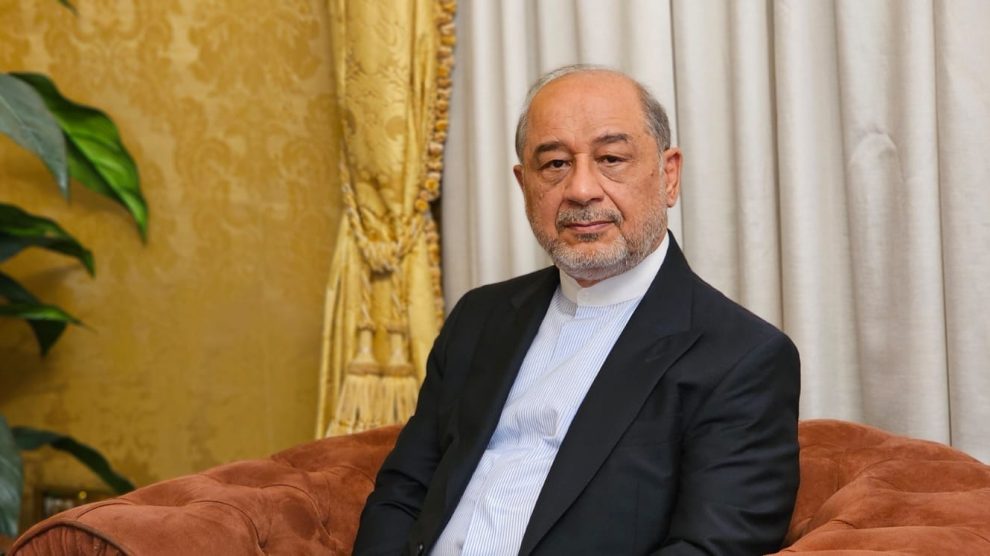
In written answers to questions submitted by Decode39, the ambassador of the Islamic Republic of Iran to Italy, Mohammad Reza Sabouri, rejects Western accusations regarding Iran’s nuclear and missile programs and attributes the current escalation to the military actions of Washington and Tel Aviv. He also reflects on the broader regional risks of the conflict, the domestic situation inside Iran and the potential economic consequences for global energy markets and trade routes.
On the diplomatic front, Sabouri outlines three conditions that Tehran considers necessary for ending the war: recognition of Iran’s legitimate security rights, compensation for the damage caused by the attacks, and credible international guarantees against future aggression. Within this framework, the ambassador points to a potential role for European countries—particularly Italy—in supporting diplomatic efforts, while also highlighting the Vatican’s possible moral influence in promoting a clearer stance against war and violence.
Q: The United States and Israel argue that Iran has been advancing a nuclear program with possible military dimensions, conducting activities related to ballistic missiles capable of carrying nuclear weapons (an issue addressed in UN Security Council Resolution 2231), expanding its regional influence through allied groups in the Middle East, and repressing domestic protests. In your view, are these factors the reasons that led to the decision to resort to military action? And how does Tehran interpret the chain of events that led to the current escalation?
A: One of the bitter ironies of history and one of the symbols of double standards is that the United States, which in 2018 unilaterally and illegally withdrew from the JCPOA and violated Resolution 2231, today—after seven years—accuses Iran of wanting to build nuclear weapons and of violating that very same resolution.
- Israeli Prime Minister Benjamin Netanyahu has, since the 1990s, constantly accused Iran of wanting to build nuclear weapons and periodically claims that six months, two months, or—recently—one week remain before the construction of the bomb. The lies that are today used as justification to kill innocent people are nothing more than a distortion of reality and an attempt to mislead global public opinion.
- The illegal, illegitimate and brutal aggression by the United States and the Israeli regime on February 28, 2026 represents a grave violation of all international norms and principles. Attempts are made to conceal it behind superficial justifications such as “preventive war” or the alleged necessity to prevent Iran from obtaining nuclear weapons.
- This comes while Iran, in good faith, had begun negotiations with the United States to resolve the issue peacefully. However, the United States betrayed diplomacy: it bombed the negotiating table once during the twelve-day war and a second time on February 28. It must also be emphasized that [U.S. President Donald] Trump, contrary to the slogan “America First,” has today fallen into the trap of “Israel First” and has sacrificed the region and American interests to Netanyahu’s personal interests.
Q: How would you describe the current situation in the region and what risks do you see for further escalation involving other regional actors?
A: In theories of regionalism it is said that countries live in a house of glass. It is not possible to throw a stone at the neighbor’s house without also putting one’s own house at risk. Iran has always given priority to a policy of good neighborliness and to relations based on cooperation and friendship with the countries of the region. However, before the war it had clearly warned that if the United States were to use the airspace or territory of other countries to attack Iran, those places would be considered legitimate targets.
- Despite this, Iran responded in a proportionate manner only against U.S. military targets in the region and sought to avoid striking civilian areas.
- It should also be remembered that the policy of false flags is one of the strategies of the Israeli regime to deteriorate relations among countries. Some of the information in our possession indicates that certain targets struck in the region may have been attacked by Israel itself and not by Iran. No one has forgotten how a few months ago Israel attacked Qatar. The aggressive and destructive nature cannot be separated from the Israeli regime.
- In my view, the true enemy of Israel is peace and security. In other words, Israel can continue to exist only in a condition of war.
Q: How is this crisis affecting the internal situation in Iran from a political, social and economic point of view? And what is today the mood of Iranian society?
A: Those who attacked Iran know nothing about Iranian civilization, culture and history. Iran has resisted for more than 7,000 years against invaders and criminals and has remained standing until today. For example, after February 28, Israel destroyed during the attacks one of the historical monuments of Isfahan, one of Iran’s historic cities, with more than 400 years of history. In reality that monument had historical roots five times older than the State of Israel itself.
- Iranians have never been warmongers, but geography has taught us how to fight. We will make any aggressor regret it and force him to surrender. Since the beginning of the war our people, despite differences of opinion and political sensitivities, have united in a compact way against aggression and foreign interference. Unity and solidarity under the flag of Iran have been strongly demonstrated. This sense of national unity has inspired scenes of pride inside the country, visible also in the media.
- This is not the first time in history that Iran has been brutally attacked: none of the aggressors’ names have remained, but the name of Iran has remained and will remain.
Q: What economic consequences do you foresee from this conflict for the Middle East and for the global economy, particularly for energy markets, trade routes and overall stability?
A: The current situation goes beyond a simple regional conflict. The aggressions by the United States and Israel have made the entire region insecure. Even though Iran has never closed the Strait of Hormuz nor prevented the passage of ships, the fear of conflict has pushed oil tankers and commercial vessels to avoid the area. In the past Iran guaranteed the security of navigation in the Persian Gulf.
- The U.S. military presence, instead of bringing security, has created divisions and instability. This situation has brought global energy markets to face a crisis even more severe than those of 1973, the Iranian Revolution of 1979 and the invasion of Kuwait in 1990.
- The economic consequences will not remain limited to the region. According to some analysts, the world could be facing an inflationary tsunami. In a short time the prices of oil and gas have increased significantly. If the conflict continues, energy prices could rise further, with direct effects on the daily lives of citizens all over the world.
- Regional economic stability depends on the cessation of aggression. If the attacks continue, Iran considers it its natural right to strike the source of any aggression wherever it may be. This would mean lasting instability in all areas of energy production and transportation in the region.
Q: According to Tehran, what conditions are necessary to put an end to the hostilities and what diplomatic scenarios could realistically lead to a reduction of tensions in the coming months?
A: As I said, Iran has never sought war nor started it. Despite the Israeli aggression during the twelve-day war, Iran accepted a ceasefire without preliminary conditions. However, today we see that this gesture of goodwill did not prevent a new aggression.
- For this reason, Iranian President Massoud Pezeshkian has clearly indicated three main conditions for ending the war.
-
- First, recognition of Iran’s legitimate rights: the international community must recognize the political and security rights that Tehran considers legitimate under international law.
- Second, compensation for the damages of the aggression: the human and material losses inflicted on the country must be compensated.
- Third, strong international guarantees against future attacks: concrete guarantees must exist to prevent new aggressions against Iran in the future.
- When the aggression stops and the implementation of these conditions is guaranteed, Iran will be ready to stop its legitimate responses.
Q: What role can European countries—and in particular Italy—play in facilitating dialogue and supporting diplomatic efforts to reduce tensions? And could the Vatican have a role?
A: The international system is going through a phase of transition. One of the characteristics of this period is the reduction of Europe’s role in global balances. Because of its policy of alignment with the United States in recent decades, Europe has gradually lost influence. Today even the United States is no longer willing to bear the costs of European security.
- Nevertheless, Iran has always welcomed any constructive initiative based on mutual interests and mutual respect. However, this requires a concrete commitment to respect international law, such as condemning aggression, and not ambiguous positions.
- This could be a decisive moment for European countries, including Italy, to adopt independent policies and initiatives based on common interests in order to prevent the expansion of tensions and instability. European countries today face the greatest security risk since the end of the Second World War because of the extreme unilateralism of the United States and the policy of “Israel First.”
- In this context the role of the Vatican, as the main moral and spiritual anchor of the West, is particularly important. The fight against war, violence and extremism—values proclaimed by the Church—should translate into concrete actions. The fact that even from the Church one does not hear a clear condemnation of crimes and killings is a worrying signal on which European religious society should reflect.
Q: What message does Iran want to send today to Europe, the countries of the Gulf, the United States and Israel regarding the future of the region and the prospects for stability?
A: Iran’s message to the region and to the world is peace, stability, security and prosperity for all. One cannot think that the people of one country can suffer aggression, instability and poverty without this having consequences for other actors. Iran has always been a promoter of peace and dialogue and opposes war, aggression and interference in the internal affairs of others.
- Today the region and the world stand before a historic crossroads: peace and stability for all, or war and instability for all. Human choices build the future. Iran has chosen the right side of history—the side of peace—and will continue to do so. Now it is up to others to decide whether they too will choose the right side of history.