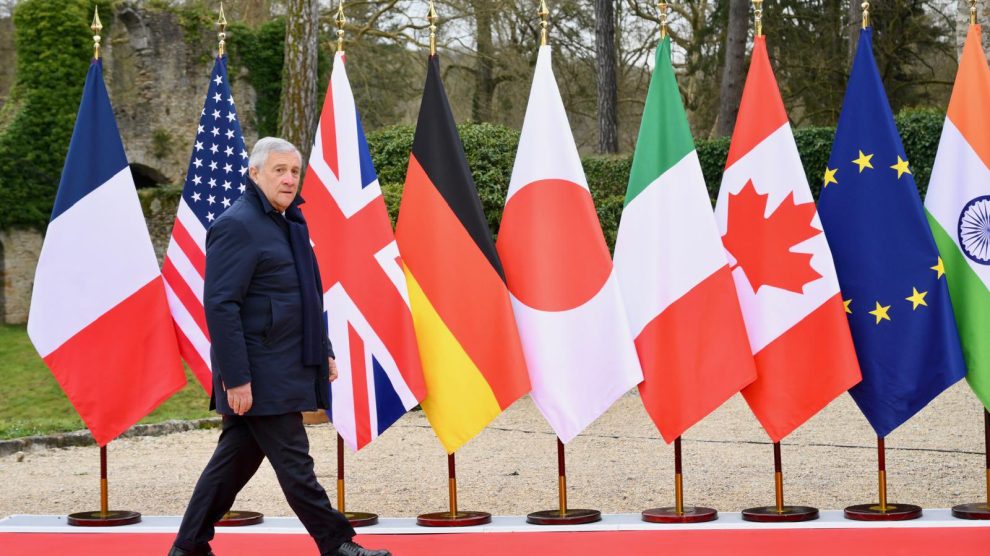
Italy’s foreign minister Antonio Tajani joined his G7 counterparts for two days of talks under the French presidency, with discussions ranging from reform of global governance to Ukraine’s reconstruction, maritime security and the escalating crisis in Iran and the wider Middle East.
Reforming global governance. The first day of discussions focused on reforming global governance, with ministers addressing long-standing inefficiencies in multilateral institutions. Talks centred on the reform of the United Nations, the future of peacekeeping operations and ways to improve the effectiveness of humanitarian supply chains.
- Italian officials indicated that the objective was to inject political momentum into stalled reform processes and encourage the UN system to deliver more tangible results, particularly in crisis response and conflict management.
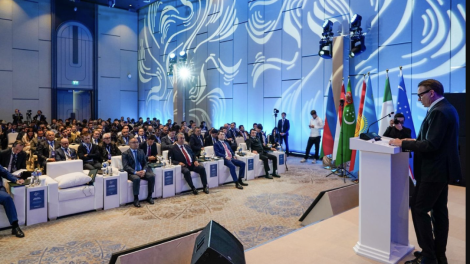
- The enlarged format underlined the G7’s intention to broaden ownership of these reforms, recognising the growing weight of emerging powers in shaping global governance frameworks.
Ukraine: reconstruction, financing and sustained support. Ukraine featured across both days, combining reconstruction, financing and political backing.
- A first‑day working dinner addressed nuclear safety at Chernobyl, where damage to the New Safe Confinement—hit by a Russian drone in February 2025—could lead to structural failure by around 2030 without repairs. Costs are estimated above €500mn, with Kyiv having already allocated over €31mn. G7 members discussed mobilising funding and technical support.
- Ministers reviewed the ERA loans scheme—up to €45bn for Kyiv, including €18.1bn from the EU—while calling for swift implementation. Tajani said support for Ukraine remained “a top priority”, urging Russia to engage in ceasefire talks and stressing transatlantic unity.
- Italy has provided over €3bn in financial aid and more than €140mn to Ukraine’s energy sector, alongside a further package of nearly €100mn. Tajani also highlighted the need to protect nuclear sites, in coordination with the IAEA, and linked the Gulf crisis to the war, noting both Iran’s support for Moscow and the potential economic spillovers.
Tajani’s focus: Iran, energy security and regional stability. Italy’s foreign minister placed the crisis in Iran and the wider Middle East at the centre of his intervention, describing the need to avoid further escalation as an “absolute and collective priority” for the G7. At the same time, he reiterated that Iran “cannot be allowed to acquire nuclear weapons and missiles to threaten our countries”, while warning that indiscriminate attacks on strategic infrastructure were “particularly alarming”.
- Tajani highlighted the broader risks stemming from the conflict, including civilian casualties, environmental damage and significant economic and energy repercussions.
- Particular concern was expressed over the Strait of Hormuz, where any disruption to maritime traffic could have global consequences for energy markets, food security and supply chains.
- “For Italy, freedom of navigation is a strategic priority,” he said, pointing to Rome’s role in the EU’s Aspides mission in the Red Sea, which Italy commands, as well as its participation in Operation Atalanta in the Indian Ocean.
- Italian officials also stressed recent commitments to contribute to efforts aimed at ensuring safe passage through Hormuz.
- The minister called for stronger coordination between the G7 and Gulf partners, suggesting that a joint meeting with the Gulf Cooperation Council would send a “strong political signal of unity”.
- He noted ongoing contacts with regional counterparts and referred to Italy’s co‑sponsorship of a Bahrain-led resolution at the UN Security Council, alongside efforts to strengthen the defensive capacities of Gulf partners.
- Energy security and maritime routes were also discussed in a broader Indo‑Mediterranean context.
- Tajani held a brief exchange with India’s external affairs minister Subrahmanyam Jaishankar on the sidelines of the meeting, underlining the growing relevance of the Indian Ocean in safeguarding global trade and energy flows.
Lebanon: humanitarian risks and security concerns. On Lebanon, Tajani expressed deep concern over the spillover effects of the regional crisis, condemning Hezbollah’s attacks and stating that the group’s disarmament remains “an essential part of any long-term political solution”.
- While acknowledging ongoing diplomatic efforts, he warned of a deteriorating humanitarian situation and mounting pressure from refugee flows. Italy has announced an initial €10mn emergency aid package and dispatched a humanitarian flight carrying 30 tonnes of supplies.
- Tajani also cautioned that attacks on civilian infrastructure risk undermining the country’s long-term stability and the future of vulnerable communities, including Christian populations in the south. He described President Joseph Aoun and Prime Minister Nawaf Salam as “the best opportunity” to strengthen national unity and peaceful coexistence.
- With more than 1,000 Italian troops deployed in Lebanon, largely within the UNIFIL mission, Rome emphasised the need to avoid a security vacuum in the south of the country, particularly in view of a potential future drawdown of international forces, and to reinforce support for the Lebanese armed forces.
Iraq: preventing further destabilisation. Turning to Iraq, Tajani said Italy was closely monitoring developments both in the country and in the Kurdistan region, following discussions with foreign minister Fuad Hussein and Kurdish president Nechirvan Barzani.
- He warned that attacks by Iran-backed militias risked dragging Iraq into a broader regional conflict, undermining years of international investment in stabilisation efforts. Preserving Iraq’s stability, he said, remained a key priority for Italy and its partners.
A broader G7 agenda. Across both days, the meeting highlighted an evolving G7 agenda that increasingly blends traditional security concerns with geoeconomic priorities and systemic risks, Italian officials highlighted.
- From global governance reform to supply chain resilience and maritime security, From Iran and the wider Middle East to Ukraine, the discussions underscored how geopolitical crises, energy flows and economic stability are increasingly intertwined.
- For Italy, the talks highlighted its focus on de-escalation in the Gulf, safeguarding freedom of navigation and maintaining support for Ukraine, while reinforcing its role within a broader network of partnerships extending beyond the G7.
(Photo: X, @Antonio_Tajani)