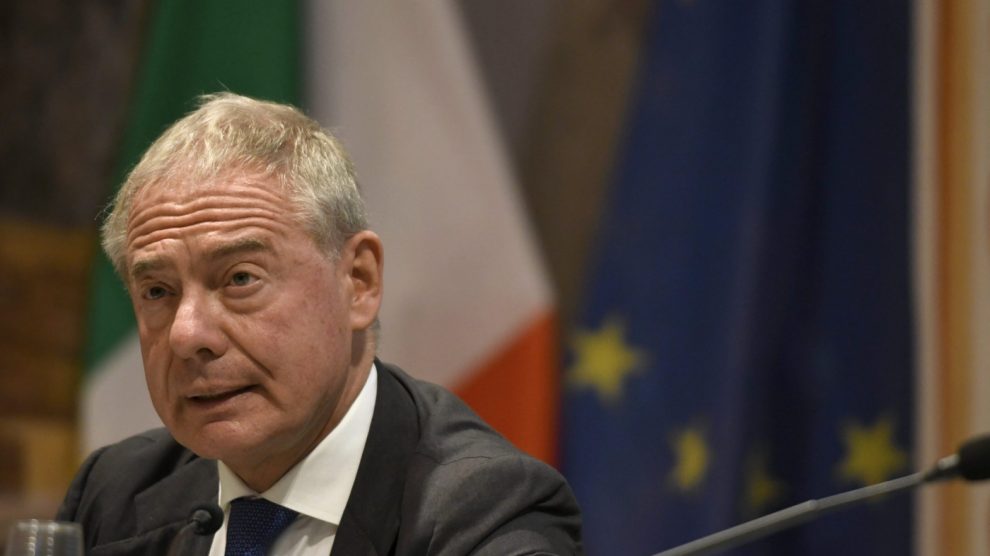
The mission to Washington of Italy’s Minister of Enterprises and Made in Italy, Adolfo Urso, represents more than a routine institutional visit. It is an operational move within a broader strategy: positioning Italy at the center of the West’s emerging industrial and technological value chains.
Why it matters: It is not only the agenda — space, critical raw materials, and emerging technologies — that signals this ambition. It is the context in which the mission takes place: a phase where global competition is increasingly defined not by end products, but by the infrastructures that make innovation possible.
- In this framework, Washington is not simply a diplomatic destination, but the decision-making hub of a technological and industrial ecosystem with which Rome seeks deeper, more strategic integration.
A mission as strategic leverage. Urso’s visit is structured along three key axes — space, critical minerals, and emerging technologies — which now represent the real nodes of global competition.
- Meetings with U.S. administration officials, the NASA, and private sector actors are not limited to bilateral cooperation. They reflect a broader objective: embedding Italy within the most advanced segments of Western value chains.
- In this sense, the mission functions as a platform — to attract investment, strengthen industrial partnerships, and consolidate Italy’s positioning in high-tech sectors.
AI and supply chains: the invisible competition. Artificial intelligence sits at the convergence of this transformation.
- As Elon Musk once noted, AI could be “the best or worst thing to happen to humanity.” Beyond the rhetoric, the point is structural: AI is not a standalone technology, but a system dependent on an extended value chain.
- Silicon, rare earths, energy, digital infrastructure, data centers, manufacturing capacity and logistics form the backbone of this system. Control over these segments increasingly determines not just innovation, but national security trajectories.
- Urso’s mission is positioned precisely at this level — not on innovation alone, but on the infrastructure that enables it.
Critical minerals: the material foundation. Critical minerals represent the deepest layer of this competition.
- The U.S. administration under Donald Trump has moved toward a more interventionist approach, including plans for a $12 billion strategic stockpile. The shift is significant: supply chains are no longer seen as neutral, but as instruments of power.
- China’s dominance in rare earth processing and refining has turned industrial dependency into geopolitical leverage — a vulnerability Washington and its allies are now actively addressing.
- The Critical Mineral Summit held in Washington earlier this year underscored a shared awareness: without secure access to strategic materials, technological leadership — particularly in AI — cannot be sustained.
Emerging technologies: the transatlantic dimension. If critical minerals are the material base, emerging technologies represent the systemic layer of competition.
- This was clearly reflected in the “EU-US Tech Agenda 2030” event organized by our sister media company Formiche, where policymakers, industry leaders, and research institutions emphasized that technological competition now carries direct geopolitical implications.
Space: infrastructure of future power. Alongside terrestrial supply chains, space is emerging as a critical infrastructure of global power.
- As highlighted by Marco Peronaci, “space has become one of the pillars of the partnership” between Italy and the United States — not just as an industrial sector, but as a shared strategic vision.
- Cooperation now spans key programs such as Artemis and early Mars missions. In this context, the agreement between the Italian Space Agency and SpaceX places Italy within the Starship program with an unprecedented role for an international partner.
- At the same time, collaboration with NASA — reinforced through Urso’s engagement with Administrator Jared Isaacman— translates into concrete industrial contributions, from lunar habitats to components of the commercial space economy.
Italy’s positioning: inside the chain. It is at the intersection of these three dimensions — minerals, technology, and space — that the strategic meaning of Urso’s mission emerges.
- Italy is seeking to position itself within Western value chains, not at their margins.
- This involves not only attracting investment, but actively contributing to the construction of future industrial and technological infrastructures.
- Growing exports to the United States and improved performance in attracting foreign direct investment reinforce this trajectory.