Italy’s top institutions are converging on a clear message: hybrid threats are now a concrete and growing challenge to national security. Recent warnings by President Sergio Mattarella and assessments by the Supreme Defence Council point to rising cyber and influence operations targeting critical infrastructure and democratic processes.
Within this evolving landscape, the cognitive domain is emerging as a critical frontier of competition, where technology, information and human behaviour intersect.
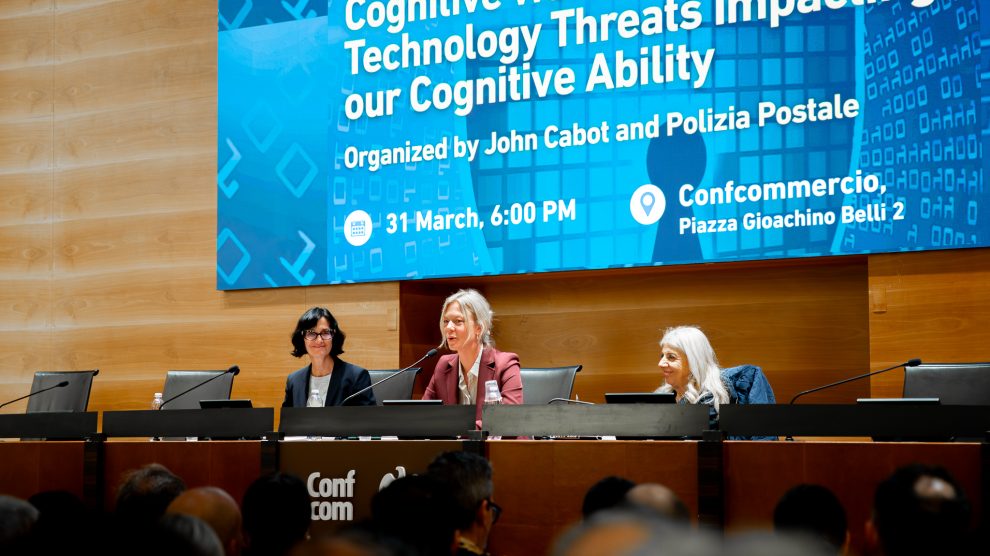
The event: The following interview with Janet Martha Blatny — Special Advisor to NATO’s Chief Scientist, Research Director at the Norwegian Defence Research Establishment (FFI), and Visiting Professor at Imperial College London — was conducted on the sidelines of the event “Cognitive Warfare: Technology Threats Impacting our Cognitive Ability”, held on Tuesday in as part of the John Cabot University’s Kushlan Lecture Series, in collaboration with Polizia Postale.
Q: Technological advancements are increasingly shaping the information environment and influencing human cognition. From your perspective, how is the manipulation of cognition changing the nature of security — both in civilian societies and in military contexts?
A: We are operating in an environment that is becoming increasingly unpredictable. Strategic competitors and different actors are exploiting the openness of our societies, and using available data and information to influence. At the same time, public trust in institutions, in science, and even in governments is weakening and fragmenting, and thus provides vulnerabilities.
- In addition, technology, especially AI, shapes the future geopolitical environment. Technological advancements have made it easier to manipulate human cognition, exploiting the complexities of human behavior. Therefore, the information environment and our cognitive ability play an even more important role within security and defence.
- This complex environment will impact how we think, perceive and make decisions at all levels (individual-group-national) and both within the civilian societies and the military context.
- It is within this broader national and global security context – this complex ecosystem – that Cognitive Warfare plays an important role. Furthermore, these challenges might challenge our national security and defence, as well as influencing our will to defend our nations and NATO.
Q: Given your work on total defense and resilience, what are the most critical vulnerabilities that societies and institutions face today in the cognitive domain? And what practical steps should governments and organizations take to strengthen resilience against manipulation in the information?
A: The strategic and complex information environment causes challenges. Cognitive warfare is not entirely new, but it is the speed and scale with which it can be conducted. Technology has become more available and affordable for “all” and the technological developments/advancements, e.g. within the digital environment, social media and AI, provides new opportunities, but also vulnerabilities. We need to understand the technological advancements and their enablers and the impact it has on cognitive ability and cognitive effects.
- However, technological advancements are also positive and provide for instance new ways of processing information and increasing situational awareness. Knowledge about the actors’ intention, the threat space, and social and cultural societies is also needed. Trust is an important element within the cognitive area, trust to information, trustworthy information as well as trust to and within our society are crucial areas to understand.
- Human cognition is an area that impacts both civilian and military sectors, governments, private and at individual levels. Education, training, leadership, and the understanding of the consequences are needed.
- This field of complexity (human cognition and technology) also calls out for a coordinated approach from the authorities to actively establish measurements – from a whole-of-society perspective – to defend and secure our nations and NATO.
- Strengthening resilience against cognitive warfare also strengthens national and NATO’s resilience (Article 3 of the Washington Treaty).
Q: In the context of NATO and great-power competition, how do you see the role of cognitive warfare and information influence evolving in the coming years? Are we adequately prepared, or is there still a gap between technological change and strategic adaptation?
A: The complex security environment we are facing, along with hybrid warfare, technological advancements and strategic competition will continue. Emerging and evolving technologies, e.g AI, can further be manipulated and exploited to encourage instability by undermining truth, and influencing public opinion and trust both within a nation and globally.
- The need to understand human and technological cognition and cognitive effects will increase. It is difficult to see that information manipulation, influencing and cognitive warfare will decrease in the future due to the evolving strategic geopolitical and technological environment, which could further lead to political polarization and fragmentation impacting our will to defend and secure our values.
- Another concern is the trust in empirical and scientific information, which could also be likely to decline.