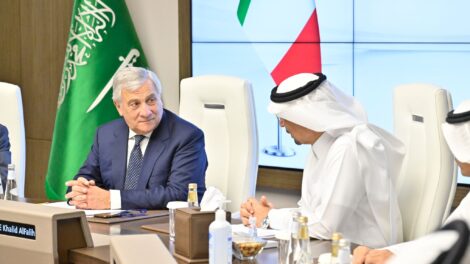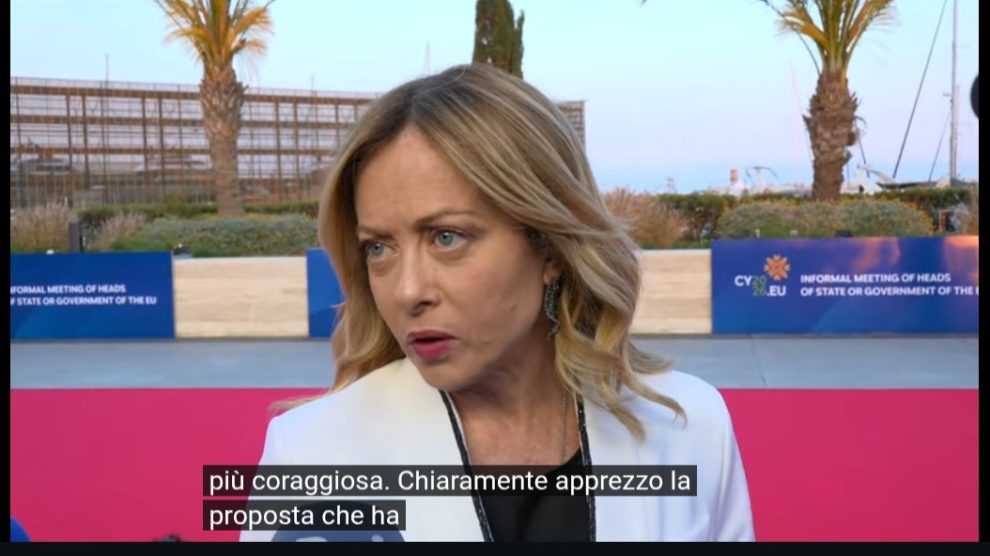
The big picture: At the informal EU summit in Agia Napa, Prime Minister Giorgia Meloni used the platform to reinforce Italy’s credibility on public finances while pressing Brussels to move faster on energy and migration.
The timing matters: rising regional instability — from the Middle East to maritime chokepoints — is reshaping the EU’s risk perception.
State of play: Italy’s message
- On fiscal policy: “We inherited an 8.1% deficit, today it stands at 3.1%.” PM Meloni framed the reduction as proof that Italy’s accounts are back under control, despite the long-term burden of the Superbonus.
- On legacy costs: The tax incentive scheme remains a structural drag — €140 billion overall, with an annual impact that still constrains fiscal space.
- On migration: Rome claims validation from EU-level judicial developments on its Albania initiative, reinforcing its argument that its approach was legally sound.
- On energy: Italy backs proposals from Ursula von der Leyen — but calls them insufficient.
- The key ask: more flexibility on state aid, potentially mirroring defense spending exemptions.
Why it matters: Meloni is trying to reposition Italy from rule-taker to agenda-setter — especially on issues where geography gives Rome leverage.
- Energy security and migration are increasingly intertwined, particularly in light of instability around key routes like Hormuz.
Between the lines: A joint statement by Cyprus, Greece, Italy and Malta signals more than coordination — it points to the emergence of a Mediterranean frontline within the EU.
- The explicit reference to the 2015 crisis reframes migration as a systemic risk, not a cyclical issue.
- Cooperation with Middle Eastern partners suggests a stronger external dimension of EU migration policy.
- In parallel, the four countries are aligning internally to avoid fragmented national responses.
- The subtext: prevent a crisis — but also shape the EU response before northern capitals do.
Zoom in: security dimension. Cyprus President Nikos Christodoulides raised the need to operationalize Article 42.7 of the EU Treaty — the mutual assistance clause.
- Recent regional tensions, including missile-related incidents from war against Iran, are pushing member states to think beyond migration and toward collective security preparedness.
The Ukraine backdrop. On the sidelines, Ursula von der Leyen, Antonio Costa and Volodymyr Zelensky met as the EU moved forward on a €90 billion loan to Kyiv, following Hungary’s decision to lift its veto.
- The package — coupled with new sanctions on Russia — is designed to sustain Ukraine’s war effort and stabilize its economy under continued pressure.
- As ECFR’s Leo Litra notes: “This funding will allow Kyiv to finance its defence, place new orders and meet social obligations… It also sends a strong message to Russia, disrupting Moscow’s strategy of outlasting Western support.”
- The urgency is immediate: Russian strikes on critical infrastructure continue to strain Ukraine’s economy and energy system.
- The loan is expected to act as a short-term lifeline ahead of the next winter.
- But it also highlights a structural issue: financing Ukraine beyond 2027 will require more durable EU mechanisms.
The bottom line: Italy is leveraging a moment of overlapping crises to push for structural shifts in EU policy — on energy, migration and fiscal flexibility. Whether Brussels follows will depend on how quickly risk turns into reality.