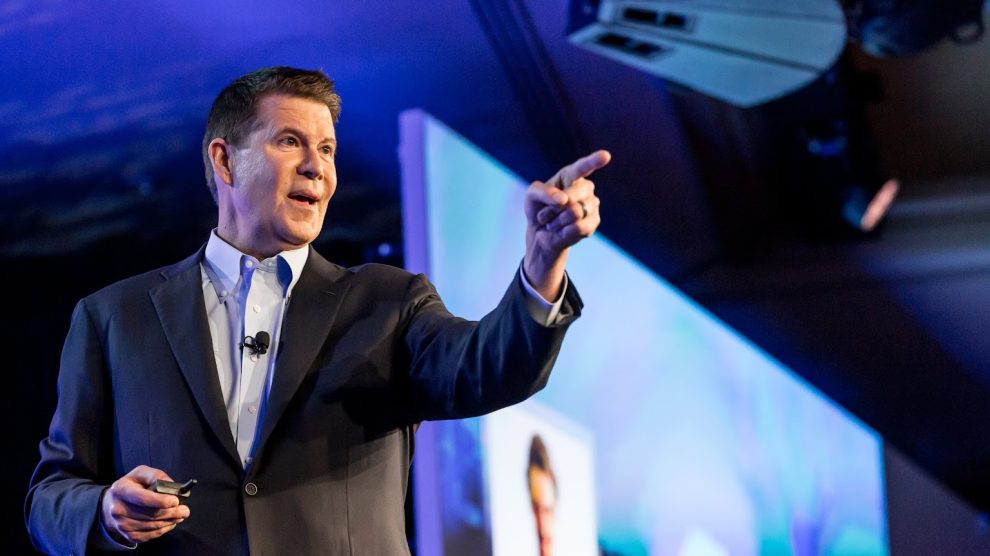
The competition that will redefine global balances is fought in silence, within networks, clouds and supply chains. Keith Krach, founder of the Krach Institute for Tech Diplomacy and former Undersecretary of State in the first Trump administration, is convinced of this. Krach was among the speakers on April 28 at the “U.S.–Italy Trusted Tech Dialogue: Accelerating Transatlantic Innovation.”
In a context of intensifying systemic competition, the dialogue focuses on three main priorities: strengthening collaboration among democracies in building secure technology ecosystems, reducing strategic dependencies in supply chains, and accelerating the transition from innovation to industrial deployment. The underlying point is increasingly clear: technology is no longer just an economic factor, but a structural component of geopolitical power.
Why he matters: Keith Krach is the founder of the Krach Institute for Tech Diplomacy, one of the leading international platforms focused on the intersection of technology and foreign policy.
- Krach served as Under Secretary of State during the first Trump administration, with responsibilities in economic security and tech diplomacy.
- He is currently CEO of Freedom 250.
- A seasoned entrepreneur, he previously founded and led major technology companies, including DocuSign. His profile combines industrial experience with strategic vision, making him one of the most influential voices in the debate on technological competition between democracies and authoritarian systems.
Trusted Tech as a Geopolitical Pillar. In a context of intensifying systemic competition, why have “trusted technologies” become a central pillar for the security and prosperity of democracies? And what, in concrete terms, distinguishes a “trusted” technology ecosystem from one that is not?
A. “We’re in the middle of the defining contest of our time—and most people don’t see it. It’s being fought silently, inside our networks, our clouds, and our supply chains.
- This is a competition between two systems: freedom versus authoritarianism. And technology is the main battleground.
- Technology today is the architecture of modern life. It shapes how power is exercised and how societies function. So the real question is simple: what values are embedded in that technology? That’s where trusted tech comes in.
- Trusted technology is built on integrity, accountability, transparency, and the rule of law. If you don’t have trust, you don’t have security—and you don’t have prosperity.
- A trusted ecosystem is one you can rely on. It doesn’t create hidden dependencies or give others leverage over you. Because untrusted technology may look cheaper on day one—but over time, it creates strategic vulnerability.
- This isn’t just about innovation. It’s about whether the digital world runs on trust—or on control—and whether technology advances freedom or undermines it.”
Italy’s Role in the Transatlantic System. In the effort to build secure and resilient technology ecosystems among allies, what specific role can Italy play, both at the industrial level and as a bridge between Europe and the United States?
A. “Italy is a pivotal player in this new era. No country can win alone. The winners will be those who build the strongest trusted networks—and Italy is a powerful node in that network.
- The U.S.–Italy Dialogue on Trusted Technologies is a big step forward. It’s not just about alignment—it’s about execution. It’s about strengthening supply chains, scaling trusted technologies, and countering authoritarian influence together.
- Italy brings industrial strength and cybersecurity leadership, but also something just as important: the ability to connect ecosystems.
- In a fragmented world, Italy helps unify the free world’s approach to technology. And in this contest between freedom and authoritarianism, unity among trusted partners is our greatest advantage.”
Cooperation Beyond Political Cycles. The dialogue on emerging technologies appears to aim at objectives that extend beyond political cycles. What mechanisms or partnerships are needed to ensure continuity and deliver tangible results over the long term between the United States, Italy, and Europe?
A. “Technology moves fast. Politics doesn’t. So if we want lasting results, we have to build systems that outlast political cycles.
- That’s what efforts like the U.S.–Italy dialogue are designed to do—create continuity through ongoing collaboration, not one-off meetings. But the real key is bigger than institutions. It’s networks.
- When we built the Clean Network alliance of democracies to secure global 5G infrastructure, we didn’t just align governments—we aligned markets around trust. And that changed behavior at scale.
- That’s the model now. It’s being replicated beyond 5G to other advanced technologies that have an outsized impact on our way of life.
- When trust becomes the standard—driving procurement, investment, and partnerships—you create momentum that ultimately advances freedom itself.
- That’s how you move from coordination to execution—and from execution to lasting impact. It’s how you turn shared values into enduring systems.”
U.S.–China and Technological Competition. Looking at the relationship between the United States and China, to what extent is competition over technologies — particularly in AI, supply chains, and digital infrastructure — reshaping international relations?
A. “What we’re seeing between the United States and China is not just competition—it’s a battle over who sets the rules of the digital age.
- China understands that if you control the technology stack, you shape the system.
- But during the 5G fight, we discovered something critical. Countries would say, “China is important”—then whisper, “But we don’t trust them.”
- That was the a-ha moment. Lack of trust is China’s biggest weakness and the free world’s greatest competitive advantage.
- Trusted technology gives democracies a way to compete—and win—without compromising their values.”
On the Embassy Event. The event hosted on April 28 at the Embassy of Italy in Washington, “The U.S.–Italy Trusted Tech Dialogue,” brings together policymakers, industry leaders, and research actors — reflecting everything we have discussed so far — with the aim of moving from political coordination to the industrial deployment of emerging technologies. In your view, what are the key pathways, tools, and priorities to ensure that this kind of cooperation becomes truly effective?
A. “The U.S.–Italy Trusted Tech Dialogue is exactly what we need right now. It brings together government, industry, and research to solve real problems—securing AI, strengthening supply chains, and scaling trusted technologies.
- The focus is clear: align, then execute.
- We need to turn shared vision into joint projects. We need to scale trusted solutions so they can compete globally. And we need to connect trusted ecosystems, because the greatest force multiplier in history is a trusted network.
- When you get that right, everything accelerates—innovation, adoption, and strategic advantage. That’s how you get real-world impact.”
America 250. As the United States approaches the 250th anniversary of its founding, how do technology and innovation connect the country’s historical identity with its future trajectory? And what role will they play in shaping the next phase of American global leadership?
A. “As the United States celebrates its 250th birthday, it’s a moment to renew what has always set us apart: freedom, innovation, and trust. From the very beginning, this country has been about building—taking risks, solving problems, and pushing the frontier. Technology is the next chapter in that story.
- But today, the stakes are global. Technology is shaping the future of freedom itself. The next phase of American leadership will be about leading a network of trusted partners—free nations, free businesses, and free people working together to ensure that innovation reflects our shared values.
- Because this isn’t just about who builds the best technology. It’s about whether that technology carries forward what George Washington called “liberty’s sacred fire”—or extinguishes it. That’s our shared mission as free nations. And this is our moment to renew it.”
(Photo: kiethkrach.com)