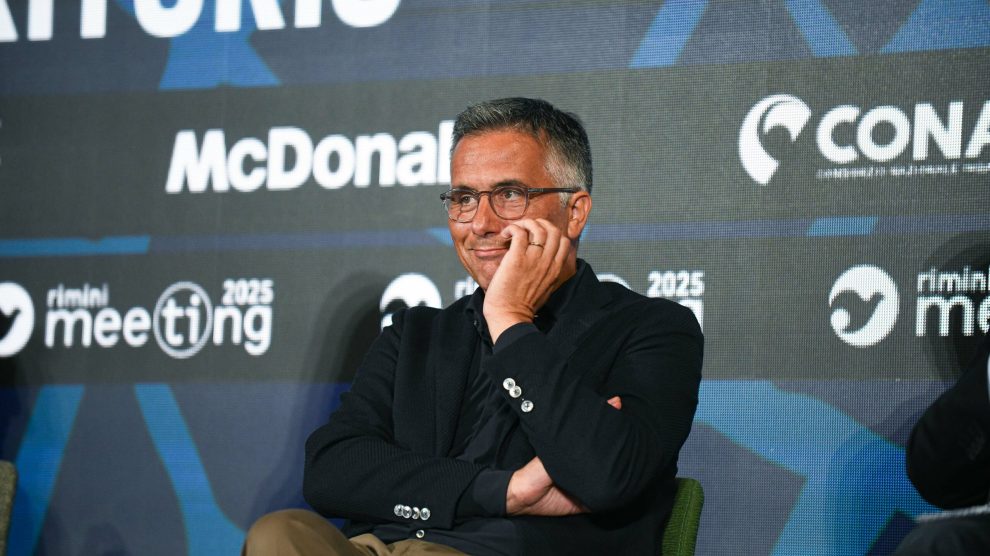
The dialogue with the Gulf, Massimiliano Salini argues, cannot be left to informal brokers working in the background. “One cannot think that it will always be the eternal outside consultant Tony Blair, operating under the radar, to connect the dots of these very interesting attempts,” the EPP MEP tells Formiche.net. “What is needed is someone with the right historical and geographic position, alongside political stature. I hope that will be Italy.”
- Salini, a member of the European Parliament’s delegation to the Parliamentary Assembly of the Union for the Mediterranean, sees Rome as the natural driver of the new forum for cooperation and dialogue between the Mediterranean and the Gulf — the GCC-MED Summit proposed by Giorgia Meloni in Navarino during last Saturday’s meeting.
- “The directions discussed in Greece in recent days,” he says, “all contribute to recovering precisely this possible protagonism, in which Italy would play a central role. This is also shown by the organisers’ decision to offer the Italian prime minister one of the opening speeches, without forgetting that the Italian economy is by far the most important among all the countries bordering the Mediterranean.”
Q: What contribution can Italy make to relations between the EU and the Gulf?
A: Italy’s role in the Middle East has always been a very particular one, based on a method that has historically been a distinctive feature of Italian foreign policy. We have an objective capacity to build relationships with the Middle East, including with the most critical interlocutors, the Shia world included.
- Italy has always had very solid relations with Iran, of which we were once one of the privileged trading partners. And, since the days of Mattei, we have also been able to engage with some of the most disliked interlocutors imaginable, including many of the protagonists of the most anti-Western actions carried out over the decades.
- That diplomatic capacity, which Italy had built over time, has gradually been replaced by a position that is, in essence, a lowest common denominator of all the positions within the Atlantic Alliance, interpreted mostly by the United States — but with unsatisfactory results.
Q: In what sense?
A: The lack of foresight, from a foreign-policy perspective, in this Western and Atlantic approach to the Middle Eastern chessboard is showing, precisely in this period, its lowest point and its inadequacy, not only in solving problems.
- The central issue is the relationship between Israelis and Palestinians, while keeping in mind two unquestionable elements. First, the absolutely meritorious fact of having at least slowed down Hamas and Hezbollah, and therefore greatly reduced the strength of anti-Western Islamist terrorism, especially in Gaza, even though Gaza is still marked by a latent human tragedy that is entirely unacceptable.
- Second, the capacity to weaken the atrocious power of the Islamic Republic, but with an outlook so uncertain that it risks jeopardising even the achievements made so far.
Q: What role could Italy play?
A: Italy should take a slight step sideways and recover its structural ability to speak with those worlds. What is clearly happening is that muscular relations will not produce any real progress on the crisis in the Strait of Hormuz. Only negotiating capacity under the aegis of the United Nations will produce results.
- That means reviving the Mediterranean’s ability to act as a political space, with Italy once again becoming a privileged interlocutor for all the other Middle Eastern actors, Iran included.
Q: From Navarino, the prime minister threw a stone into the pond: bringing those countries closer to the Mediterranean, also to prevent a different kind of dialogue with China. How?
A: Italy has every interest in supporting such a perspective, because it is, first of all, consistent with reality. The Mediterranean is the reference basin for Middle Eastern access to Europe and the West. It is therefore a privileged space, a gateway to some of the most attractive markets in the world.
- There are two ways to reach the Mediterranean. One is the traditional route, especially for the countries bordering the Persian and Arabian Gulf, through the Red Sea and the Suez Canal, or through the circumnavigation of Africa.
- But there is also another route, where important investments are developing, especially in Israel, in infrastructure linked in particular to the transport of hydrocarbons.
Q: Why is direct access to the Mediterranean through Israeli ports geopolitically and economically relevant?
A: Because the Mediterranean is going through a phase of weakening in its role and in its centrality, due to the reduction in the flow of goods from the Gulf through the Suez Canal after the disruptions caused by the Yemenis and following the Israeli attacks on Gaza.
- Before that, there had been the Hamas attack of October 7 and the well-known escalation that also involved this terrorist action by the Yemenis. In addition, there is the proliferation, to the north, of new routes reaching Europe through the Arctic. Over time, this has reduced the Mediterranean’s centrality.
- The directions discussed in Greece in recent days all contribute to recovering precisely this possible protagonism, in which Italy would have a central role. This is shown by the organisers’ decision to offer the Italian prime minister one of the opening speeches, without forgetting that the Italian economy is by far the most important among all the countries bordering the Mediterranean, from north to south.
- This is therefore a new initiative linked to the so-called Wider Mediterranean, which is also the subject of a new development coming from the European Commission: the Pact for the Mediterranean.
Q: Prime Minister Meloni has repeatedly spoken of “polycrisis” and of the need for a new strategic cooperation based not only on emergency management, but on a shared long-term vision. What mistakes must the EU avoid — such as the one made with China and the raw materials of the Green Deal?
A: The mistake Europe must not make is to continue imagining itself as a place that can afford the luxury of being a global protagonist simply because it has the liveliest and most advanced internal market.
- The strength of the Old Continent has decisively diminished over time. Continuing to think that Europe can play a leading role in the world without dealing with foreign policy and defence is a huge illusion.
- We cannot imagine containing the progressive decline of our presence on the international stage unless we restructure the governance of the European Union, even through treaty change, to achieve a common foreign and defence policy.
- Another mistake would be to think that political strength can be preserved without protecting Europe’s economic peculiarity — namely, manufacturing — while possessing almost nothing in terms of raw materials.
- The Green Deal is a fitting case. It is a real stumble, though not entirely so, because sustainability was invented in Europe, not elsewhere. The point is that today we have developed a very capricious tendency that seems to be pushing our continent from producer to consumer, without considering that certain economic and environmental policies are moving production out of Europe.
Q: With what consequences?
A: Without those productions being made in Europe, not only is the world dirtier — because producing steel in China or Turkey is not the same, environmentally, as producing it in Europe — but Europe has also stopped relying on the cornerstone of its own economic protagonism.
- The result is a complete failure from the standpoint of political strategy. So, as a first point, we should recover a new and possible protagonism. The second point is deciding where to begin, in other words, what the new horizon will be.
- Once those first two steps are taken, what remains is the major investment that must be made, without hesitation, in the Mediterranean. That means the idea that the relationship between the Mediterranean and Africa, on the one hand, and between the Mediterranean and the Middle East on the other, is the best way to give a role back to the West and to Europe.
- Because if Europe does not prepare itself to fulfil this function of safeguarding the Mediterranean as the starting point for new political balances, Turkey and Russia will do so. They are already very active in the Mediterranean. One only needs to look at the way they have moved in Libya, as shown by investments in the port of Misrata.
Q: A structured partnership also requires mutual trust. How do you assess Meloni’s proposal for a new forum of cooperation and dialogue between the Mediterranean and the Gulf – a GCC-MED Summit? And what qualities should whoever leads it possess?
A: I see a bottleneck. The point is: who will lead this effort? Who within the West can play this kind of role? Who will be able to invest substantially in a project of this kind, ensuring that it does not become simply one more table where people meet and talk, but rather a true political actor — capable of taking responsibility for important and risky political objectives, such as those connected to resolving the current crisis in the Strait?
- For all these reasons, I believe the proposal should be accompanied by a project that sees Italy as a possible strategic brain in this effort. One cannot think that it will always be the eternal consultant Tony Blair, operating under the radar, to connect the dots of these very interesting attempts.
- What is needed, instead, is someone with the right historical and geographic position, alongside political character. I hope Italy will do it.