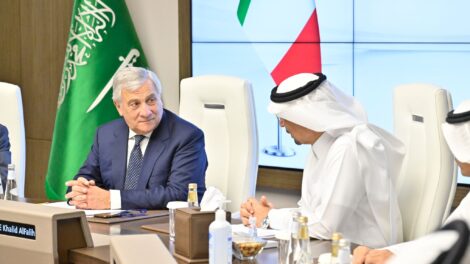

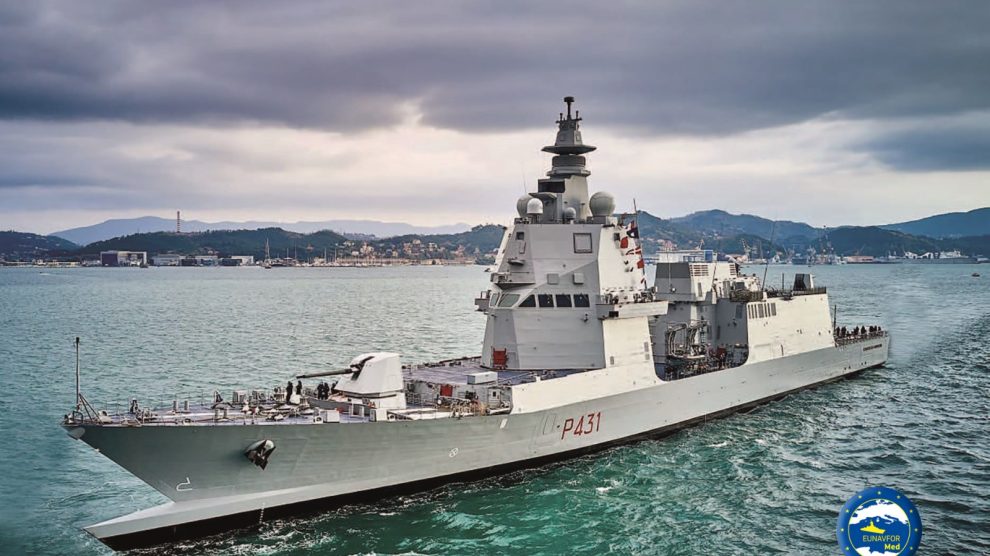
During his first official visit to Tripoli, the commander of Operation EUNAVFOR MED Irini, Italian Rear Admiral Marco Casapieri, met with the Chief of Staff of the Libyan Army, General Salheddin Al Namroush. The meeting was described as “very productive,” focusing on strengthening cooperation in areas of common interest, with the aim of consolidating cooperation between the European Union and Libya and contributing to the security and stability of the shared Mediterranean.
It is an important step, within the ordinary framework of military diplomacy, which nonetheless opens the way to a phase of transformation—already underway—of Operation Irini. With the renewal of its mandate until 31 March 2027 and the extension of its operational scope to Maritime Situational Awareness (MSA) and the indirect protection of critical subsea infrastructure—assets that are increasingly central to the EU’s shared security architecture—Irini is entering a new dimension. No longer only an instrument for implementing the UN arms embargo on Libya, but also an advanced observatory of strategic competition in the central Mediterranean, in a context where the sea is once again a contested, hybrid space, increasingly connected to other European and global theatres.
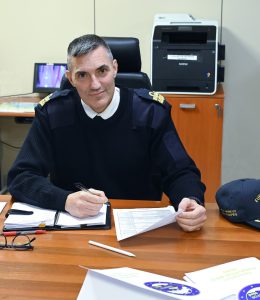 Leading the challenges of this transition is Admiral Casapieri, commander of the operation since September 2025. His assessment is clear: the threat is no longer linear nor confined within traditional categories. “The threat we face is hybrid and constantly evolving,” he told Decode39, highlighting how Irini has had to adapt to a rapidly changing operational environment. In this framework, seemingly distant phenomena—from so-called shadow fleets to attacks on critical infrastructure—end up overlapping, “bringing distant regions such as the Baltic and the Mediterranean closer together once again.”
This geographical and conceptual convergence is one of the key elements for understanding Irini’s strategic relevance today—and in the future. The Mediterranean is no longer merely a regional sea, but a node of interconnection between European security, energy flows, value chains, and geopolitical competition. In this context, the ability to “see” what happens at sea becomes a prerequisite for any form of deterrence or intervention.
Admiral Casapieri insists precisely on this point: “the operation is increasingly based on an integrated information cycle,” he explains. Naval and aerial patrol activities are combined with the systematic use of open sources, including AIS (Automatic Identification System), satellite intelligence, and information shared by European agencies such as Frontex, Europol, and the EU Satellite Centre. “We have a dedicated intelligence and information-sharing platform,” he adds, designed to precisely define the operational environment in the central Mediterranean and reduce the margin of operational ambiguity.
This approach reflects a broader transformation in the way the European Union exercises its maritime presence. It is no longer just about being present at sea, but about building an autonomous capacity for analysis, correlation, and attribution. In a context of hybrid threats, informational superiority becomes a factor of sovereignty.
Irini’s historic task remains the enforcement of the UN arms embargo on Libya, with a view to stabilising the country, but here too the commander invites a realistic reading. The embargo applies exclusively to the maritime domain, and its effectiveness depends on the international legal framework and the cooperation of flag states.
The operation remains the only international actor deployed off the Libyan coast with a specific mandate to enforce the embargo at sea. Strategically, this means increasing the operational costs for those attempting to violate it, forcing actors to change routes, timing, and methods of access to the country, thereby reducing the predictability of illicit trafficking—“and this is not a negligible effect,” Casapieri underlines.
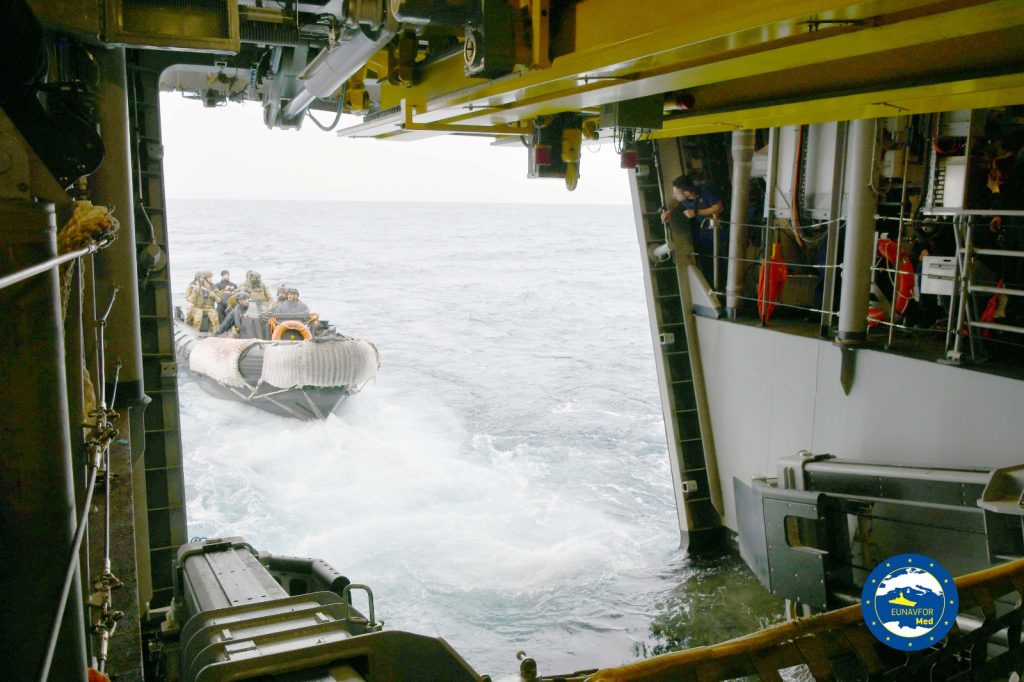
The most significant qualitative leap, however, concerns the extension of the mandate to contribute to the indirect protection of critical maritime infrastructure. It is here that Irini fully aligns with the new European security agenda and positions itself as an operational tool of essentially global relevance, considering that subsea connectivity lines link Europe with Africa and Asia. “The Mediterranean is not only threatened on the surface, but also in its depths,” warns Casapieri, recalling that beneath the sea run optical fiber backbones, pipelines, power cables, and energy infrastructure on which European economies depend. Monitoring suspicious activities near these assets does not mean militarising the subsea domain, but rather reducing the space for ambiguity and strengthening the capacity for prevention and attribution. “This is achieved through the collaboration of the European countries participating in Operation Irini, including Italy, and together we share information that allows us to increase the effectiveness of our work day by day,” the Commander specifies.
In this sense, Irini increasingly takes shape as an instrument of strategic resilience. Maritime security is no longer only about controlling routes, but about protecting the invisible connections that sustain Europe’s economic and digital life.
On the resources front, Casapieri offers a meaningful snapshot of European political support. Twenty-four member states contribute to the operation in various forms, a figure that reflects broad alignment on objectives. When asked whether resources are sufficient, the response is pragmatic: “An operational commander can always wish for more resources.” Additional assets would strengthen monitoring. But the politically relevant point is another: despite new crises and emerging fronts—from wars in Eastern Europe to global tensions—the resources allocated to Irini have not been reduced. “The operation has in fact demonstrated the ability to adapt to an evolving scenario,” Casapieri notes.
Alongside its operational dimension, Irini generates less visible but equally important systemic effects. The operation promotes interoperability, joint training, and cohesion among European navies.
“Irini is a kind of hub where different forces can integrate and maintain their operational readiness, benefiting from the infrastructure of our operation,” Casapieri adds. “At our headquarters in Rome, military personnel and civilians from different European countries work side by side around the clock, overcoming cultural barriers and building relationships. This mechanism is at the foundation of future European defence. Irini represents a tool that could be used to integrate future European naval assets.”
Casapieri also highlights work on maritime interdiction, cooperation to be developed with the NATO centre in Souda, and above all the relationship with Libyan authorities.
Capacity building and training are growing areas of both operational and political relevance for Irini. Since December 2024, CB&T (Capacity Building and Training) initiatives have begun to produce tangible effects in strengthening trust with Libyan counterparts, opening doors at both the operational and political levels.
Dialogue with Libyan authorities is described as positive, and a concrete result has been achieved with the first basic training of thirty Libyan personnel—from both the East and the West of the country—held at the Italian Navy training centre in Taranto last September.
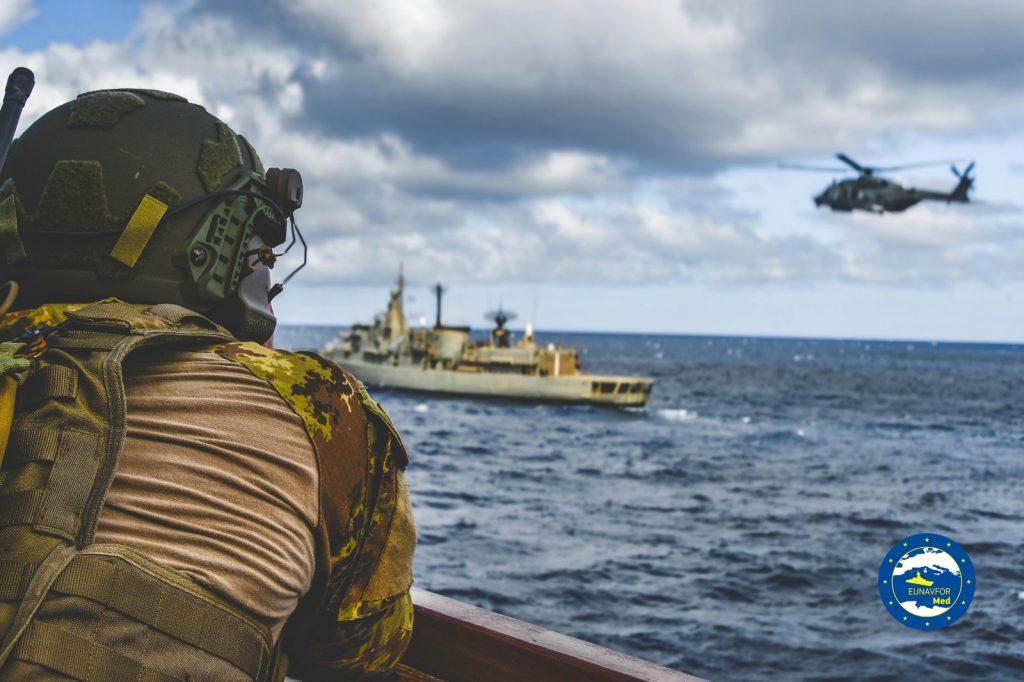
These activities fall within the broader framework of actions, not only at EU level but also under the United Nations, aimed at achieving international standards in Search and Rescue and the respect of human rights. In the near future, for example, the establishment of a Maritime Rescue Coordination Centre (MRCC) in Benghazi is planned, modelled on the one already initiated in Tripoli. “Moreover, Libyan authorities have expressed strong interest in participating in a first joint SAR exercise to be held in the coming months, involving the simulation of an incident of a disabled merchant vessel,” Casapieri specifies. “This approach, firmly rooted at the technical level, involves both western and eastern Libyan entities, thereby supporting Libyan institutions responsible for law enforcement and search and rescue at sea in accordance with international standards and humanitarian law.”
“Capacity building and training are receiving strong appreciation from Libyan authorities, as evidenced by all recent engagements. Further exercises and initiatives are already planned,” the Commander adds.
A step of symbolic relevance in a context of deep institutional fragmentation. This capacity-building dimension is directly linked to the political perspective. In a country like Libya, stability also depends on building competencies and communication channels, more than on rapid or purely military solutions.
It is no coincidence that Irini is increasingly looking at the need for coordination among different European maritime operations. It is within this logic that the first EU Maritime Operations Commanders’ Meeting took place on 25–26 February in Rome, at Irini’s headquarters in Centocelle. The initiative, strongly promoted by Admiral Casapieri, was designed to share operational best practices and thereby enhance the effectiveness of the European Union’s three key operations—Irini, Atalanta, and Aspides—within a more coherent vision of European maritime capabilities.
It is also in this framework that Irini’s growing role in Libya should be understood. Casapierirecalls how, in its early stages, the operation was criticised by both sides of the conflict—almost a paradoxical sign of impartiality. Over time, however, “over the course of these nearly six years, the operation has gained increasing credibility” and has opened stable channels of engagement with actors on the ground.
On Libya’s future, the commander maintains a cautious yet forward-looking approach. “Stability,” Casapieri emphasises, “is a long process—a marathon rather than a sprint.” And perhaps this is Irini’s most realistic hallmark: not to promise immediate solutions, but to work to reduce disorder, strengthen maritime domain awareness, and provide the European Union with concrete tools to act as a credible player in a Mediterranean that has, in every sense, returned to being a strategic frontier.