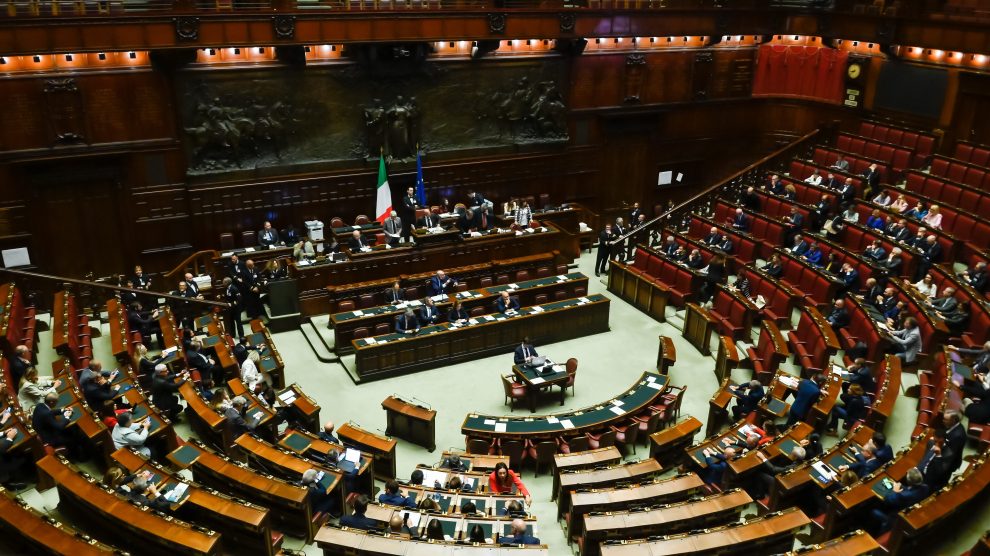
Foreign Minister Antonio Tajani and Defense Minister Guido Crosetto used a joint parliamentary hearing to deliver a coordinated message: Rome does not want to be drawn directly into the conflict with Iran, but it also does not want to be unprepared if allies move toward a maritime stabilization mission in the Gulf.
The hearing reflected growing concern in Rome that instability around Hormuz has become a broader economic and geopolitical issue touching energy security, trade routes and international law.
Why it matters: Italy says the Hormuz crisis directly affects European energy supplies and industrial competitiveness.
- Rome is aligning with allied planning while trying to avoid the appearance of military escalation.
- The government is framing freedom of navigation as a global security issue rather than a regional dispute.
- The discussion also highlighted rising concern over Iran’s regional posture and China’s leverage over Tehran.
The big picture: Italian officials increasingly describe the Strait of Hormuz as a strategic chokepoint whose disruption would have global consequences.
- Tajani told lawmakers that freedom of navigation through the strait “cannot be held hostage through military force or through the imposition of tolls,” calling maritime security an “absolute priority” for Italy, Europe and global trade.
- “What is happening in the Strait of Hormuz cannot be reduced to a regional crisis from which, as some would like, we should stay away,” he said. “This is a global shock.”
- At the same time, the government repeatedly stressed that any future Italian role would remain defensive, legally grounded and politically authorized by Parliament.
Zoom in: Tajani’s diplomatic line. Tajani sought to “clear up misunderstandings” surrounding reports of a possible Italian military role in Hormuz.
- “We are not here to ask for authorization for a new military mission in the Gulf,” he told lawmakers. Any Italian participation, he said, could materialize “only after the definitive cessation of hostilities.”
- The foreign minister insisted that:
- no Italian naval deployment would occur without parliamentary approval,
- no personnel would be sent without adequate security guarantees,
- and any initiative would require a precise international legal framework.
- Still, Tajani argued that Italy “cannot be a spectator” given its “vital” energy, commercial and strategic interests in the Gulf.
- He also sharpened Rome’s rhetoric toward Tehran, saying Iran “cannot acquire nuclear weapons or missile systems capable of threatening the region.” He accused the Iranian regime of internal repression and of attacks targeting civilian and energy infrastructure across Gulf countries.
- Tajani reiterated Italy’s solidarity with the United Arab Emirates following recent attacks.
The China angle. Tajani also pointed to China as a potentially important actor in any diplomatic de-escalation: a .
- He said he delivered Italy’s message directly to Chinese Foreign Minister Wang Yi during a recent visit to Beijing, arguing that China holds “undeniable influence” over Tehran and has a direct interest in restoring freedom of navigation through Hormuz.
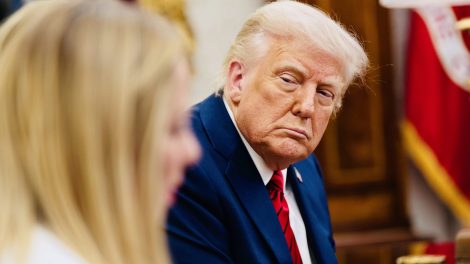
- “China’s commitment to peace is fundamental,” Tajani said. The remarks came hours before the expected Trump-Xi meeting in China, adding another geopolitical layer to Rome’s message. Italian officials increasingly see Beijing as one of the few actors with meaningful leverage over Tehran, particularly on energy flows and regional stability.
- The remarks reflected an Italian effort to frame maritime security not only as a Western priority, but as a shared interest among major global economic powers.
Zoom out: Italy quietly prepares. While Tajani focused on diplomacy and political conditions, Crosetto outlined the operational logic behind Italy’s military preparations.
- The MoD confirmed that Rome is preparing to move two mine countermeasure vessels closer to the region — first to the eastern Mediterranean and later to the Red Sea — within the framework of existing missions, including Aspides and Mediterraneo Sicuro.
- He described the move as precautionary, arguing that allied naval units would otherwise need weeks to reach the Gulf if conditions for a stabilization mission suddenly emerged.
- “If peace were suddenly to break out,” Crosetto said, allied forces would still require nearly a month of navigation time to reach the area.
- The likely Italian contribution, if eventually approved, would rely primarily on the navy’s mine-clearing capabilities, reflecting concerns that naval mines could become a central operational issue in Hormuz.
- Crosetto repeatedly emphasized that any future initiative would remain “exclusively defensive” and clearly separated from ongoing hostilities.
- He also pointed to broader European coordination, saying France had already taken similar steps while the U.K., Germany, Belgium and other partners were conducting comparable planning activities.
- “Preparing today in order to intervene tomorrow, if possible,” he said, “is a choice of responsibility.”
Between the lines: The hearing showed the government trying to balance three pressures simultaneously:
- reassuring allies,
- managing domestic political sensitivities,
- and avoiding direct association with a broader regional war.
- Italian officials repeatedly separated the idea of protecting maritime navigation from participation in military operations against Iran.
- At the same time, Rome appears increasingly intent on portraying Hormuz as a test of international order and economic stability rather than solely a Middle East security file.
Political reaction. Paolo Formentini, vice chair of the Foreign Affairs Committee in Italy’s lower house and a lawmaker from the ruling League party, backed the conditions outlined by the government for any future mission.
- “We are satisfied with the conditions you outlined: a real truce and an international legal framework so that our ships can help restore peace in Hormuz,” he said during the parliamentary hearing, while also warning about risks to strategic maritime chokepoints.
- Formentini also argued that the crisis should not be framed solely as a consequence of Western actions, pointing instead to the broader geopolitical role played by Iran and China.
What to watch:
- Whether the fragile ceasefire holds.
- Potential allied discussions on a multinational Hormuz initiative.
- The evolution of European naval planning.
- China’s role in influencing Tehran (much more after Donald Trump mission to Beijing).
- Parliamentary debate in Italy if conditions for a mission eventually emerge.
The bottom line: Italy is politically and militarily preparing for the possibility of a future role in securing the Strait of Hormuz — but Rome is drawing clear red lines around any deployment, insisting on a stable truce, legal cover and parliamentary approval before moving further.