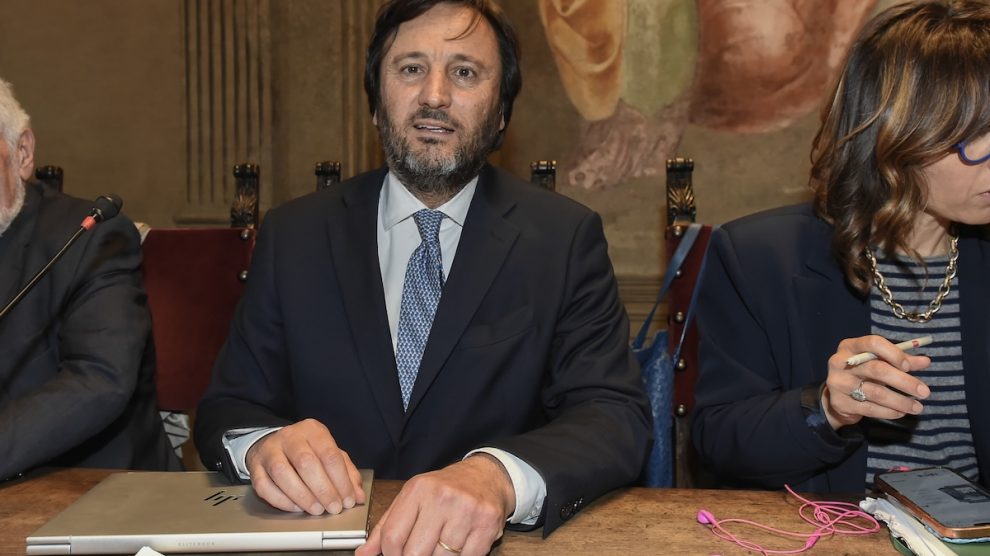
The move places an Italian lawmaker, Democratic Party’s Senator Alberto Loscacco, alongside newly elected Assembly President Marcos Perestrello of Portugal at a time when NATO members are debating how to strengthen collective defense while increasing Europe’s contribution to the Alliance.
Why it matters: The NATO Parliamentary Assembly brings together legislators from the Alliance’s 32 member states and partner countries, helping shape political debate around NATO priorities.
- The election gives Italy renewed visibility within a key transatlantic institution.
- Losacco immediately tied the role to debates over deterrence, European defense capabilities and the strategic importance of the Mediterranean.
- The appointment comes as European allies face mounting pressure to strengthen defense capabilities amid a deteriorating international security environment.
The big picture: Losacco framed the Assembly as a forum where democracies can coordinate responses to growing geopolitical instability.
- “The more international disorder grows, the more important the places where democracies meet, dialogue and build common answers become,” he said after the vote.
- He described the NATO Parliamentary Assembly as an increasingly important space for cooperation in a world marked by wars and conflicts.
- He also identified three priorities for the Alliance: strengthening deterrence, consolidating Europe’s contribution to common security and improving the quality of defense spending.
Zoom in: The Mediterranean argument. A central message from Losacco was the need to elevate NATO’s southern flank. “The Mediterranean and the southern front must assume an increasingly central role in NATO’s agenda,” he said, arguing that a significant share of today’s global tensions are concentrated in the region.
- That position aligns with a longstanding Italian effort to ensure that security challenges emerging from the Mediterranean receive greater attention within the Alliance, alongside concerns focused on NATO’s eastern flank.
Between the lines: Losacco also used his election to argue for a stronger European defense role within NATO rather than outside it.
- According to the Italian senator, a more integrated European defense structure would improve interoperability, distribute strategic capabilities more evenly and strengthen the competitiveness of Europe’s defense industry. He presented that effort as a reinforcement of NATO’s European pillar, not an alternative to the Alliance.
Historical context: The election marks a new chapter in Italy’s presence within the NATO Parliamentary Assembly leadership.
- In November 2016, Italian politician Paolo Alli was elected president of the Assembly during its annual session in Istanbul, becoming the first Italian to hold the post in 55 years after Pietro Micara. Alli was subsequently confirmed in the role during the 2017 annual session in Bucharest.
- While Losacco’s new position is vice president rather than president, his election restores an Italian presence in the Assembly’s top leadership at a moment of heightened attention to NATO’s future direction.
What to watch:
- Whether Italy can leverage the position to push Mediterranean security higher on NATO’s agenda.
- How parliamentary discussions evolve around European defense integration and defense spending.
- The priorities pursued by the new Assembly leadership under Perestrello and his vice presidents.
The bottom line: Losacco’s election gives Italy a renewed voice inside one of NATO’s key political forums, while highlighting Rome’s push to link transatlantic security, European defense and the strategic importance of the Mediterranean.