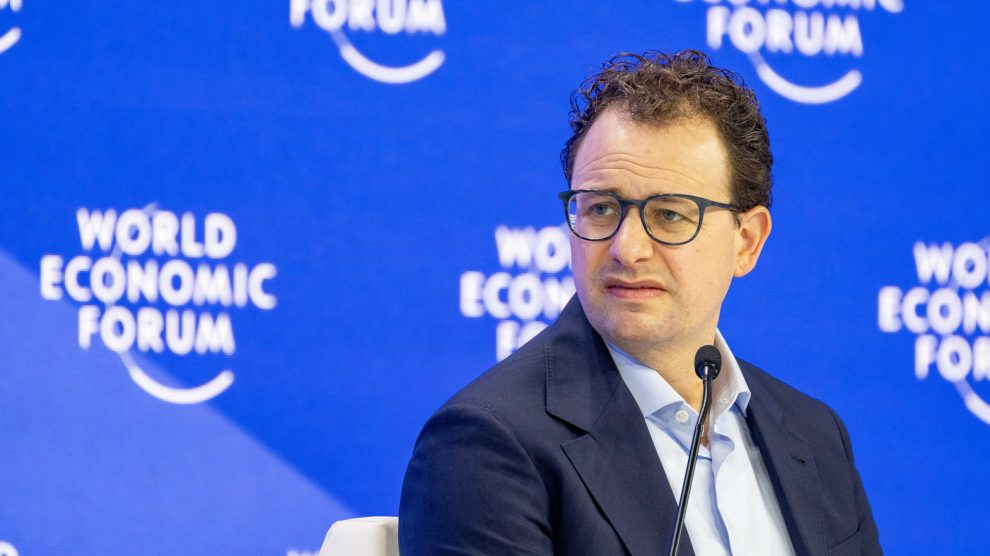
The Move. Pope Leo XIV will personally present his first major teaching document on AI’s ethical challenges alongside Christopher Olah, co-founder of Anthropic and developer of Claude, one of the world’s most widely used AI models.
- The encyclical, titled *Magnifica Humanitas*, will be released on May 25, 2026, addressing “the protection of the human person in the age of artificial intelligence.”
- Shortly after, CEO Dario Amodei is expected to travel to Rome for meetings with senior Italian institutional figures – a visit that signals the company’s concrete ambitions in the country and raises expectations of potential investment announcements.
Why It Matters. The timing is no accident. On February 27, 2026, President Trump directed all federal agencies to cease using Anthropic’s AI technology, and Defense Secretary Pete Hegseth designated the company a “supply chain risk” — the first time such a designation has been applied to an American firm.
- The move followed Anthropic’s refusal to remove ethical safeguards from its models, including restrictions on lethal autonomous weapons and mass surveillance. OpenAI moved swiftly to fill the gap, securing a Pentagon contract hours after Anthropic was blacklisted. Battered domestically, Anthropic is now looking to Europe – and to Rome specifically – to reconstruct its reputational standing and secure new political footholds.
Strategic Convergence. The Vatican’s choice of Olah was deliberate. The encyclical bears the Pope’s signature dated May 15th — the 135th anniversary of Leo XIII’s *Rerum Novarum*, the foundational text of Catholic social teaching on workers’ rights during the industrial revolution.
- The parallel is unmistakable: Leo XIV is framing AI governance as the defining social question of the age, and he has selected Anthropic — not OpenAI, not Palantir — as his interlocutor from the technology world. The Pope also approved the creation of a new Vatican commission on artificial intelligence on May 16, the first time the Catholic Church has formally coordinated its AI engagement under a single institutional body.
- The selection of Anthropic’s co-founder as a panellist reads as a clear preference for the ethics-driven approach over the accelerationist camp.
The Bigger Picture. Anthropic’s Roman pivot fits into a broader and rapidly accelerating European expansion. The company has tripled its EMEA headcount, opened new offices in Paris and Munich – alongside existing hubs in London, Dublin, and Zurich – and seen European revenues grow nearly tenfold in a single year.
- Notably, it has placed Liam Booth-Smith, a former British MP and former chief of staff to Rishi Sunak, at the helm of this regional push, signalling that the expansion is as much political as it is commercial. On infrastructure, Anthropic is actively seeking data centre partnerships in Southern Europe.
- It is not alone: Oracle is already expanding cloud infrastructure in Italy, Microsoft is investing billions in Portugal and Spain, and Google — which already operates in Italy via a cloud partnership with TIM — has announced an additional €5.5 billion investment in Germany through 2029. Amodei’s Rome visit will be followed by a trip to London to meet Prime Minister Keir Starmer, part of a wider European diplomatic offensive.
Political Fault Lines. The Vatican alignment carries implicit geopolitical weight beyond corporate positioning. The contrast with Peter Thiel’s Palantir – whose principals held closed-door seminars in Rome on technology and democracy, reportedly to a lukewarm reception in Vatican circles – is pointed.
- Where Palantir represents the accelerationist wing of Silicon Valley, closely aligned with the Trump orbit, Anthropic presents itself as the responsible counter-model. Pope Leo XIV’s stance on AI is expected to become a new flashpoint with the Trump administration, and his choice of Anthropic as a platform partner signals which side of that divide the Church intends to occupy.
- The legal dispute between Anthropic and Washington, meanwhile, remains unresolved: with split decisions by two courts, Anthropic is excluded from Pentagon contracts but able to continue working with other government agencies while litigation plays out.
Anthropic’s Vatican moment comes after Thiel’s Rome stop. Olah and Amodei are not the first Big Tech figures to pass through Rome in recent months. Before them, Peter Thiel, the founder of Palantir Technologies, drew attention with a visit to the Italian capital that included a series of closed-door seminars on the Antichrist and the relationship between technology and democracy. The initiative reportedly generated little enthusiasm in Vatican circles.
- That backdrop gives added weight to Christopher Olah’s presence alongside Pope Leo XIV at the presentation of the forthcoming encyclical. The pontiff, himself fresh from a clash with Donald Trump’s U.S. administration, to which Thiel is famously close, has deliberately drawn a parallel between the document he is preparing and Rerum Novarum, the 1891 encyclical on workers’ rights during the Industrial Revolution that remains a cornerstone of modern Catholic social teaching.
- Seen in that light, the decision to host Olah as a speaker appears neither accidental nor neutral. It suggests a clear preference for Anthropic’s ethics-driven approach to artificial intelligence over visions that place technological acceleration above all else.
- When the Pope presents his encyclical on the relationship between human beings and AI, Anthropic co-founder Christopher Olah will be at his side. Shortly afterwards, CEO Dario Amodei is also expected in Rome for meetings with Italy’s institutional leadership. Attention is already turning to whether the visit could open the door to future investments in the country.
What It Signals. Anthropic’s Roman moment is a masterclass in soft-power repositioning. By embedding itself in the Vatican’s moral architecture at the precise moment it is under fire from Washington, the company is doing several things simultaneously: insulating itself from U.S. political pressure, building legitimacy with European regulators and publics, and opening a path into one of the continent’s most symbolically significant – if institutionally complex – markets.
- For Italy, where public opinion on AI remains cautious and where the Church’s voice still carries institutional weight, the papal association is no marginal asset. Whether Amodei’s political meetings in Rome translate into concrete investment commitments remains to be seen. But the strategic logic is clear.
- Anthropic is not merely selling an AI product. It is selling a vision of what responsible technology looks like — and it has found, in the Pope, a remarkably powerful co-author. All roads lead to Rome, even in the age of AI.