TAIPEI – Inside Taiwan, the debate over a potential conflict with China is increasingly shifting away from “will Beijing invade?” toward a more practical question: how can society continue functioning during a prolonged crisis?
Why it matters: At the center of that shift is Taipei-based Kuma Academy, one of the island’s most visible civil resilience organizations, where civilians are trained not only in emergency medicine and disaster response, but also in cognitive warfare and disinformation awareness.
- For years, international discussions around Taiwan focused heavily on military timelines, but Taiwanese resilience planners increasingly frame the challenge differently.
The big picture: The concern is about sustaining institutional continuity, public morale and social cohesion during a long-term period of pressure — potentially stretching years into the future.
- That includes preparing society psychologically for the reality that modern wars rarely resemble cinematic collapse scenarios.
What Kuma teaches: Kuma Academy combines traditional civil defense training with lessons more commonly associated with hybrid warfare.
- Programs include:
- CPR and trauma care;
- hemorrhage control;
- emergency response;
- open-source intelligence (Osint);
- disinformation analysis;
- cognitive resilience training.
- Tourniquets and first-aid kits coexist with classes focused on information manipulation and psychological pressure campaigns.cThe underlying idea is that resilience in modern conflict depends as much on societal endurance as on military deterrence.
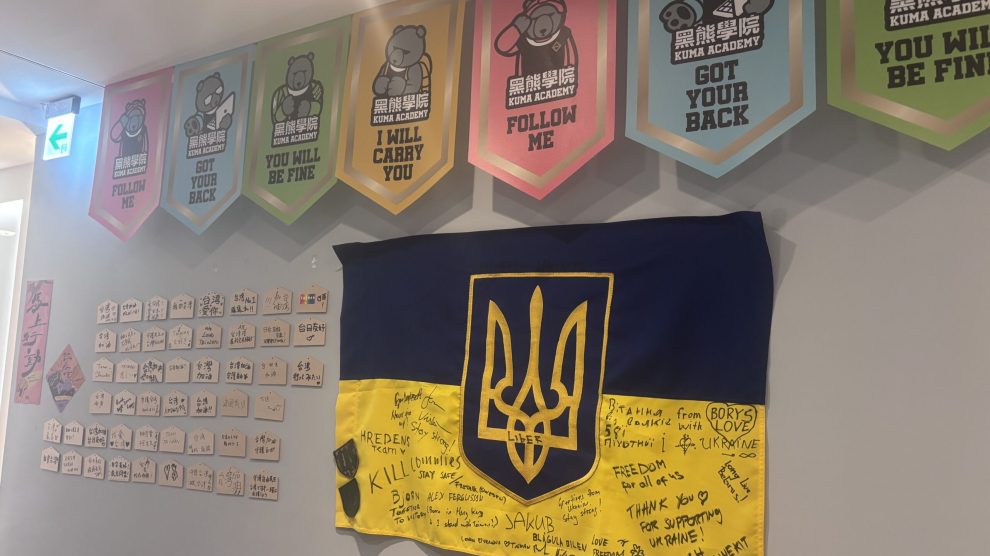
The Ukraine factor. Inside one of Kuma’s training rooms hangs a Ukrainian flag signed by visitors and instructors who traveled from Ukraine to Taiwan in recent years. Ukraine has become among the major reference points for Taiwan’s preparedness debate.
- “For many people, war is a combination of drama and cinema,” Kuma Academy chief executive Fu-Ming Chu said in response to a question from Decode39 during a briefing in Taipei. “But in reality, even though Ukraine is fighting a very brutal war, around 70% of its cities still function more or less normally.”
- The exchange between Kyiv and Taipei increasingly revolves around practical lessons on how societies operate under sustained pressure — not simply battlefield tactics.
- According to Chu, the most dangerous risk in wartime is often panic itself.
- “If Taiwan ever truly became a country at war,” he said, “people would need to understand concretely what daily life during wartime actually looks like. Otherwise war only generates panic.”
Narrative warfare. Since launching its first invasion of Ukraine in 2014 — and later the full-scale invasion in 2022 — Russia has framed the conflict as a mission to defend Russian-speaking populations from alleged Ukrainian “Nazis.”
- Kuma officials see similarities in the way Beijing portrays Taiwan, often framing the island through unresolved narratives tied to the Chinese civil war and the protection of Chinese identity.
- For Taiwan’s resilience activists, these narratives matter because they shape perceptions of legitimacy long before any military escalation.
Between normality and pressure. Kuma officials describe Taiwan as already living inside a permanent “grey zone” confrontation with China.
- That includes:
- near-daily Chinese military pressure around the island;
- cyber intrusions;
- coordinated disinformation campaigns;
- online narratives designed to weaken trust and social cohesion.
- Particular emphasis is placed on what is commonly called “cognitive warfare” — efforts aimed at shaping public perceptions and eroding confidence in democratic institutions.
- According to Kuma, some recurring narratives attempt to portray the United States as unreliable, question Taiwan’s democratic system or frame civil defense initiatives as hidden militarization.
The risk of normalization. One of the most striking points raised by Chu concerned what he described as a growing “insensitivity” inside Taiwanese society toward Chinese military threats.
- Anyone arriving in Taiwan, he argued, quickly notices how normal daily life appears despite the constant strategic pressure surrounding the island.
- “If you walk alone at night in Taiwan, you will feel very safe,” Chu said. “Nobody will attack you.” That sense of normality represents both a strength and a vulnerability.
- For Taiwan’s civil resilience movement, the challenge is preserving an open, democratic and functioning society without allowing constant military and informational pressure to become psychologically invisible.
By the numbers:
- Around 100,000 people have participated in Kuma training programs, according to the organization.
- Roughly 70% of participants are women.
- That statistic matters politically in Taiwan, where resilience initiatives are increasingly presented as collective preparedness rather than paramilitary activity.
- “Everything we teach has nothing to do with the use of force,” Chu said. “Civil defense is not based on weapons.”
The bottom line: Taiwan’s resilience debate increasingly reflects lessons drawn from Ukraine: modern conflict does not necessarily mean immediate societal collapse.
- For organizations like Kuma Academy, the challenge is preserving an open and functioning democratic society while preventing constant military and informational pressure from becoming psychologically normalized.