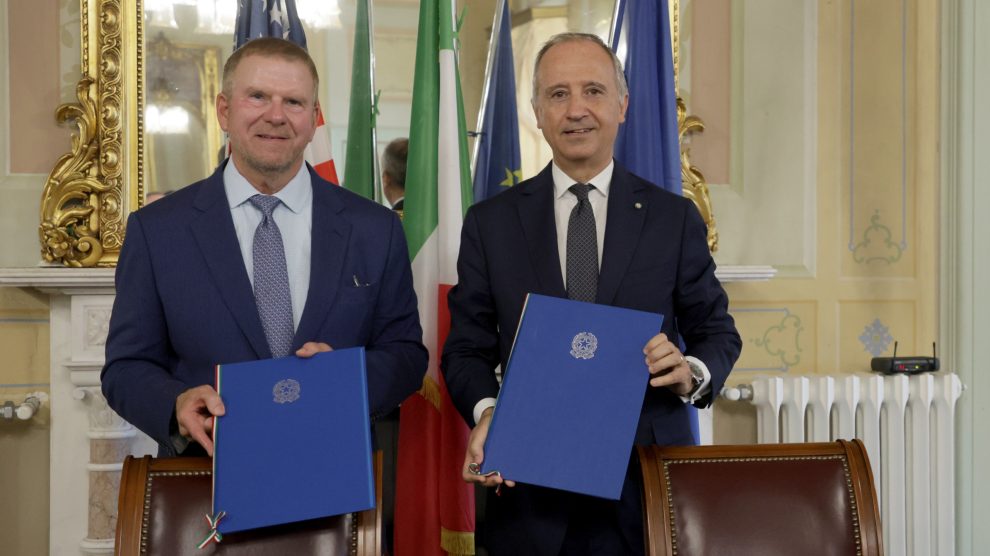
It’s done: Italy signed the Pax Silica Declaration this morning in Brindisi, formally joining the U.S.-led architecture of technology alliances on semiconductors, artificial intelligence and critical minerals. As Martijn Rasser (SCSP) put it yesterday, “Italy’s participation strengthens that network and reinforces the durability of transatlantic technology cooperation.”
The signing. As expected, Ambassador Armando Varricchio, Special Envoy for Innovation and New Technologies at the Italian Foreign Ministry, and U.S. Ambassador to Italy Tilman Fertitta signed the declaration, with Apulia’s regional institutions gathered at the prefecture in attendance.
What the Foreign Ministry says. The Farnesina explains that with this accession Italy joins “in full” an initiative that today counts more than 20 countries, and that the signing represents “a further building block in the strategic character of Italy-U.S. relations.”
- The goal is to build a reliable, resilient ecosystem grounded in shared standards for the key technologies of the AI era — from silicon to critical minerals, from high-tech systems to digital infrastructure — within a Euro-Atlantic framework that, for Rome, remains “one of the pillars of the West’s unity.”
- On critical raw materials, Minister Antonio Tajani and his U.S. counterpart, Secretary of State Marco Rubio, will sign a Memorandum of Understanding in the coming weeks, the operational follow-up to the Critical Minerals Summit held in Washington on February 4.
Complementary, not alternative. The Italian government frames its Pax Silica accession as complementary to, not a substitute for, the one already signed by the European Union a few weeks earlier.
- That complementarity is playing out today on another table too: Brussels has just launched a tender worth more than €30 billion to build up to seven AI Gigafactories in Europe, with Italy bidding to host one through a consortium bringing together Eni, Leonardo and Turin’s Italian Institute for Artificial Intelligence for Industry (AI4Industry).
Reading the Gigafactories right. It’s worth reading that initiative through the same lens as Pax Silica rather than as a chapter in fully autonomous European tech sovereignty — a goal that remains, for now, largely unrealistic.
- For the hardware, for instance, the Commission has already signed letters of intent with AMD, Nvidia and Qualcomm, three U.S. giants without whose chips Europe’s Gigafactories wouldn’t have the computing power they need.
- Europe’s Gigafactories become another node in the same transatlantic supply chain Italy just formalized its place in at Brindisi — not an alternative to it.
Brindisi as an industrial platform. Speaking at the ceremony, Forza Italia MP Mauro D’Attis noted that the choice of venue wasn’t incidental.
- Tthe city, he said, is already part of that network, “at the forefront” of Italy’s economic, industrial, environmental and digital transition, with more than 35 investment proposals identified for the industrial area — over €10 billion in potential investment and more than 2,000 direct jobs expected — including Eni Storage Systems’ FAENIX project on LFP batteries, a 400+ MW data center from Solaria with a U.S. partner, and Enel’s electrochemical storage system.
The declaration’s language. Per the text of the joint declaration signed in Brindisi, the goal of the cooperation is to pursue “a comprehensive economic partnership aimed at building an economic security order grounded in trust, technological complementarity, shared interests and a joint commitment to a more prosperous future.”
The diplomacy behind it. Credit is also due, on both sides of the Atlantic, to Ambassador Fertitta in Rome and Italy’s ambassador in Washington, Marco Peronaci, who over recent weeks worked to smooth over some friction in the bilateral relationship — including the stumble over Italy’s participation in Shanghai’s WAIC — without letting it derail the underlying trajectory.
The bottom line on timing. Today’s signing, even though it slipped by a few weeks precisely because of that friction, confirms that diplomacy remains the tool holding international relations together even when domestic politics generates friction of its own.
- Fittingly, on the eve of the signing, Senator Enrico Borghi — deputy leader of Italia Viva and a member of Copasir — had already told Formiche.net his verdict on Italy’s Pax Silica accession: “It’s not just important. It’s decisive.” [Full interview here, in Italian]
“Italy did the right thing in joining Pax Silica,” commented Valbona Zeneli, nonresident senior fellow at the Atlantic Council’s Europe Center and at the Transatlantic Security Initiative, and author of Decode39’s [Over]views.
- “In a moment when other capitals are still hedging between Washington and Beijing, hoping to preserve commercial ties with China while avoiding the cost of choosing, Rome’s accession, following its entry into the 6G security coalition and Minister Tajani’s participation in the Critical Minerals Summit, signals it does not intend to play that game. It fits a pattern of Rome positioning itself early rather than waiting to see how the architecture settles, betting on where the balance of power is actually heading rather than keeping every door open indefinitely.“
That instinct extends beyond Pax Silica alone. “The European Commission opened its call for up to seven AI Gigafactories, backed by up to €10 billion in EU and national funding and expected to unlock more than €30 billion in total investment,” added Zeneli.
- “Together, the two moments capture transatlantic technology cooperation in this phase, not Europe choosing Washington over its own capacity, but the two reinforcing each other. Pax Silica anchors Italy in a US-designed trusted-supply-chain architecture; the Gigafactories initiative gives Europe the sovereign computing capacity to use that access on its own terms.”
What’s next. The signing closes the formal accession phase. The real test — for Italy and the coalition’s other members alike — is whether political alignment gets translated into investment and real productive capacity.