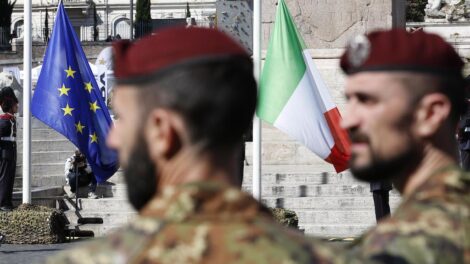
Decoding the news. The parliamentary debate on defense spending has revealed deep divisions across Italy’s political spectrum. Prime Minister Giorgia Meloni’s government argues that Italy has already increased defense and security spending to 2.8% of GDP and plans to present this figure as evidence of burden-sharing at the upcoming NATO summit.
- At the same time, parties disagree sharply on future spending targets, European defense initiatives, and the country’s commitments within NATO. The discussion encompasses the EU’s Readiness 2030 agenda, the SAFE defense financing mechanism, and proposals for deeper European military integration.
Why it matters. The debate comes at a critical moment for European security. NATO allies are facing mounting pressure to increase defense investments as Russia’s war against Ukraine continues and instability spreads across the Middle East.
- For Italy, the question is no longer whether defense should remain a strategic priority, but how to finance it and under which political framework. The absence of a clear national consensus risks weakening Rome’s influence in both NATO and European discussions at a time when major decisions on defense capabilities and industrial cooperation are being made.
Strategic divergence. The divisions extend well beyond the traditional government-opposition divide. Meloni’s Fratelli d’Italia supports higher defense spending while emphasising the need to focus on military capabilities rather than numerical spending targets. Forza Italia broadly aligns with this approach and advocates strengthening the European pillar of NATO through greater industrial and defense cooperation.
- The Lega, while firmly committed to NATO, remains sceptical about financing additional military expenditures through higher public debt or cuts to domestic priorities.
- On the opposition side, the differences are even more pronounced. The Partito Democratico supports increased defense efforts but insists they should be organized at the European level through joint procurement, common planning, and deeper institutional integration.
- By contrast, the Movimento 5 Stelle opposes further increases in military spending, rejects the use of EU defense funds, and calls for a reassessment of NATO commitments. Alleanza Verdi e Sinistra goes further, arguing against additional military investments altogether and advocating that EU resources remain focused on social and environmental priorities.
- Meanwhile, Azione has emerged as one of the strongest supporters of increased defense spending, linking military modernisation directly to continued support for Ukraine.
- The emergence of actors such as Futuro Nazionale, led by Roberto Vannacci, further complicates the picture. While supporting stronger security measures, the party prioritises border defense and migration control over traditional debates about military spending. Its more sceptical stance on support for Ukraine adds another layer to an already fragmented national discussion on Italy’s strategic posture.
The bigger picture. As NATO allies prepare to ask for greater commitments and Europe accelerates its defense agenda, Rome is working to turn a growing awareness of the threat environment into a coherent national position.
- The challenge is to build the political convergence needed to arrive at key international negotiations with greater leverage and a clearer message on Italy’s long-term security priorities.