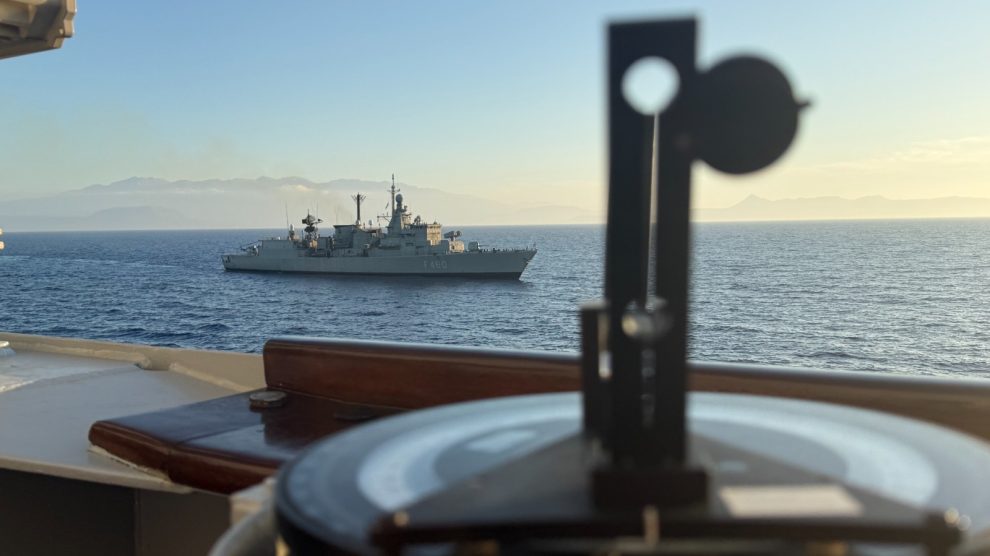
EUNAVFOR MED Operation IRINI has concluded NEREUS 2026, a ten-day surge of naval and air activities across the Central Mediterranean and the Aegean Sea. While officially focused on readiness and interoperability, the operation also offered a glimpse into IRINI’s gradual transformation into a broader EU maritime security instrument.
Why it matters: NEREUS 2026 was more than a readiness exercise.
- The operation offered a snapshot of how the European Union is trying to strengthen its maritime presence in the Mediterranean at a time when concerns over sanctions evasion, maritime security and strategic competition at sea are growing.
What happened: Between 3 and 12 June, IRINI coordinated naval assets from Italy, Greece and Romania, alongside air assets from Luxembourg, Poland, Italy and Greece.
- The operation covered the Central Mediterranean and the Aegean Sea and included activities ranging from Maritime Situational Awareness to surface warfare, air defence and responses to asymmetric threats.
- Part of the training was conducted with NATO’s Maritime Interdiction Operational Training Centre (NMIOTC) at Souda Bay in Greece.
- According to IRINI, the objective was to improve readiness, interoperability and the ability of participating forces to operate under common procedures.
The bigger picture: NEREUS comes as IRINI has become increasingly active at sea.
- In the past month, the mission carried out three flag verification boardings on the high seas involving the MV Nelsa, MV Oneiroi and MV Sandhya.
- Those inspections were conducted under Article 110 of the UN Convention on the Law of the Sea, which allows warships to verify a vessel’s nationality under specific circumstances.
- Officially, the boardings focused on verifying flag registration claims. In practice, they have become one of the clearest signs of IRINI’s expanding role in monitoring maritime networks linked to sanctions evasion and the so-called Russian shadow fleet.
What has changed: When IRINI was launched in 2020, its primary task was supporting the implementation of the UN arms embargo on Libya.
- That mandate remains unchanged. But the mission’s operational profile has gradually widened as Brussels has placed greater emphasis on Maritime Situational Awareness and on monitoring activities that affect regional maritime security.
- The recent boarding operations reflect that shift. European officials increasingly view maritime transparency as a security issue, particularly in areas where vessels operate under questionable registrations, opaque ownership structures or unclear identities.
Between presence and deterrence. The significance of NEREUS is less about the individual activities conducted during the ten-day surge and more about what they reveal about the EU’s approach.
- The operation demonstrated the ability of multiple member states to deploy and operate together under a common framework.
- It also reinforced a message that European officials have been sending more frequently in recent months: the EU wants to be seen as a credible maritime security provider in the Mediterranean.
- That does not mean IRINI is becoming a naval enforcement mission.
- But it does suggest that Brussels is looking for ways to translate maritime presence into operational credibility.
What we’re watching: A post-operation assessment will identify lessons learned and shape future surge activities.
- The broader question is whether initiatives such as NEREUS will remain periodic demonstrations of interoperability or become part of a more sustained European maritime posture.
- The recent boarding operations suggest the direction of travel is already becoming visible at sea.