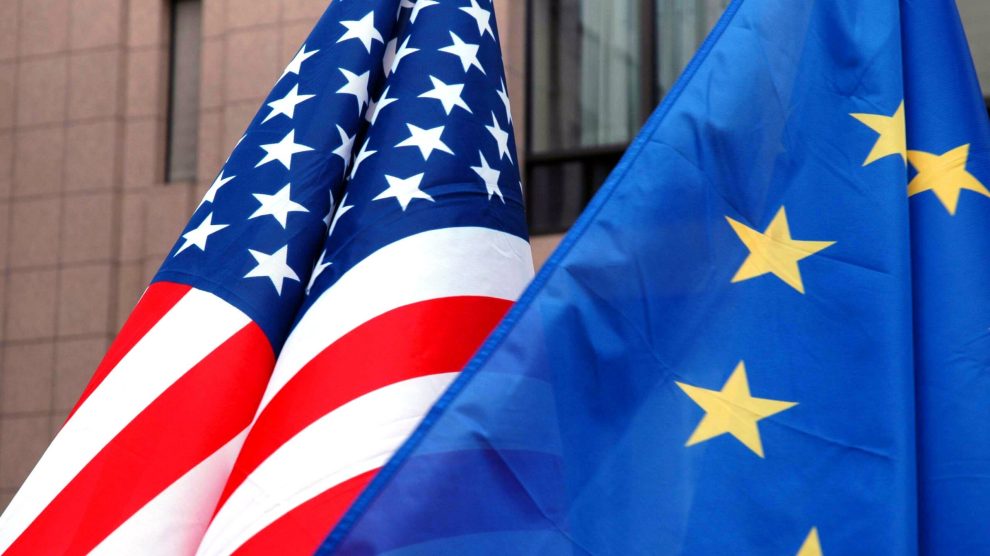
Washington’s new technology strategy is sending a message to Italy and other European allies: access to deeper U.S. cooperation will increasingly come with demands to align supply chains, investment, research and defense around shared strategic priorities.
For Italy, that could create opportunities in defense, aerospace and semiconductors — while imposing costs on industries with significant exposure to China.
- That is the picture drawn by Alberto Pagani, adjunct professor of Geopolitics and Geostrategy at the University of Bologna and an expert on intelligence and cognitive warfare, in the analysis of the Trump administration’s new National Security Science and Technology Strategy (NSSTS).
This analysis is part of a broader series by Formiche.net and Decode39 — covering dimensions ranging from the military to biotechnology and academy — on what is one of the most strategically consequential documents produced by the Trump administration.
Why it matters:
- Washington wants more from its allies. Pagani reads the strategy as an effort to turn NATO and traditional partnerships from primarily military alliances into a more coordinated economic and technological bloc.
- Italy has assets Washington needs. Defense, aerospace, advanced manufacturing and semiconductors could benefit from a push to make critical supply chains more resilient and geographically distributed.
- But alignment has a price. Italian machinery, robotics and automation companies could face tighter access to the Chinese market as technology controls expand.
- Trust could become the weak link. The U.S. is asking Europe for deeper technological alignment while, Pagani argues, pursuing a commercial and political approach that risks pushing Europeans in the opposite direction.
The big picture: Published by the White House Office of Science and Technology Policy in August, the NSSTS identifies four pillars — focus, resilience, agility and protection — and 14 critical and emerging technology areas.
- Artificial intelligence cuts across the entire agenda, alongside technologies including semiconductors, biotechnology, quantum computing and advanced nuclear energy.
- Pagani sees something larger at work. The strategy, he argues, formalizes a shift away from relying primarily on markets to determine the direction of technological development. Instead, Washington is increasingly deciding where public resources, regulatory flexibility and security protections should be concentrated.
- That shift did not begin with the NSSTS. Pagani traces it from the tariffs of the first Trump administration through the subsidies and export controls adopted under Biden to today’s more systematic attempt to connect technology policy with geopolitical competition.
What Washington wants: The demands on allies fall into four broad areas, according to Pagani.
- First, export controls. Washington wants partners to tighten restrictions on sensitive technologies reaching strategic rivals, with U.S. pressure on Dutch semiconductor equipment maker ASML serving as a precedent for a broader approach.
- Second, defense capacity. Allies seeking advanced cooperation in areas such as AI, nuclear technology, quantum and satellite systems are increasingly expected to demonstrate real industrial capabilities rather than simply consume American security.
- Third, de-risking from China. Telecommunications, batteries, pharmaceuticals and critical minerals are among the supply chains where Washington wants partners to reduce vulnerabilities, strengthen investment screening and coordinate more closely with the U.S.
- Fourth, research security. That means tighter scrutiny of funding recipients and projects, restrictions involving high-risk entities and closer counterintelligence cooperation with research institutions.
For European universities deeply interconnected with Chinese institutions through Horizon programs and bilateral partnerships, Pagani argues, that could mean growing pressure to move toward U.S.-style research-security standards.
Zoom in: Italy. Italy enters that equation with both potential winners and exposed sectors.
- Defense and aerospace are on the opportunity side. Pagani points to Leonardo and Fincantieri, as well as the network of precision-mechanics SMEs feeding their supply chains. European rearmament and greater NATO integration could reinforce that industrial base.
- The logic fits one of Washington’s priorities: reducing excessive geographic concentration in critical industries and building redundant production capacity.
- Semiconductors offer another opening. STMicroelectronics’ Italian facilities producing chips for automotive and energy applications sit in an area the strategy identifies as a priority for public-private investment.
- But Pagani cautions that this is an opportunity rather than an automatic benefit. Italy would have to move quickly enough to capture it.
- Rome is also moving closer to the U.S. approach in protecting strategic assets, with growing use of Golden Power to scrutinize foreign acquisitions involving areas such as networks, data and energy — a trajectory Pagani compares with Washington’s strengthening of CFIUS.
Follow the risk. China is where the costs become clearer. Italian SMEs producing machinery, robotics and automation remain exposed to Chinese demand. A progressive tightening of technology restrictions could narrow their sales channels.
- That makes alignment with Washington a much more complicated calculation for Rome than it appears from the defense side alone.
- Pagani frames the Italian choice as increasingly sector-specific: where should Rome align most rapidly because Italian and Atlantic interests converge, and where does alignment create immediate economic costs?
- Defense and semiconductors fall closer to the first category. China-exposed manufacturing supply chains make the second considerably harder.
The European squeeze. The dilemma is even broader for Brussels.
- Pagani describes Europe as caught between U.S. subsidies capable of attracting investment and industrial capacity across the Atlantic and tighter restrictions on exports to China, one of the world’s largest markets.
- Europe also lacks a federal budget comparable to Washington’s. The EU Chips Act consequently depends heavily on individual countries’ fiscal capacity, creating inevitable differences between Germany, France and other member states.
- The emerging choice, in Pagani’s framing, is between Europe’s declared ambition for strategic autonomy and practical interoperability with the American technology-control system.
The academic question. There is another vulnerability closer to home.
- Pagani argues that European universities risk excluding themselves from an increasingly important source of technological investment because many institutions restrict participation in military research on ethical grounds.
- His point is that many technologies that later became widely used in civilian life passed through publicly funded military or dual-use programs during their early, high-risk development.
If U.S. and allied funding increasingly moves toward dual-use research in critical technologies, European universities maintaining strict barriers between academic and defense research could find themselves cut off from part of that investment.
- For Europe, Pagani argues, reconsidering the relationship between academia and defense will therefore become part of the wider technological competition.
The transatlantic paradox. But Washington faces a contradiction of its own.
- The U.S. is asking European allies for unprecedented coordination while the Trump administration, in Pagani’s assessment, has simultaneously pursued tariffs, criticized EU institutions and often preferred bilateral dealings with European capitals over negotiations with Brussels.
- That matters because technological alignment ultimately depends on political trust. Pagani argues that a stronger European defense pillar, operating as the European component of NATO rather than separately from it, would actually serve the industrial and technological coordination Washington says it wants.
- Yet he sees little U.S. effort to encourage that European cohesion. The risk is that pressure designed to bring Europe closer instead strengthens those arguing for greater distance from Washington.
What we’re watching. For Italy, the question is becoming less whether to participate in the emerging U.S.-led technology ecosystem than where the benefits of alignment outweigh its costs.
- Defense, aerospace and semiconductors offer relatively clear areas of convergence. Manufacturing industries dependent on China present a much harder trade-off.
- But Pagani’s analysis ultimately puts the biggest variable outside Rome’s control: Washington itself.
The bottom line: The U.S. is asking Italy to become more than a security ally. It wants a partner in a coordinated technological and industrial ecosystem. Whether Rome can embrace that model will depend not only on economics and China, but on whether Washington can build the political trust needed to sustain it.