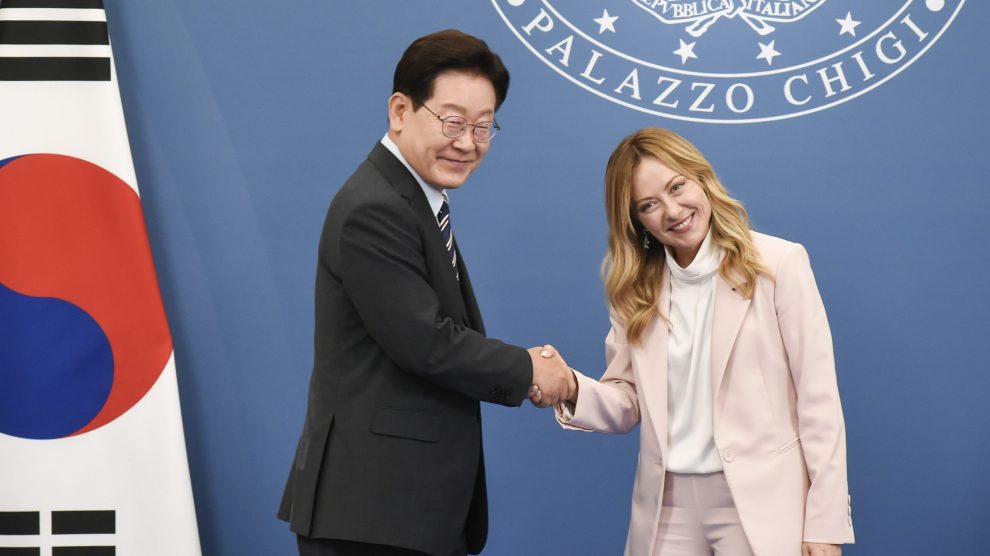
Italian Prime Minister Giorgia Meloni and South Korean President Lee Jae Myung on Friday elevated bilateral relations to a Special Strategic Partnership, deepening cooperation in advanced technologies, industry, security and economic policy as both countries seek to strengthen their position in an increasingly competitive geopolitical environment.
The move came during Lee’s state visit to Italy and follows Meloni’s trip to Seoul on January 19. The two leaders also adopted a 2026-2030 Action Plan aimed at expanding cooperation in political, economic, scientific, technological and cultural fields, as well as security and defense.
Why it matters: Italy and South Korea are expanding cooperation in sectors considered critical to economic competitiveness and technological resilience.
- Semiconductors, artificial intelligence and other advanced technologies were at the center of the talks.
- The upgrade adds a stronger political and security dimension to a relationship traditionally driven by economic ties.
- The discussions linked bilateral cooperation with broader strategic issues, from Indo-Pacific stability to maritime security in the Strait of Hormuz.
The big picture: The decision to elevate ties to a Special Strategic Partnership reflects a broader effort by Rome and Seoul to build a more structured framework for cooperation at a time when technology, supply chains and economic security are becoming increasingly intertwined with geopolitics.
- Italian officials presented the agreement as a platform to deepen collaboration across strategic sectors while strengthening political coordination on regional and global issues.
Zoom in: Technology and industry. Meloni and Lee discussed expanding cooperation in semiconductors and industrial partnerships, with a focus on sectors where both countries see significant strategic potential:
- Artificial intelligence
- Space
- Automotive
- Energy
The emphasis on high-tech industries comes as governments worldwide seek to secure access to critical technologies and strengthen industrial ecosystems linked to future economic growth.
During the High-Level Economic Forum between Italy and South Korea held in Rome, Foreign Minister Antonio Tajani placed particular emphasis on critical minerals, describing them as “crucial for our companies” and a challenge that Italy and South Korea intend to address together, including through joint initiatives and partnerships in Africa and Latin America, regions he identified as strategically important for both economies.
- Tajani stressed that Italy is “at the forefront of efforts to place critical minerals at the center of the European agenda,” while also promoting closer cooperation across the Atlantic. He welcomed the signing of the EU-U.S. Memorandum on critical raw materials and said Italy was following with “great attention and interest” the Pax Silica initiative, of which South Korea is a participant.
- The minister also underlined the convergence between the Italian and South Korean economic models, noting that both countries are export-oriented manufacturing economies with a shared interest in strengthening supply-chain security and securing access to strategic resources.
Beyond bilateral ties. The two leaders also exchanged views on major international dossiers.
- According to the Italian government, they reaffirmed a shared commitment to the stability and prosperity of the Indo-Pacific and expressed a common intention to contribute to ongoing efforts to reopen the Strait of Hormuz, a vital corridor for global trade and energy flows.
- The discussion underscored how security concerns in distant regions are increasingly affecting the economic and strategic calculations of both European and Asian partners.
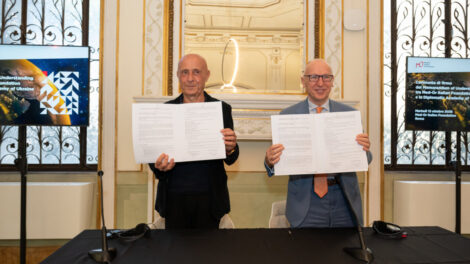
Follow the agreements. Four memoranda of understanding were exchanged on the sidelines of the meeting, covering development cooperation, science and advanced technologies, the social and solidarity economy, and small and medium-sized enterprises.
- The agreements involved senior officials from both governments, including Foreign Minister Antonio Tajani, University and Research Minister Anna Maria Bernini, Deputy Labor Minister Maria Teresa Bellucci and Deputy Minister for Enterprises Valentino Valentini, alongside their South Korean counterparts.
What we’re watching: The meeting comes as Italy intensifies engagement with key Indo-Pacific partners on issues that increasingly cut across economics, technology and security.
- On Monday, Meloni is due to host Japanese Prime Minister Sanae Takaichi in Rome ahead of the G7 summit. Tokyo is expected to promote an updated vision of the Free and Open Indo-Pacific that places greater emphasis on economic security, resilient supply chains, critical technologies and energy security.
- The overlap with themes discussed during Lee’s visit highlights growing convergence between European and Asian partners on challenges that extend well beyond traditional regional boundaries.
The bottom line: The Italy-South Korea strategic partnership reflects a broader trend: advanced technologies, supply-chain resilience, energy security and maritime stability are increasingly being treated as part of the same strategic agenda.
- With Meloni set to meet both the South Korean and Japanese leaders within days, Rome is positioning itself as an increasingly active European interlocutor in the evolving dialogue between Europe and the Indo-Pacific.