
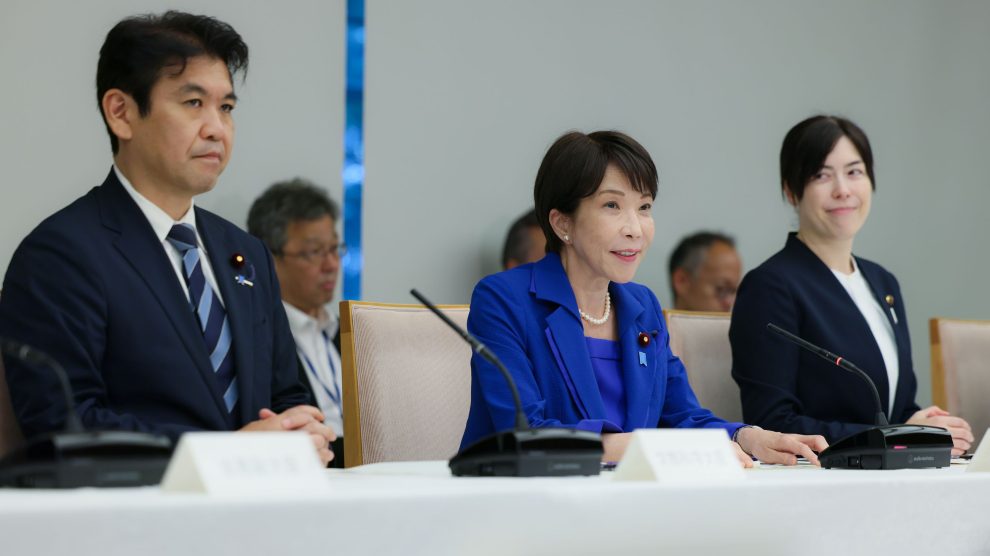
Japanese Prime Minister Sanae Takaichi will meet Italian Prime Minister Giorgia Meloni in Rome on Monday, just days before the G7 summit in France, as Tokyo seeks to broaden its Indo-Pacific agenda into a wider framework for economic and strategic security.
The big idea: Japan is increasingly presenting the challenges of energy security, supply chains, critical technologies and maritime stability as part of the same strategic conversation. Rome has emerged as one of the European capitals where that message is likely to find a receptive audience.
Why it matters: Tokyo wants to position its updated Free and Open Indo-Pacific (FOIP) strategy as more than a regional concept.
- Energy security and economic resilience are pushing European and Asian priorities closer together.
- Italy and Japan have developed growing convergence on critical technologies, strategic supply chains, defense, energy and economic security.
- The G7 offers Japan an opportunity to test support for a broader vision of global security governance.
The big picture: Takaichi’s European trip comes as Japan seeks to translate its regional priorities into proposals for a wider international agenda.
- According to the policy orientations Tokyo plans to bring to the G7, Japan will present itself as an Asian country particularly exposed to the consequences of Middle East tensions and potential disruptions to global energy markets.
- That concern resonates in Italy: Rome has repeatedly highlighted the risks that instability in the Middle East poses to energy security and international trade. Italian officials have also stressed the importance of turning the current ceasefire between the United States, Israel and Iran into a more durable arrangement.
Against that backdrop, Japan is expected to promote three initiatives at the G7:
- defending open and transparent trade against what it sees as unjustified export restrictions;
- strengthening strategic oil reserves through closer cooperation with the International Energy Agency;
- expanding dialogue between producing and consuming countries.
Zoom in: Rome. The meeting between Takaichi and Meloni is expected to cover both bilateral ties and the broader international environment. For Tokyo, Italy represents one of the European partners with which strategic alignment has deepened in recent years.
- Areas of growing convergence include:
- economic security;
- strategic supply chains;
- critical technologies;
- energy;
- defense cooperation;
- Indo-Pacific stability.
- The political relationship between the two leaders also provides favorable ground for dialogue. Both lead conservative governments and have placed growing emphasis on national resilience, protection of strategic infrastructure and the reduction of economic vulnerabilities.
- While the fact that they are currently the only women leading G7 countries adds visibility to the relationship, the significance of the meeting appears to lie primarily in its strategic content.
The between the lines: The energy agenda is only part of the story. Behind Takaichi’s European mission lies a broader effort to gauge how far key European partners are prepared to embrace Japan’s updated vision of international security.
- Tokyo’s focus appears to be on building closer cooperation with governments that view economic security and strategic competition as increasingly central policy challenges.
- In that context, the Italian, and British, stops carry importance beyond bilateral diplomacy, even as discussions feed into the wider G7 framework.
The new FOIP. A key reference point is Takaichi’s foreign policy speech in Hanoi on May 2.
- There, the Japanese leader outlined an evolution of the Free and Open Indo-Pacific, a concept originally developed by her political mentor, the late Shinzo Abe.
- The updated version expands the initiative’s scope well beyond traditional security concerns.
Alongside regional stability and maritime security, Tokyo now places growing emphasis on:
- artificial intelligence and data governance;
- resilient energy and critical goods supply chains;
- common rules for emerging economic sectors;
- public-private cooperation;
- economic security.
The result is a framework in which economic resilience occupies a role increasingly comparable to that of traditional security.
The Europe angle. Japan’s G7 proposals can be read as practical applications of this updated FOIP. The defense of freedom of navigation — including security in the Strait of Hormuz — reflects the importance of open maritime routes.
- Efforts to strengthen energy reserves aim to improve resilience among import-dependent economies.
- Dialogue between producers and consumers is intended to create mechanisms of cooperation in an international system increasingly shaped by fragmentation.
- The broader question for Tokyo is whether a vision developed in the Indo-Pacific can gain wider acceptance among geographically distant partners facing many of the same vulnerabilities.
- Europe’s energy shocks, supply chain disruptions and technological competition have narrowed the gap between European and Asian strategic priorities.
The Indo-Mediterranean connection. Rome occupies a distinctive place in that discussion. The concept of the Indo-Mediterranean, recently referenced by Meloni and Indian Prime Minister Narendra Modi as a space of growing strategic integration, offers a potential bridge between European and Indo-Pacific priorities.
- If Abe’s 2007 “Confluence of the Two Seas” speech in New Delhi provided the intellectual foundation for viewing the Indo-Pacific as a single geopolitical theater, the latest evolution of FOIP reflects a different reality.
- Energy networks, value chains, critical infrastructure and maritime security increasingly connect the Pacific, the Indian Ocean and the Mediterranean.
The bottom line: Takaichi arrives in Rome seeking more than bilateral coordination ahead of the G7. Japan is testing whether European partners are prepared to view energy security, supply chains, technology and maritime stability as parts of a shared strategic agenda — and whether that agenda can become a common framework linking Asia and Europe.
(Photo: X, @takaichi_sanae)