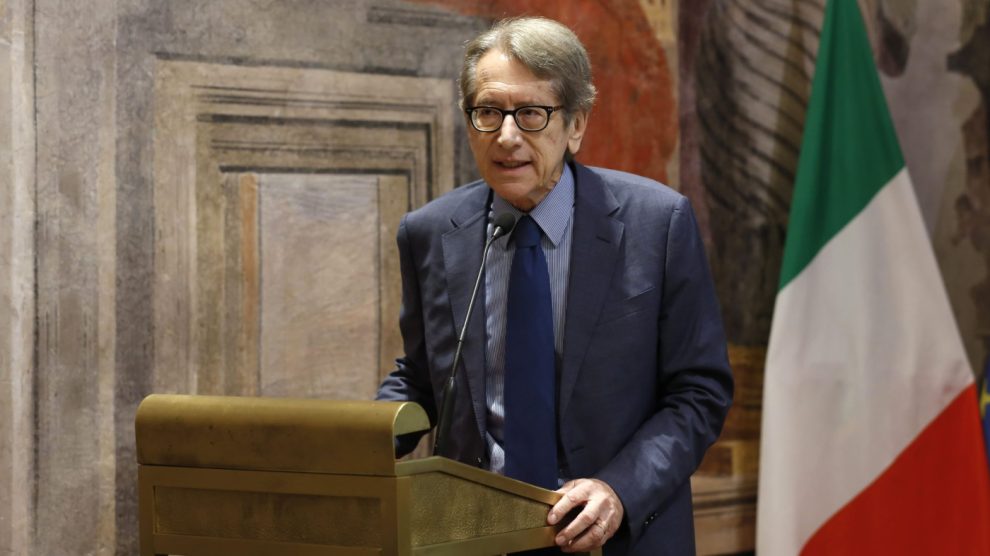
The summary: The meeting, organised at the initiative of the U.S. Embassy in Rome, brought together Terzi, chair of the Italian Senate’s EU Policies Committee, and senior staffer of the U.S. House Select Committee on the Chinese Communist Party.
- According to Terzi, discussions centred on alleged coercive, covert and illicit activities linked to Chinese state-affiliated actors abroad, and on the need for greater transatlantic coordination to counter them.
Why it matters. The meeting reflects increasing alignment between parts of the Italian political establishment and Washington on concerns related to Chinese influence operations.
- It places foreign information manipulation and interference (FIMI) higher on the bilateral agenda.
- The discussion linked disinformation, political influence efforts and alleged intimidation of overseas Chinese communities.
- It suggests growing interest in parliamentary-level cooperation between Italy and the U.S. on security and resilience issues.
The big picture. The U.S. House Select Committee on the Chinese Communist Party was established to examine challenges posed by Beijing and to provide recommendations to Congress.
- According to Terzi, members of the delegation outlined concerns about activities conducted abroad by entities including the Chinese Communist Party’s United Front Work Department, which the delegation described as engaging in coercive and influence operations in Europe and elsewhere.
- Terzi said the discussion highlighted what participants viewed as extensive Chinese disinformation campaigns that exploit the openness of Western democratic societies and affect institutions, social cohesion and national resilience.
Zoom in. FARA and foreign influence
- A key point raised by the U.S. delegation, according to Terzi, was the role of the Foreign Agents Registration Act (FARA), the U.S. law requiring individuals acting on behalf of foreign governments or interests to disclose those activities publicly.
- Terzi described the legislation as an effective transparency tool, noting that violations can carry criminal penalties.
- The reference comes amid broader debates in Europe over how democratic systems should address foreign influence while preserving civil liberties and political openness.
Concerns over overseas Chinese communities:
- Terzi also said U.S. lawmakers expressed concern about alleged clandestine Chinese police stations operating abroad and their impact on Chinese communities outside China.
- The issue, he said, was discussed in relation to Chinese communities in Europe, including Italy, with concerns centered on surveillance and intimidation activities.
Between the lines. Terzi used the meeting to highlight work already carried out in the Italian Senate on FIMI — foreign information manipulation and interference.
- He noted that the Senate’s 3rd and 4th Committees recently adopted a resolution containing recommendations aimed at preventing and countering foreign disinformation and cognitive manipulation strategies following hearings with experts.
The expert take. Laura Harth, CitW Director at Safeguard Defenders, said:
- “The Select Committee is an incredible resource of insights on the multitude of threats posed by the CCP both at home and abroad, and of actions to counter them in defense of the freedoms and sovereignty we hold dear.
- By contrast, Italy is the only (!) G7 country that not only hasn’t adopted a single policy to counter the Chinese Communist Party’s malign influence and interference… Parliament hasn’t even begun discussing these issues!
- This inaction only emboldens the CCP, which – as the Government well knows but chooses to ignore – has a sprawling proxy network in Italy and does not refrain from increasingly aggressive behaviour on Italian soil.”
What to watch. The two sides agreed on the value of continuing regular consultations on these issues, including through parliamentary channels.
- The meeting points to a broader effort by lawmakers on both sides of the Atlantic to coordinate responses to foreign influence operations, with China increasingly at the center of those discussions.
Bottom line. The Rome meeting underscored growing concern among Italian and U.S. lawmakers over Chinese influence activities and signaled support for deeper transatlantic cooperation on disinformation, foreign interference and democratic resilience.