Why it matters: Jacob Helberg is the U.S. Under Secretary of State for Economic Affairs and the architect of the Pax Silica initiative. His latest manifesto against the U.N.’s vision of “digital sovereignty” is more than an opinion piece on AI governance. Read alongside this week’s Pax Silica Summit in Washington — and Italy’s signature of the Joint Statement on AI Opportunity — it offers the clearest articulation yet of how the Trump administration wants to organize the West’s technological future: not through national self-sufficiency, but through trusted interdependence.
- Italy moved one step closer to Washington’s emerging technology strategy this week.
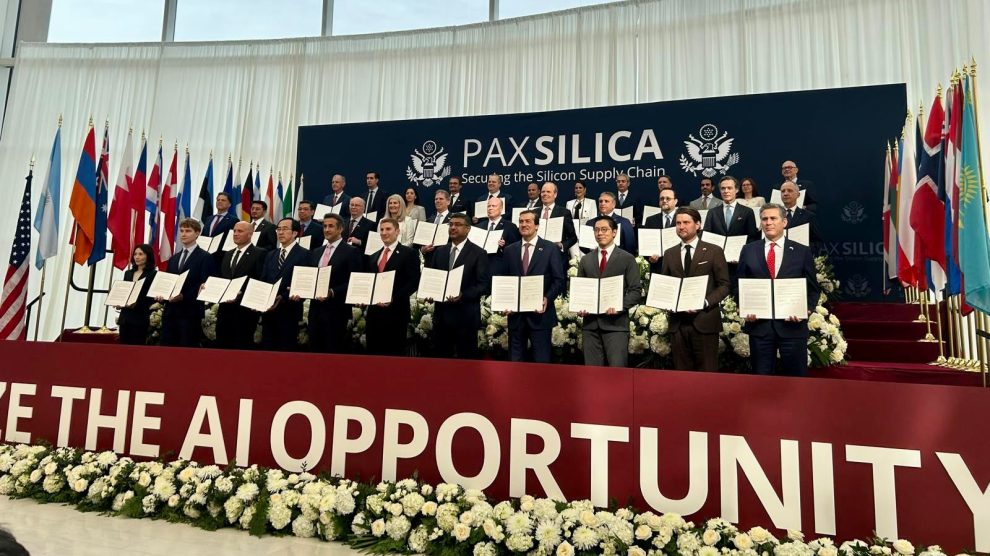
At the Pax Silica Summit convened by the U.S. State Department, Ambassador Armando Varricchio, Special Envoy for Innovation and New Technologies to Foreign Minister Antonio Tajani, signed the Joint Statement on AI Opportunity on behalf of Italy. The declaration commits participating partners to deepen cooperation on artificial intelligence, trusted technologies and resilient supply chains.
The announcement provides an important backdrop to an essay published just days earlier by Jacob Helberg, the U.S. Under Secretary of State for Economic Affairs and the public face of Pax Silica. Read together, the speech and the summit tell a broader story: the United States is moving from debating AI governance to building a coalition around AI innovation.
The core of Helberg’s argument is straightforward. Countries that try to build every layer of an AI stack at home—from compute infrastructure to frontier models—are likely to spend enormous sums reproducing technologies that already exist elsewhere. The result, he argues, is duplication rather than innovation.
What he said: Published on June 23, Helberg’s essay landed just as Pax Silica, the U.S.-led initiative he helped design, moved into the spotlight during its Washington summit. The initiative aims to assemble a network of trusted partners across the AI supply chain, from semiconductors and critical minerals to energy and advanced manufacturing.
- Helberg’s target is the model of “digital sovereignty” promoted through U.N. initiatives on digital governance. In his view, treating technological sovereignty as the ability to replicate an entire national technology stack risks creating dozens of parallel ecosystems competing to build yesterday’s breakthroughs instead of tomorrow’s.
His alternative is what he calls “innovation sovereignty.” The distinction is more than semantic. A country, Helberg argues, is not sovereign because it can reproduce existing technologies. It is sovereign because it can contribute new ones. Competitive advantage comes not from rebuilding what already exists but from continuously generating new capabilities through research, entrepreneurship and industrial learning.
That argument reflects a broader shift in American industrial strategy. Washington has spent the past several years strengthening domestic technological capabilities. At the same time, it has increasingly moved away from the assumption that every segment of critical supply chains must be recreated inside the United States. The emphasis is instead on building a trusted ecosystem in which allies specialize according to their comparative strengths.
That is the logic behind Pax Silica. Rather than a technological fortress, it is conceived as a coalition of complementary capabilities. One partner contributes compute, another industrial manufacturing, another research, another critical minerals or energy infrastructure. The objective is integration, not duplication.
The timing is hardly accidental. During this week’s summit, Washington announced that Pax Silica would expand to 24 participating countries, adding new European partners — including the Netherlands, Germany and Greece — as well as countries from Latin America and Central Asia.
- Speaking to the Financial Times, Helberg explained the rationale behind the initiative in broader geopolitical terms:“There’s no grouping that’s purpose-built to manage the AI economy at a time when AI is revolutionising the shape of the global economy.”
- That helps explain why the administration sees Pax Silica not simply as another diplomatic forum, but as an institutional answer to a gap left by existing formats such as the G7 and G20.
The bigger picture: The broader message is directed at America’s allies. Much of Europe continues to frame technology policy around the concept of “digital sovereignty.” Washington increasingly appears to be asking a different question: what unique contribution can each ally make to a shared technology ecosystem?
- The difference reshapes industrial policy itself. Instead of encouraging dozens of national champions to develop similar technologies, the objective becomes identifying complementary specializations while building trusted strategic interdependence across the alliance.
Italy fits in. Viewed through that lens, the ongoing U.S.-Italy dialogue on Trusted Technologies takes on broader significance.
- The initiative — coordinated by Roberto Baldoni, Senior Advisor on Technology and Cybersecurity Policy to the Italian Ambassador to the United States, together with the Krach Institute of Tech Diplomacy and the SERICS Foundation — is less about bilateral cooperation than about defining Italy’s place inside an emerging Western technology architecture.
- The underlying question is not simply how to coordinate research or industrial policy. It is how each trusted partner can create the greatest value within a shared ecosystem while preserving control over strategically sensitive technologies and reducing dependence on systemic competitors.
Italy followed a parallel track. At the Today’s summit, Ambassador Varricchio signed the Joint Statement on AI Opportunity, reinforcing cooperation with the United States on AI, trusted technologies and resilient supply chains. While this is distinct from formal participation in Pax Silica, it places Italy squarely within the diplomatic architecture Washington is building around trusted technology partnerships.
- Italy’s signature gives that framework immediate practical relevance. The U.S.-Italy dialogue on Trusted Technologies is no longer simply a bilateral initiative promoted by diplomats and policy experts. It increasingly appears aligned with the broader architecture emerging through Pax Silica, suggesting that Rome is positioning itself as one of Washington’s preferred partners in shaping trusted AI ecosystems.
EU strategic dilemma. Whether this vision can coexist with Europe’s ambitions for strategic autonomy remains an open debate.
- Many European governments continue to view domestic technological capacity as essential for reducing external dependencies. Helberg turns that argument on its head. The greater vulnerability, he suggests, lies in spending scarce resources replicating technologies others already produce instead of investing in the next generation of innovation—the one that ultimately creates lasting strategic advantage.
The bottom line: Helberg’s essay is best understood not as a critique of the U.N.’s digital agenda, but as a blueprint for a new Western technology order.
- Italy’s participation in this week’s AI Opportunity declaration suggests that Washington’s vision is already moving from theory to diplomacy. If Pax Silica evolves into the organizing framework for American technology diplomacy, bilateral and minilateral initiatives such as the U.S.-Italy dialogue on Trusted Technologies could become the mechanisms through which Washington translates its strategy into practical cooperation with trusted allies.
- In that vision, competitiveness will depend less on national technological self-sufficiency than on becoming an indispensable node inside a trusted innovation ecosystem.
(Photo: X, @ItalyinUS)