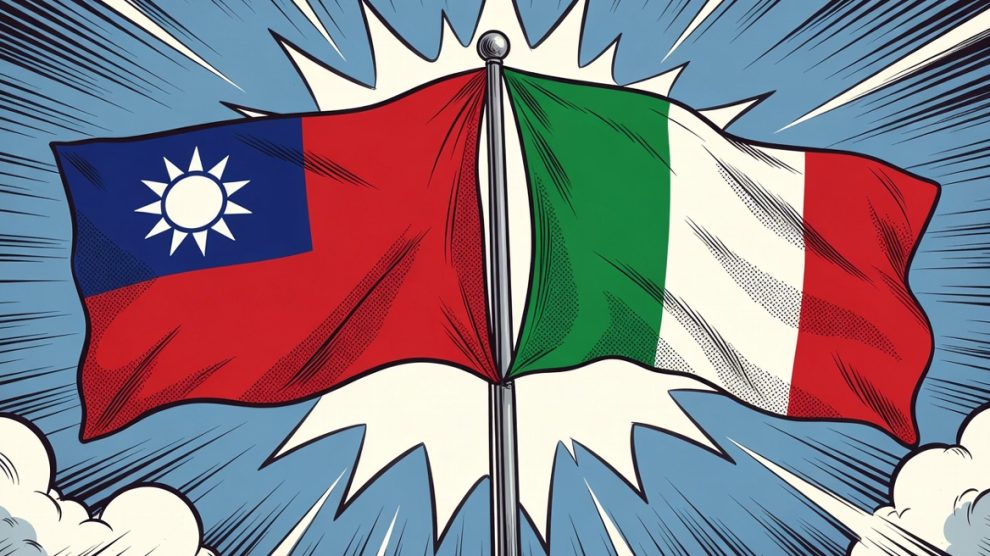
While a high-level Taiwanese delegation was in Milan this week to deepen economic ties with Lombardy, another meeting in Rome helped explain the broader strategic significance of that visit.
Paolo Formentini, Vice Chair of the Foreign Affairs Committee of Italy’s Chamber of Deputies, met former Taiwanese President Tsai Ing-wen, who was visiting Italy to attend an event on women’s leadership. The meeting also included MP Eugenio Zoffili, Vice President of the OSCE Parliamentary Assembly, and members of Italy’s opposition.
- According to Formentini, the discussion went far beyond semiconductors.
- “It was a very frank and open conversation,” he told Decode39. “Without going into sensitive details, we discussed a wide range of issues, starting with the importance of preserving stability across the Taiwan Strait. This is no longer an issue concerning only Asia. Europe has a direct interest in the security of the region, its maritime corridors and the strategic chokepoints through which essential goods, technologies and industrial components flow.”
Why Europe should care. The Taiwan Strait is one of the world’s busiest maritime routes. A significant share of Asia-Pacific trade—including advanced semiconductor shipments—passes through its waters every year.
- Any disruption would have immediate consequences for Europe. While the EU has limited influence over a potential crisis across the Strait, it would bear substantial economic costs. Bloomberg Economics has estimated that a major conflict could generate losses of up to $2 trillion globally in its first year, with Germany among the economies hardest hit.
- Formentini argues that this is why semiconductors should no longer be viewed simply as an industrial issue.
- “Semiconductors are now an integral part of geopolitical competition because they enable artificial intelligence and every other critical technology. Economic security increasingly depends on building resilient and trusted supply chains.”
Lombardy’s opportunity. That strategic vision was reflected in the recent conference “Italy–Taiwan: Beyond Technology, Economic Opportunities and Cultural Exchange,” hosted at Palazzo Pirelli by the Lombardy Regional Council.
- The Taiwanese delegation, led by Foreign Minister Lin Chia-Lung, included senior representatives from the Industrial Technology Research Institute (ITRI), the Taiwan Electrical and Electronic Manufacturers’ Association and HCG Corporation.
- Formentini believes Italy has an opportunity to strengthen its role. “I found a genuine willingness to deepen cooperation. President Tsai herself acknowledged that Italy’s foreign policy is attracting greater attention than in the past. I believe our country can play a much more active role by leveraging the industrial complementarities that already exist.”
- Among those complementarities, Lombardy stands out. “Taiwan sees Lombardy as a natural partner. On one side there is one of the world’s leading semiconductor ecosystems; on the other, one of Europe’s strongest manufacturing regions, with excellence in advanced machinery, automation and industrial engineering. These value chains complement each other.”
More than chips. Perhaps the most revealing part of the conversation concerned a challenge that receives far less international attention.
- “President Tsai explained that Taiwan is facing a growing shortage of skilled workers. It is an extremely dynamic economy that needs new talent and additional human resources. That creates opportunities for cooperation with partners such as Italy—not only in industry but also in education and workforce development.”
- For Formentini, cooperation between Rome and Taipei ultimately goes beyond economics. “Working together among advanced democracies means building more resilient supply chains, but also defending a model based on economic freedom, mutual trust and shared rules. This goes well beyond semiconductor supply. It is a strategic—and ultimately existential—challenge.”
- As Europe seeks to diversify critical supply chains without retreating from open markets, the strengthening relationship between Taiwan and Lombardy may offer an example of how industrial cooperation can become an instrument of both competitiveness and strategic resilience.
Democracy under pressure. Formentini says the conversation with Tsai closely echoed discussions he had only days earlier with bipartisan congressional staff from the U.S. House Select Committee on the Chinese Communist Party, where Italian lawmakers presented the work of Parliament’s Indo-Pacific Committee.
- “There is a much stronger awareness in Washington of hybrid threats, foreign interference, disinformation and the need to protect strategic investments,” he says. “In Italy, these issues still struggle to receive the same level of attention, even though they are becoming central to our national security.”
- The message was remarkably consistent with Tsai’s own recent public remarks. In an interview with the French magazine L’Express, the former president argued that Taiwan must prepare not only for military pressure but also for information warfare, economic coercion and gray-zone activities. She identified three pillars for Taiwan’s resilience: strengthening self-defense, increasing societal resilience and deepening cooperation with democratic partners.
- Formentini believes this convergence is significant: “Today, protecting democracy also means protecting supply chains, strategic investments and the integrity of our information space. These are no longer separate issues.”