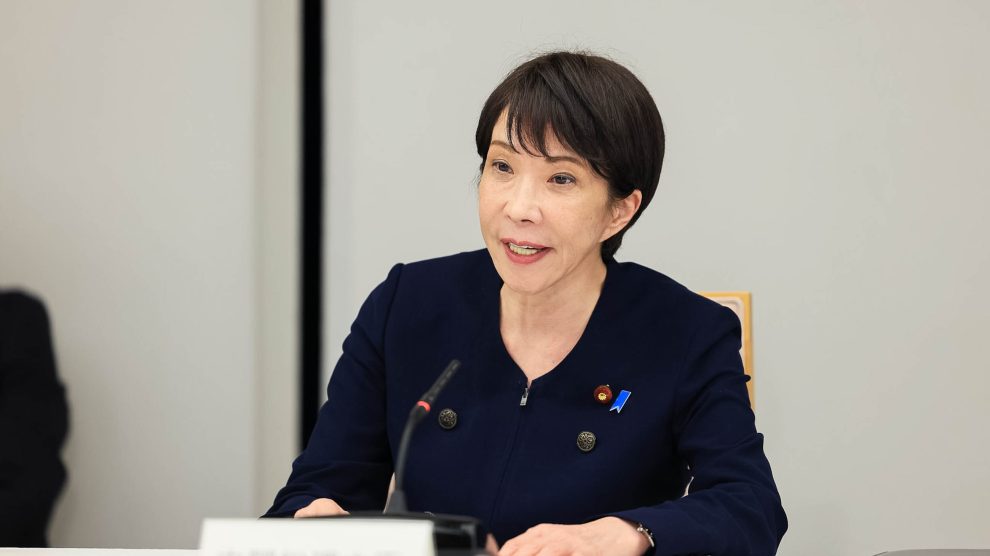
Japanese Prime Minister Sanae Takaichi will travel to New Delhi from July 1 to 3 for the 16th India-Japan Annual Summit, her first official visit to India since taking office last October.
What’s happening: Meeting Prime Minister Narendra Modi, Takaichi is expected to discuss a broad agenda spanning trade, investment, defence, energy security, critical minerals, semiconductors and artificial intelligence. Japanese officials are also preparing agreements on LNG cooperation and closer coordination on strategic supply chains, while a large business delegation accompanying the prime minister underscores the growing economic dimension of the bilateral partnership.
- The visit follows Modi’s trip to Tokyo last year and comes against a rapidly evolving geopolitical backdrop, shaped by renewed tensions in the Middle East, intensifying technological competition and shifting strategic alignments across the Indo-Pacific.
Why it matters: The summit is more than another “milestone” in India-Japan relations.
- It offers the clearest indication yet of how Tokyo intends to operationalise the updated version of its Free and Open Indo-Pacific (FOIP) vision. Rather than focusing primarily on maritime security and freedom of navigation, Japan increasingly frames the Indo-Pacific through the lens of resilience: secure energy supplies, trusted technology partnerships, resilient supply chains and industrial cooperation.
- The visit also carries a broader European dimension. Only days before travelling to India, Takaichi presented her updated FOIP vision in Rome during pre-G7 talks with Prime Minister Giorgia Meloni, asking Italy to help promote the strategy across Europe. With both Meloni and Modi having met in recent weeks, and with growing attention to the “Indo-Mediterranean” concept, Rome is emerging as a natural European interlocutor in Tokyo-Delhi’s effort to build wider support for the evolving Indo-Pacific agenda.
Back where the idea began. The symbolism of Takaichi’s visit extends well beyond the annual summit.
- This year marks the tenth anniversary of the FOIP, officially launched by former Prime Minister Shinzo Abe at the Tokyo International Conference on African Development (TICAD VI) in Nairobi in August 2016.
- Its intellectual foundations, however, were laid almost a decade earlier — and in the same city where Takaichi is now meeting Modi.
- In August 2007, Abe addressed the Indian Parliament with his landmark speech, Confluence of the Two Seas, describing the Indian and Pacific Oceans as a single strategic space linked by democracy, economic openness and the rule of law. That speech would later provide the conceptual basis for what became the FOIP.
- Takaichi, widely regarded as Abe’s political heir on security and foreign policy, has sought to preserve those principles while adapting the strategy to a markedly different international environment.
From principles to resilience. The updated FOIP does not abandon its original pillars of openness, freedom of navigation and international law. Instead, it expands them.
- Wars, economic coercion, hybrid and cyber threats, supply chain disruptions and technological competition have broadened Tokyo’s definition of security. Resilience has consequently become the organising concept of Japan’s Indo-Pacific strategy.
The agenda in New Delhi reflects that evolution almost point by point. Japan and India are expected to establish a joint task force on liquefied natural gas stockpiling in response to growing concerns over energy security following instability in the Middle East.
- Critical minerals, semiconductors and advanced manufacturing feature prominently as both governments seek to diversify supply chains and reduce strategic vulnerabilities.
Artificial intelligence is becoming another central pillar. Tokyo increasingly sees India not only as a technology market but as a partner capable of shaping AI research, standards and governance. This fits within Japan’s broader ambition to develop a network of trusted technology partners that extends beyond the US-China technological rivalry and supports the Digital Corridor envisioned in the updated FOIP.
- The presence of a major Japanese business delegation further reinforces the message that private capital and industrial partnerships are becoming essential instruments of Japan’s strategic statecraft.
China in the background. China is not the explicit focus of the summit, but it remains impossible to separate the agenda from the broader regional balance.
- Japan’s concerns over Chinese military activity and economic coercion have grown steadily in recent years, while India continues to manage recurring tensions with Beijing along their disputed Himalayan border.
- Yet Tokyo’s updated FOIP deliberately avoids presenting itself as a containment strategy. Instead, Japan continues to describe it as an inclusive framework designed to strengthen partners’ resilience without forcing countries into rigid geopolitical alignments — a message that resonates with India’s long-standing preference for strategic autonomy.
Italy’s POV: For Italy, the summit illustrates how the Indo-Pacific is becoming increasingly relevant to European economic and security interests, and how the Indo-Mediterranean can serve as the bridge connecting Rome’s priorities to the global stage.
- Italy already cooperates closely with Tokyo through initiatives such as the Global Combat Air Programme (GCAP), while recent discussions between Meloni and Takaichi have expanded the agenda to include economic security, critical minerals, artificial intelligence, cybersecurity and resilient infrastructure. At the same time, Rome has been steadily deepening its engagement with India, particularly in areas such as energy transition, digital innovation and industrial partnerships.
- If New Delhi is becoming the principal Asian testing ground for Japan’s updated FOIP, Italy has the opportunity to position itself as one of its key European partners — helping connect Indo-Pacific priorities with a broader Euro-Mediterranean strategic agenda.
(Photo: X, @takaichi_sanae)