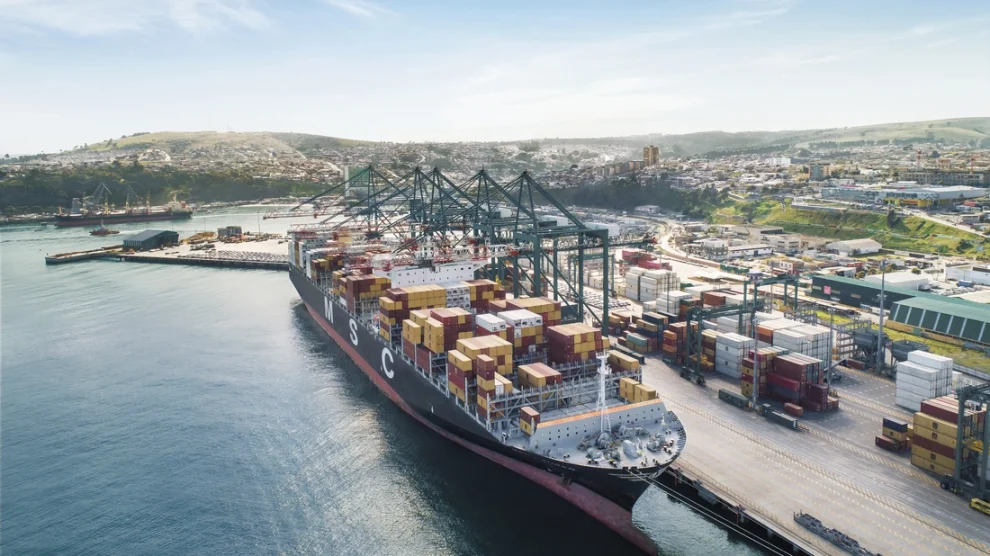
MSC’s deal is more than a port investment. It strengthens a long-term partnership between the world’s largest container shipping company and India’s largest private port operator, while underscoring the growing strategic importance of commercial infrastructure across the Indian Ocean.
Why it matters: MSC gains a strategic position in one of India’s most important emerging container hubs.
- The investment supports India’s effort to capture cargo long handled by regional transshipment ports.
- The deal reflects the increasing geopolitical importance of ports as critical nodes in global supply chains.
The deal: MSC completed the acquisition through its terminal operating arm, Terminal Investment Limited (TiL), purchasing a 49% stake in Vizhinjam for about $1.4 billion.
- The transaction includes an upfront payment of $539 million, followed by $858 million once the port’s expansion is completed by December 2028.
- Adani Ports will retain 51% ownership and management control of the joint venture.
The big picture: The transaction reflects India’s broader effort to develop domestic transshipment capacity after decades of relying on regional hubs such as Colombo and Singapore.
- Located on India’s southern coast, Vizhinjam sits just off the main East-West shipping corridor linking Europe, the Middle East and Asia through the Suez Canal and the Strait of Malacca, allowing ultra-large container ships to call with minimal deviation from their routes. Few ports are as well positioned to capture cargo moving across the Indian Ocean.
- MSC’s investment also reinforces the port’s commercial prospects. As both a shareholder and one of the world’s largest shipping operators, the company has a stronger incentive to route cargo through Vizhinjam as the terminal expands.
- More broadly, the deal illustrates how commercial infrastructure is becoming an increasingly important element of geopolitical competition.
Zoom in: Vizhinjam is India’s first deep-water transshipment port designed to handle ultra-large container vessels.
- The ongoing expansion is expected to increase capacity to 5.7 million TEUs, up from the 1.6 million TEUs initially planned. During the fiscal year ending March 31, the port handled about 1.3 million TEUs, including 70 ultra-large container ships, according to figures cited by Adani.
- The transaction also deepens an existing relationship between TiL and Adani, which already cooperate at container terminals in Mundra and Ennore.
Between the lines: For MSC, the investment is part of a broader long-term commitment to India’s maritime sector rather than a standalone transaction. For Adani, bringing the world’s largest container carrier into the project’s ownership strengthens Vizhinjam’s appeal as a future regional gateway.
- Adani CEO Ashwani Gupta said the partnership would improve supply chain efficiency, strengthen India’s access to global markets and support the port’s next phase of development.
The bottom line: As India seeks to establish itself as a leading maritime power, the MSC-Adani partnership highlights how private capital, global shipping networks and strategic infrastructure are becoming increasingly intertwined in shaping the future of the Indo-Pacific’s trade architecture.
(Photo: msc.com)