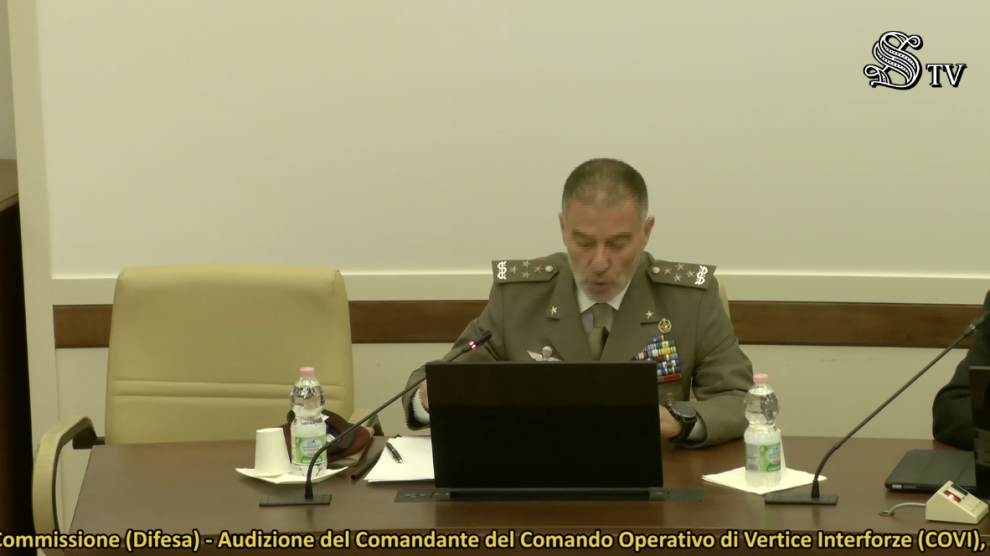
ROME — Italy expects to maintain 40 international missions and operations in 2026, while deploying one of its SAMP/T air and missile defense batteries to Turkey to help protect the upcoming NATO summit in Ankara, Italy’s Joint Operations Commander Giovanni Maria Iannucci told lawmakers on Wednesday.
The big picture: Appearing before the joint Foreign Affairs and Defense committees of the Senate and Chamber of Deputies during hearings on Italy’s international missions, Iannucci offered an updated snapshot of Rome’s operational commitments, spanning NATO air defense, maritime security and potential future missions in the Gulf.
Why it matters: Italy plans to sustain a broad overseas military footprint in 2026, with operations under NATO, the EU, the UN and bilateral or coalition frameworks.
- The hearing confirmed that an Italian SAMP/T battery will support security for the NATO leaders’ summit in Ankara.
- Iannucci also outlined what an Italian contribution to a future multinational mine-clearing operation in the Strait of Hormuz could involve.
By the numbers: Iannucci said Italy expects to deploy an average force of around 7,500 personnel across 40 international missions and operations in 2026, with a maximum authorized strength of 11,900 troops.
- Of the 40 missions, 26 will be conducted under international organizations, while 14 will take place on a bilateral basis or within coalition frameworks.
Zoom in: NATO air defense. Italy is providing its SAMP/T air and missile defense system “upon request,” Iannucci said.
- “We provide the SAMP/T air and missile defense system upon request, as happened in Slovakia in 2024, Lithuania in 2025, and more recently in Estonia,” he told lawmakers.
- “In Estonia, our SAMP/T battery was deployed until March 2026, and in Turkey, where the battery is expected to reach full operational capability on July 3.”
- He added that “all this is also connected to the increased security that will be required for the NATO summit of heads of state and government that will take place in Ankara in just a few days.”
- The SAMP/T battery referenced by Iannucci is the same system deployed earlier this year at Konya, in central Anatolia, as part of NATO’s standing air defense posture.
- Separately, Turkish Defense Minister Yasar Gule recently said Ankara is evaluating “all options” to meet its air defense requirements, including the possible purchase of the Franco-Italian SAMP/T system as well as the U.S.-made Patriot.
Zoom in: Hormuz. Iannucci also described the scale of a possible multinational mine-clearing operation in the Strait of Hormuz should Parliament authorize an Italian contribution following a stable ceasefire between the United States and Iran.
“The estimate is that there are dozens of mines in the Strait of Hormuz,” he said. “This will require a commitment of about two months. These are sophisticated and advanced mines that require capabilities and expertise not available to all countries.”
- According to Iannucci, “the prospect of a multinational mission to clear mines in Hormuz is to allow the participation of non-European and regional actors as well.”
- He added that Italian mine countermeasure vessels are currently stationed in Djibouti.
Maritime security. Regional instability continues to require the protection of critical infrastructure and freedom of navigation, Iannucci said, identifying the area stretching from the Gulf of Aden to the Suez Canal as a key operational priority.
- He noted that persistent threats during 2025 affected logistics and the competitiveness of Italian ports.
The bottom line: The hearing provided one of the clearest official overviews of Italy’s expected military posture for 2026, highlighting continued commitments on NATO’s eastern flank, maritime security from the Red Sea to the Gulf, and readiness for potential future multinational operations.