
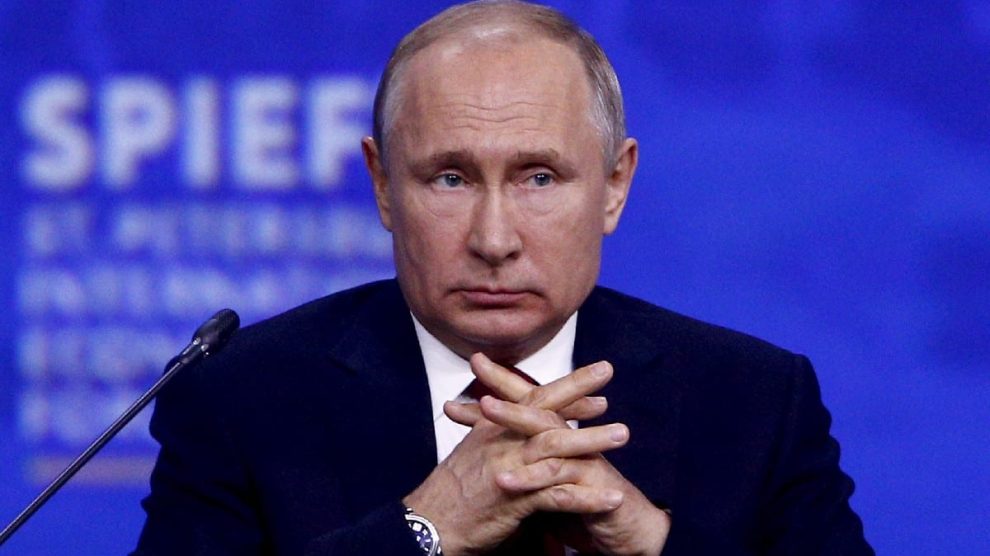
ROME — Vladimir Putin has threatened retaliation against European countries stopping Russian merchant vessels, after a series of operations targeting Moscow’s so-called “shadow fleet.”
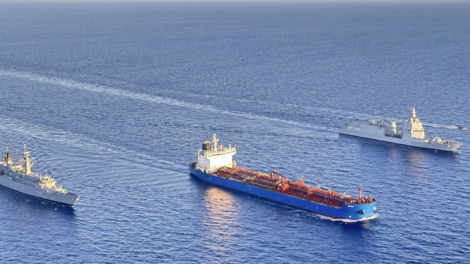
Why it matters: Italy is now directly involved. On August 3, an Italian-led EU mission boarded a Russian shadow-fleet tanker in the Mediterranean.
- It is part of a broader European push. The UK and France have stopped and seized several tankers from the fleet Moscow uses to circumvent Western sanctions imposed over its invasion of Ukraine.
Putin is raising the stakes. After previously denouncing similar operations as illegal, he is now threatening retaliation against merchant vessels belonging to the countries involved.
- Moscow is signaling that its response may not be geographically symmetrical. Putin said retaliation could come “not necessarily in the area where our ships are seized, but wherever we deem appropriate.”
The big picture: European countries are moving beyond sanctions toward more proactive measures designed to complicate the operation of Russia’s maritime networks.
- The shadow fleet sails under third-country flags and is used by Moscow to circumvent international sanctions. Operations by the UK, France and Italy show how the confrontation is increasingly moving from financial and legal restrictions to enforcement at sea.
Blowing smoke. The Kremlin’s reaction suggests these initiatives are entering Moscow’s strategic calculus. Dmitry Medvedev, deputy chairman of Russia’s Security Council, went further, arguing that Moscow has the right to attack merchant vessels carrying goods to “the enemy,” including in neutral waters.
- Adm. Viktor Liina also said the Russian Navy was ready to inspect European-operated vessels sailing under third-country flags.
Zoom in: Italy. For Rome, Russia’s threat raises a challenge that extends beyond the protection of maritime routes.
- If Rome remains at the forefront of Europe’s more proactive policies against the shadow fleet, its exposure to the kind of retaliation threatened by the Kremlin could also increase.
- The Putin’s warning about retaliation “in any sea” is particularly relevant. That means the maritime dimension extends beyond the Mediterranean.
- Putin delivered his threat from the Varyag during exercises in the Pacific, placing the naval confrontation in a broader geographical frame just as Europe and Italy increasingly see the Indo-Pacific as an area of strategic interest.
Zoom out: the Black Sea. Pressure on Russia’s maritime infrastructure is also coming from Ukraine and weighs on Putin’s narrative.
- Kyiv announced a drone attack against the Novorossiysk naval base on the Black Sea, which President Volodymyr Zelensky described as “the largest outpost of the Russian fleet in the Black Sea.”
- The attack put two major grain terminals out of operation, according to the information provided.
- JD Vance had asked Zelensky to reduce attacks against Russian oil tankers using the Novorossiysk terminal, with the aim of lowering tensions in the region.
- Moscow, meanwhile, is working to redirect its vessels onto “alternative routes.”
Between the lines: Russian leader does not establish what form such retaliation could take. But the risk is not necessarily limited to a naval response. In the broader context of hybrid confrontation, Russian “active measures” could seek to exploit vulnerabilities on the political and information fronts.
- In the same context, Japanese Prime Minister strongly protested Russian President Putin’s visit to Iturup Island, part of the Northern Territories, which Japan claims as its own. “Even amid the harsh state of Japan-Russia relations following Russia’s invasion of Ukraine, Japan has made every possible effort, but this visit can only be said to have further hardened anti-Russia sentiment within Japan and made medium- to long-term recovery of relations more difficult,” said Takaichi
- Security and geopolitical interests in the Euro-Atlantic region (centered on the Mediterranean) and those in the Indo-Pacific are no longer separate.
The bottom line: Italy is taking an operational role in Europe’s effort to make it harder for Moscow to circumvent sanctions. Putin’s words show that the Kremlin considers those initiatives significant enough to threaten a response.
- For Rome, that also puts the domestic front into focus. Pro-Russia positions exist on both the right and the center-left, potentially creating vulnerabilities if Moscow seeks to translate Putin’s threatened retaliation into “active measures” designed to exploit existing political divisions.
- The question now is twofold: how far Europe — with Italy on the front line — is prepared to go in operations against Russia’s shadow fleet, and what Moscow will ultimately mean by Putin’s promise to respond “in any sea.”