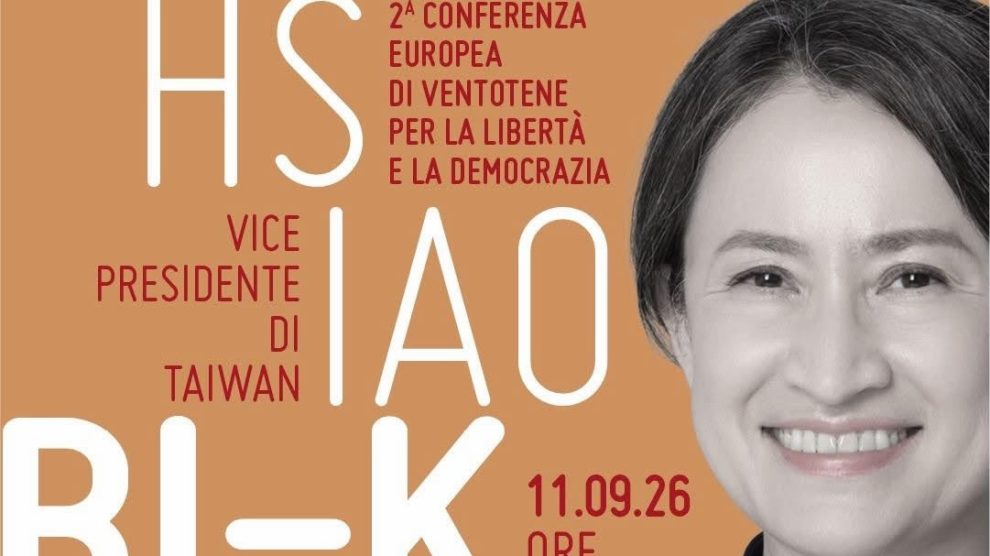
The arrival in Italy of Taiwan’s Vice President Hsiao Bi-khim was kept secret until the last moment. The precaution reflected concerns that the Chinese government could seek to interfere with her participation in the Second Ventotene European Conference for Freedom and Democracy, taking place on the Italian island from September 10 to 12.
A visit kept under wraps. Hsiao, a figure viewed with particular hostility by Beijing, including because of her close ties with the United States, is due to take part in a panel on September 11 — a symbolic date in itself. She will appear at 7pm alongside European Parliament Vice President Pina Picierno, former Italian foreign affairs undersecretary and author Gianni Vernetti, and Asia specialist and journalist Antonio Talia.
- Hsiao travelled with Taiwan’s Foreign Minister Lin Chia-lung. Taipei confirmed the trip only after Picierno, the main promoter of the conference, publicly disclosed the vice president’s presence.
- Taiwan’s foreign ministry has not said when Hsiao left the island or when she is expected to return. Other European stops may follow, potentially under the same veil of discretion until the last moment.
The location carries its own political symbolism. Ventotene became associated with the origins of European federalism after Altiero Spinelli, Ernesto Rossi and Eugenio Colorni, political opponents confined to the island under fascism, drafted the Ventotene Manifesto there in 1941.
What they’re saying: Speaking about the way the “Chinese regime” also interferes with the activities of Taiwan’s leadership, Picierno said: “At Ventotene, no one decides who can be there. Least of all a regime. No one can determine who may be hosted on European soil and which voices may or may not be heard. That is why I am honoured and delighted by the participation of Taiwan’s Vice President Hsiao Bi-khim. Freedom of debate is not negotiated with autocracies. And Ventotene, now more than ever, must continue to be a place where freedom and democracy are defended without fear.”
- “Freedom is not defended only at our borders. It is defended wherever it is threatened,” she wrote on Facebook. “From the Indo-Pacific to the Mediterranean, democracies today face a common challenge: authoritarian regimes, powers seeking to reshape international balances through force, disinformation and new forms of pressure on our societies.”
- For Picierno, that is also the rationale for deeper dialogue between Europe and Taiwan. Security and freedom, she argued, can no longer be treated as distant issues affecting somebody else. Ventotene’s history provides the European backdrop; Taiwan brings the Indo-Pacific dimension.
Beijing protests, Rome keeps its distance. China’s foreign ministry responded according to familiar diplomatic protocol, lodging “solemn representations” with Italy and the European Union.
- Its spokesperson described the behaviour of Taiwan’s ruling Democratic Progressive Party authorities as “despicable and ultimately futile”. Beijing regards Taiwan as one of its provinces and routinely objects to overseas travel by senior Taiwanese officials, which can provide Taipei with opportunities to build relationships and expand its informal international recognition.
- Hsiao herself has previously been sanctioned by Beijing, which has labelled her an “independence diehard”.
Italy’s caution, however, sets clear limits on the political meaning of the visit. Foreign Minister Antonio Tajani will not meet Hsiao or Lin, and no meetings are planned at the prime minister’s office.
- Like most governments, Rome has no formal diplomatic relations with Taipei, although Italy and Taiwan maintain de facto representations in each other’s capitals and have direct air connections. The distinction reflects the diplomatic framework surrounding Italy’s One China policy and Beijing’s insistence that recognition of the People’s Republic is incompatible with formal diplomatic recognition of the Republic of China.
- Ventotene, therefore, does not signal a shift in Italy’s official position on Taiwan. It shows instead how much political room Taipei can find in Europe even when national governments carefully maintain formal distance.
- That intermediate space — below diplomatic recognition, but visible enough to trigger a response from Beijing — is increasingly becoming a field of competition.
From Brussels to Ventotene. This is only Hsiao’s second visit to Europe since taking office as vice president in May 2024. The previous trip came in November 2025, when she addressed a summit of the Inter-Parliamentary Alliance on China at the European Parliament in Brussels.
- Ventotene brings the same dynamic to Italy, this time with an unusually high-level Taiwanese delegation given the simultaneous presence of the vice president and foreign minister.
- Taipei’s approach appears designed to exploit a distinction that European governments themselves continue to maintain: formal diplomatic recognition remains off the table, while political dialogue through parliaments, conferences and transnational networks can still take place.
For Taiwan, Europe has become an increasingly relevant arena. Taipei has sought closer relations with European countries particularly since Russia’s invasion of Ukraine in 2022, while the European Union has developed its own disputes with Beijing over trade imbalances and Chinese support for Russia.
- None of this amounts to a European diplomatic realignment towards Taiwan. Italy’s handling of Hsiao’s visit illustrates precisely how carefully governments separate informal political engagement from steps that could be interpreted as recognition.
The Eswatini precedent. The secrecy surrounding Hsiao’s journey also has a recent, more operational precedent.
- In May, Taiwanese President Lai Ching-te travelled to Eswatini, Taiwan’s sole remaining diplomatic ally in Africa, on an unannounced mission after an earlier trip scheduled for April had been cancelled.
- Seychelles, Mauritius and Madagascar had withdrawn overflight permissions for Lai’s chartered aircraft on the eve of his planned departure. Taipei attributed the decisions to diplomatic and economic pressure from Beijing.
- When the journey was eventually reorganised, Lai travelled aboard the private Airbus A340 of Eswatini’s King Mswati III, taking a longer route across the Indian Ocean. The trip was disclosed only after the Taiwanese president had landed safely in Eswatini.
- Beijing reacted furiously. Washington described the earlier obstruction as an “intimidation campaign”.
- The two cases are not equivalent. In the African episode, Taipei pointed to a concrete operational obstacle: the withdrawal of overflight permissions. In Italy, the concern was preventive — protecting Hsiao’s arrival against potential interference.
- But the response followed a strikingly similar logic: minimise information before departure and disclose the mission only once the Taiwanese leader has reached the destination.
When diplomacy becomes logistics. Within a matter of months, secrecy has therefore twice been used to protect the international movements of Taiwan’s senior leadership.
- That suggests how far Beijing’s competition with Taipei can extend. The contest is no longer confined to which countries maintain diplomatic relations with Taiwan or which politicians are prepared to meet its representatives. It can also reach the practical conditions under which Taiwan’s leaders travel abroad and gain access to international political platforms.
- For Taipei, the answer has increasingly been to operate inside the gaps left by formal diplomacy.
Brussels in 2025 and Ventotene in 2026 show how Taiwan can build a European political presence through legislatures, conferences and cross-border networks without formal diplomatic ties. The broader ambition is to frame that engagement around the defence of democratic systems at a moment when Taipei and its European interlocutors see mounting pressure on them.
The bottom line: China’s reaction shows that Beijing considers even this level of engagement significant. Its pressure can raise the political cost of Taiwanese visits and shape how they are organised, sometimes pushing them into secrecy.
- Ventotene also points to the limits of that pressure. Hsiao reached Italy. By the time her presence became public, preventing the visit was no longer an option — and the secrecy surrounding her arrival had itself become part of the political message.