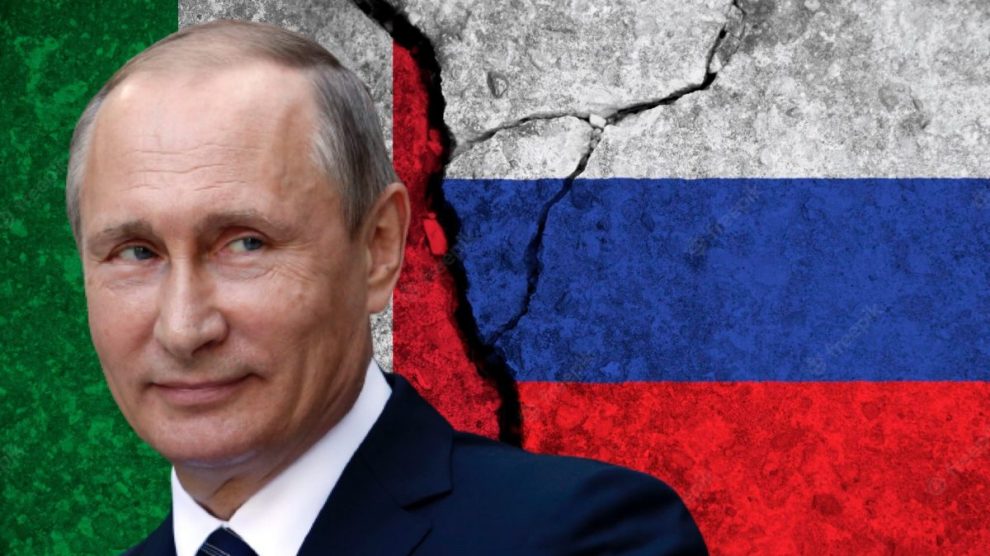
Italy has become more aware of Russian disinformation and hybrid threats since Moscow’s full-scale invasion of Ukraine. But awareness has yet to translate into a comprehensive strategy to defend the country’s information space and democratic resilience
Why it matters: Cognitive warfare is no longer simply about propaganda or planting false stories. It is about shaping how societies perceive reality, exploiting existing divisions and ultimately influencing political choices.
- That is the warningLuigi Sergio Germani warns that Italy remains vulnerable to Russian cognitive warfare despite growing awareness of Moscow’s influence operations from Luigi Sergio Germani, director of the Gino Germani Institute of Social Sciences and Strategic Studies, who argues in an analysis for Formiche.net that Italy remains particularly vulnerable to this dimension of Russian hybrid warfare.
The big picture: The concept of cognitive warfare has gained prominence within Western intelligence and security circles over the past five years. It builds on older practices of propaganda and psychological warfare but combines them with the reach of social media, artificial intelligence and increasingly sophisticated techniques of mass psychological manipulation.
- For Germani, Russia represents the most developed example of this approach against Western democracies.
- The objective is broader than persuading audiences to accept a particular Kremlin narrative. It is to create information disorder, weaken confidence in objective truth, exploit conspiracy theories and historical revisionism, amplify fear and deepen existing political and social fractures.
There is history here. Germani traces contemporary Russian practices back to the Soviet doctrine of active measures — the mix of influence operations, disinformation, covert propaganda and political interference used by Moscow during the Cold War.
- Italy was a particularly important theatre. Its position inside NATO, combined with its domestic political landscape, made it a key target for Soviet influence operations.
- But Germani’s central argument is that Italy never fully processed that experience.
- After the Cold War, the study of Soviet influence and subversion largely disappeared from the Italian political and intellectual debate. Russia was increasingly viewed through the lenses of trade, energy and economic opportunity rather than national security.
- At the same time, Italy invested relatively little in developing deep expertise on Russia and the post-Soviet space.
The result: When the Kremlin began rebuilding and modernizing its influence machinery under Vladimir Putin, Italy lacked some of the intellectual and institutional antibodies needed to recognize what was happening.
- According to Germani, Moscow revived Soviet-era techniques during Putin’s second presidential term, adapting them to the digital information environment.
- The toolbox expanded accordingly: Kremlin-controlled media, ostensibly independent websites linked to Russian interests, social-media manipulation through trolls and bots, sympathetic influencers and, more recently, AI-enabled content and deepfakes.
- After Russia’s annexation of Crimea in 2014, these activities intensified sharply across Europe.
- Yet while governments, universities and think tanks elsewhere began paying closer attention to Russian disinformation and hybrid warfare, Germani argues that the issue remained marginal in Italy for much longer.
The turning point came in 2022. Russia’s full-scale invasion of Ukraine fundamentally changed the Italian debate.
- Disinformation and foreign influence finally moved closer to the centre of the national-security conversation. Germani notes that Russia and China were explicitly identified as actors behind hybrid and cognitive threats to Italy in the Italian intelligence community’s annual report published in early 2023.
- That represented a significant shift. But recognition of the problem does not necessarily amount to a strategy for dealing with it.
What we’re watching: Germani argues that Italy still lacks a comprehensive national approach to countering Russian hybrid and cognitive warfare, despite much greater awareness among political leaders and security institutions.
- That gap matters because cognitive warfare operates below the threshold of conventional conflict. Its effectiveness depends precisely on exploiting democratic openness rather than confronting it directly.
- The target is not simply a government network or a military installation. It can be public trust, political cohesion or the ability of citizens to distinguish information from manipulation.
- And the technological environment is making the challenge harder. Generative AI can dramatically lower the cost of producing convincing text, images, audio and video while allowing influence campaigns to operate at greater speed and scale.
The bottom line: Italy’s challenge is therefore not merely to identify individual pieces of Russian disinformation. It is to treat the information and cognitive domains as part of national security.
- Germani’s argument is ultimately about resilience: understanding how influence operations work, rebuilding expertise on Russia, improving institutional awareness and giving citizens the tools to recognise manipulation.
- The Kremlin’s methods may have evolved considerably since the era of Soviet active measures. Italy’s vulnerability, Germani warns, is that its understanding of them has evolved much more slowly.