Italy missed an early exit from the EU’s Excessive Deficit Procedure by a fraction. But behind the 3.1% deficit confirmed by Istat lies a more nuanced — and considerably less negative — fiscal picture than the missed threshold suggests.
Why it matters: Prime Minister Giorgia Meloni’s government did not get the political result it wanted. Yet Italy’s fiscal consolidation remains on track, while markets and investors appear to be paying more attention to the broader trajectory than to a few decimal points around the Maastricht threshold.
- That is the picture emerging from analyses by Gianfranco Polillo and Giuliano Cazzola, two economics columnists writing for our sister website Formiche.net, who looked beyond the political debate surrounding the 3% mark.
The big picture: Polillo starts with Istat’s revisions. The updated figures leave the deficit problem essentially unchanged, but improve other indicators: nominal GDP estimates were revised upwards, while the debt-to-GDP ratio for 2025 came in 0.4 percentage points below previous estimates.
- The tax burden was also revised down, from 43.1% to 42.9%.
- For Polillo, the striking point is the mismatch between the statistical size of the miss and its institutional consequences. Around €1.7 billion in lower spending or additional revenues would have been enough to bring the deficit below the relevant threshold and allow Italy to leave the EU procedure one year early.
- The 2025 accounts, moreover, still carry around €8 billion linked to the effects of the Superbonus housing scheme, a legacy of the fiscal policies adopted during the pandemic years.
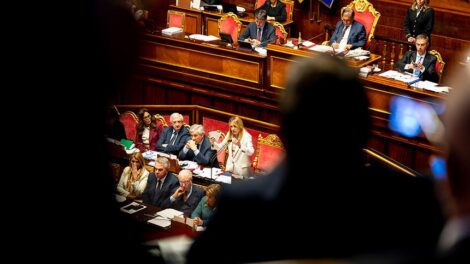
The political noise: That decimal point was enough to ignite a domestic political fight. The opposition portrayed the missed target as a government failure, while the majority pointed to the fiscal consolidation achieved in recent years and the lingering cost of the Superbonus.
- Polillo sees the controversy as disproportionate to a figure that was already largely known; Cazzola points instead to the signal coming from financial markets, which continue to reward Italy’s fiscal trajectory.
- The gap is telling: Rome is arguing over 0.1 percentage points; investors are looking mainly at the direction of travel.
Zoom out: financial credibility. Cazzola shifts the focus from the decimal point to Italy’s financial credibility.
- When the current government took office in 2022, the deficit stood at 8.1% of GDP, still heavily affected by pandemic-era measures and the Superbonus. Bringing it close to 3% over the course of the legislature therefore represents a significant adjustment, even if Rome failed to secure an early exit from the EU procedure.
Some indicators suggest that trajectory has been recognised outside Italy as well.
- The spread between Italian BTPs and German Bunds has remained around 85-88 basis points in September, far below levels reached during previous periods of fiscal stress.
- Meanwhile, Italian GDP expanded by 0.2% in the second quarter from the previous three months, with acquired growth for 2026 at 0.8%. Industrial production rose 0.7% month-on-month in July, while unemployment fell to 5.8%.
Between the lines: Italy’s real fiscal question, then, is less about that single decimal point than about what comes next.
- Remaining under the excessive deficit procedure means tighter fiscal room as the government prepares a politically sensitive budget ahead of next year’s elections. That is a disadvantage for a governing coalition that would have preferred greater room for manoeuvre.
But it could also serve as a guardrail. Cazzola notes that existing constraints may make it harder to finance expensive measures in the final stretch of the legislature. In other words, missing the 3% target limits the government’s ability to turn improving public finances into new spending precisely when the political pressure to do so is increasing.
The bottom line: Italy lost the chance to leave the EU procedure early, not the fiscal credibility it has built through consolidation in recent years.
- The 3.1% matters because it keeps Rome under Brussels’ constraints. But when assessing where Italy’s public finances are actually heading, the decimal point matters less than the trajectory.
- For now, that trajectory remains one of consolidation.