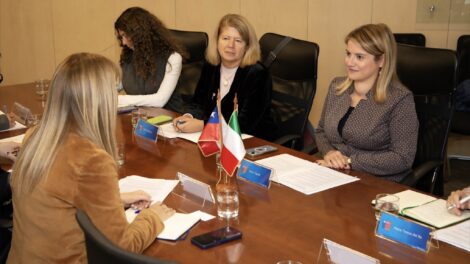

Managed Tension Is Not a Strategy. The EU commissioner for economic security, Maroš Šefčovič, has recently concluded a round of negotiations in Beijing on the 8 and 9th October with Wang Wentao, the minister of commerce of the People’s Republic of China. The two ministers produced a 16 point list of deliverables covering trade and investment balancing, export controls, intellectual property, and WTO reform.
This agreement helped calm relations after months of escalating trade disputes which risked blowing up into a full blown commercial war. Šefčovič himself called it the conclusion of a “first phase” of negotiations, with more agreements to come in the future.
The headline result is on hybrid cars, with the PRC committing to halving China’s hybrid electric vehicles and plug in hybrid electric vehicles exports to the EU. Nonetheless, the implementation mechanism has not been disclosed and Šefčovič says details will come after EU leaders have reviewed the agreement when they meet in Brussels on 15–16 October.
- China additionally agreed to explore ways to improve market access for EU firms and products by potentially lowering it’s tariff rates, alongside additional steps to facilitate EU exports of medical devices and agricultural products. Nonetheless, no deadlines or figures are outlined.
Out of this entire agreement, the most important result for European industry is also the one that changes the least. Beijing has agreed to facilitate licence approvals for exports of rare earth minerals and permanent magnets to the EU through a “green channel”.
- In exchange, the EU committed itself to work with member states to accelerate priority licensing cases for dual use items going to China. Europe is thus essentially easing its own controls on sensitive goods in exchange for quicker licences on materials it still cannot produce itself.
This is why this agreement can simply be considered a limited truce in the wider economic rivalry between the EU and China, with the fundamental dynamics creating friction between the two remaining essentially untouched. Whilst European industry will benefit from the green channel, which offers faster and more predictable licences, the critical dependence on China for these essential materials remains virtually unaltered.
- China has notoriously used this commercial chokepoint it has created from decades of elaborate industrial policy as leverage in geopolitical negotiations. The EU is especially vulnerable to this tactic, as 98% of our rare earth minerals and magnets come from China.
- Therefore, whilst Beijing is giving Europe a fast track, it still holds power over the licence, and can fall slow approvals at will. Additionally, China refuses to renounce its economic model heavily focused on overcapacityand export rather than focusing on increasing domestic demand and consumption.
- In July, it released a report titled China’s Position on the So-called Excess Capacity Issue, where the PRC attempts to systematically dismantle the critique that its economic model generates massive economic imbalances by focusing solely on exports.
- This, alongside continued investments on supply side policies, shows the PRC is still not ready to give up the model which creates the underlying imbalance in the first place.
This exposure is also much more important since these rare earth magnets and metals are essential for Europe’s rearmament drive. These magnets are used for missile guidance, drones, radar and electric motors. Whilst a carmaker can live with predictable licences, a defence industry working to guarantee our continent’s security in the face of the greatest amount of tensions with Russia since the cold war needs secure and reliable supply.
Through this deal, Brussels has thus avoided an escalation spiral in trade tensions which could have severely hindered both economies, kept dialogue on the issue alive with China, and obtained the predictability industry had been pushing for.
- European firms have spent the past year dealing with licence delays and stoppages, and thus for them, this green channel is a real relief rather than a mere symbolic gesture. Nonetheless, this truce is only worth what Europe does with the time it buys.
- Whilst it is unrealistic to expect Brussels to fix the underlying macroeconomic imbalances with China by the third ministerial meeting in March 2027, one easier measure could be treating magnets as a defence industrial priority, thus using defence funding as well as the Critical Raw Materials Act to ensure magnet capacity is created, since the industry can now compete for money on security grounds rather than green transition grounds.
The bottom line: The EU leaders will review the hybrid terms in Brussels on the 15th and 16th of October, which is the next test of whether the truce will hold. If it does, it will lower tensions but not ultimately change who controls the supply. Whether Europe’s exposure is smaller by March 2027 depends on what it builds, rather than what Beijing grants.