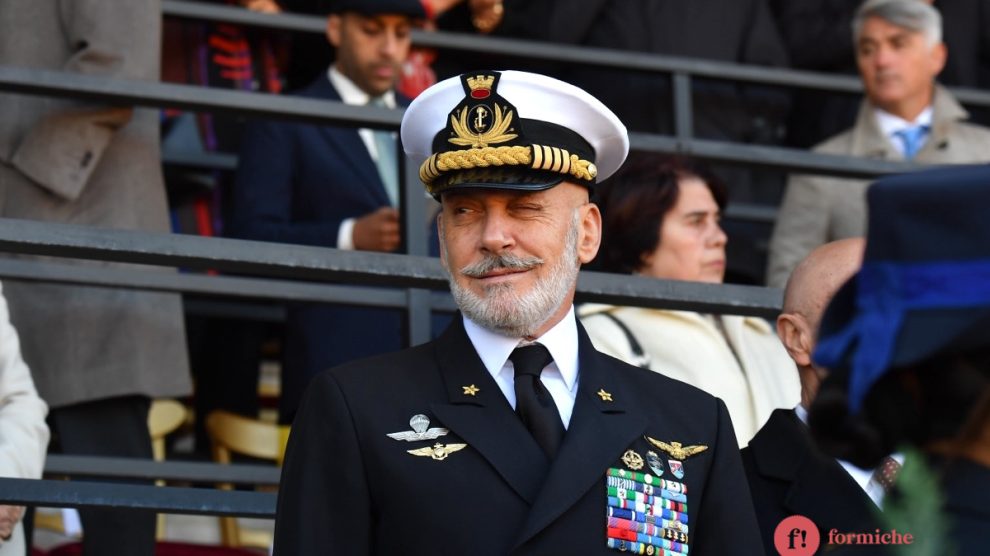
Days after NATO’s 32 Chiefs of Defence elected German General Carsten Breuer as his successor, CMC_NATO Admiral Giuseppe Cavo Dragone laid out what he sees as the Alliance’s most pressing challenges: Russian pressure below the threshold of open conflict, military readiness, industrial capacity and the accelerating role of artificial intelligence.
Breuer was elected during the annual NATO Military Committee Conference in Copenhagen and will take over as Chair in summer 2027 for a three-year term. The meeting focused on strengthening collective deterrence and defence, accelerating the adoption of new capabilities and translating the commitments made at NATO’s Ankara Summit into military output.
Speaking in an interview with Italian broadcaster Tgcom24, Cavo Dragone described an Alliance facing a security environment in which the distinction between peace and conflict is becoming increasingly blurred.
Below the Article 5 threshold. NATO does not consider its members to be at war, but neither does it see the current environment as one of conventional peacetime.
- Cavo Dragone pointed to airspace violations, drone incidents and hybrid activities attributed to Russia as attempts to test Allied resolve without crossing the threshold that could trigger a collective response. NATO’s reaction, he said, remains defensive, proportionate and visible.
- That assessment echoes his message in Copenhagen, where he cited Russia’s recent “airspace violations, drone incidents, hybrid activities and attempts to test Allied resolve,” while stressing that NATO remains ready to defend Allied territory.
Russian propaganda is another concern. According to Cavo Dragone, information operations can interfere with democratic processes and undermine cohesion among NATO members.
- But Article 5 is not an automatic switch. Cavo Dragone also pointed to Article 4, which allows Allies to request consultations when their security is threatened, and Article 3, which places responsibility on members to strengthen their own resilience and capacity to withstand crises.
Readiness is also about mobility. For Cavo Dragone, readiness is not simply about how quickly collective defence can be invoked. It requires rapid attribution, military options prepared in advance and infrastructure capable of supporting forces during a crisis.
- That puts European military mobility at the heart of the problem.
- Different national authorisations, regulatory requirements and infrastructure constraints can slow the movement of troops and equipment across Europe. Streamlining paperwork will only solve part of the problem if bridges, tunnels, railways and other infrastructure cannot accommodate military movements.
- In other words, deterrence increasingly depends on the ability to move forces at the speed demanded by a crisis.
From spending to capabilities. The same logic applies to defence spending.
- European Allies and Canada have increased defence expenditure by around $139 billion compared with last year, while another $40 billion over five years is being directed towards Drone Edge unmanned systems.
- But for Cavo Dragone, money matters when it becomes military capability that can actually be deployed.
- That was also one of the clearest messages from Copenhagen. NATO’s military leadership said the Alliance is shifting its focus “from committing budgets to delivering on capabilities,” while telling the defence industry that Allies are ready to buy at scale and expect equipment to be delivered with greater speed and predictability.
AI compresses the timeline. Artificial intelligence adds another layer to this race against time.
- According to Cavo Dragone, functions ranging from defence systems to data management and fusion can increasingly be automated, while keeping humans at the centre of — and responsible for — decision-making.
- The strategic consequence is speed.
- As adversaries accelerate their own operations, NATO must shorten the interval between identifying a threat, understanding it and responding. AI therefore becomes relevant not simply as another military technology, but as a tool for compressing the Alliance’s decision and response cycle.
The European connection. The capabilities question has also been discussed in Rome, where the second European CHOD/NAD Conference brought together European Chiefs of Defence and National Armaments Directors on September 21-22.
- The meeting, jointly organised by the EU Military Committee, European Defence Agency and Italian defence institutions, focused on bringing operational requirements and industrial capabilities closer together.
- It also reinforced a broader point running through Cavo Dragone’s assessment: NATO-EU complementarity increasingly has a practical dimension.
The bottom line: More spending is only the beginning. For NATO, the next test is turning resources into capabilities, capabilities into readiness, and technological innovation into faster responses — before an adversary can exploit the gap.