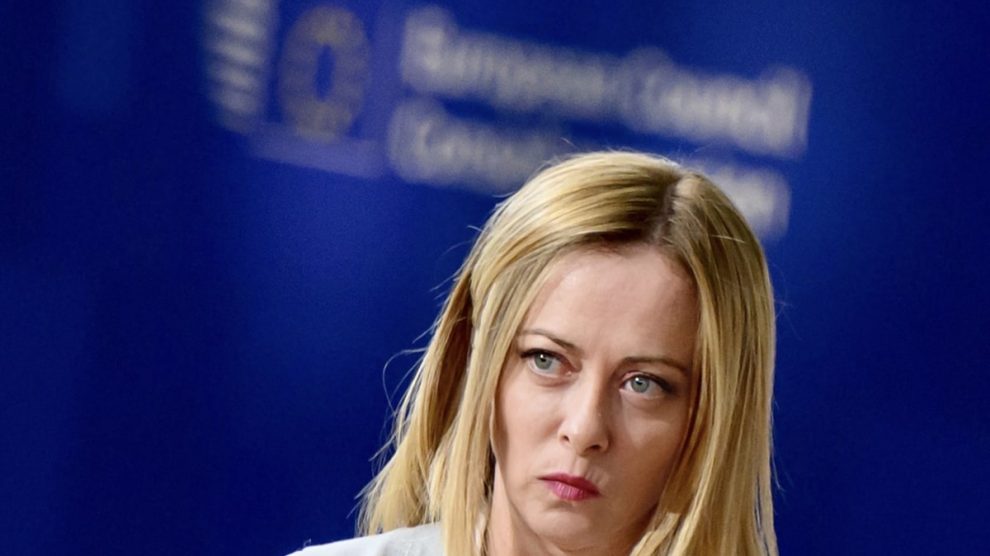
ROME – As officials discuss security guarantees for Ukraine in Brussels and Melania Trump prepares to host Ukrainian and Russian representatives in Washington, Italian Prime Minister Giorgia Meloni is pressing Europe to agree on who speaks on its behalf — and with what mandate.
With U.S.-mediated talks in Abu Dhabi also approaching, and European participation still to be clarified, Meloni has written to European Council President António Costa urging a decision on EU representation by December.
Her warning: Overlapping diplomatic initiatives are weakening Europe’s credibility and could produce commitments that countries including Italy would be expected to honour without an agreed negotiating mandate.
Why it matters: For Meloni, the stakes extend to commitments European countries could be expected to honor. She says Italy will continue contributing, while insisting that negotiations involving obligations for Rome require an agreed mandate.
- “We are not prepared to accept commitments being negotiated, in the absence of a mandate, that our nation will also subsequently be called upon to assume.”
- Europe, she argues, needs “a single, authoritative voice” to help shape the outcome.
What she’s saying: Meloni asks EU leaders to settle “once and for all who sits at the negotiating table representing the European Union, and with what mandate.”
- She describes that decision as overdue, warning that initiatives which follow and overlap one another weaken Europe’s position with its partners and with those it must persuade to end Russia’s aggression.
The backdrop: In the letter, Meloni traces a month of diplomacy involving different participants and formats:
- An “informal” meeting in Miami involving national security advisers from some European countries, Ukraine, and NATO and EU representatives, which she says was confirmed only afterwards by U.S. sources.
- A gathering in Oslo, in late October, followed by a call that Finnish President Alexander Stubb and Norwegian Prime Minister Jonas Gahr Støre held with Vladimir Putin “in a national capacity” during the Nordic Council session in Helsinki.
- A November 19 meeting in Berlin of the 37-country Coalition of the Willing, preceded by a November 12 gathering of the “Berlin format” with a different composition.
- Technical meetings in Brussels and what she describes as an unspecified European presence at the prospective Abu Dhabi talks.
Her warning: Meloni says this proliferation of initiatives is making Europe less credible on an issue involving human lives and the future of European security.
- By projecting an image of fragmentation, she argues, European governments are serving the interests of those who want the war to continue.
Italy’s position: Meloni explicitly says she is prepared to forgo a role for herself or Italy if that makes her request for common European representation more credible.
- “I am not asking for a place for Italy in this or that format,” because “the outcome matters much more to us than the format.”
- She also makes clear that she wants her objection formally recorded: “I want it to remain on record that I will not lend myself to this dynamic, nor do I intend to stand by while it unfolds.”
What’s next: Meloni formally requests a discussion at the upcoming informal European Council in Dublin, allowing leaders to adopt a decision at the December European Council, following coordination with the United Kingdom, Norway and other interested European partners.
- “In the absence of this,” she writes, “I fear we risk condemning Europe to irrelevance in the negotiating process.”