As inflation once again weighs on the Italian economy, part of the government’s response is being sought beyond the country’s borders. Higher energy costs are feeding through to petrol stations, corporate bills and ultimately household purchasing power, turning the diplomatic network Giorgia Meloni has built during her years at Palazzo Chigi into an instrument of domestic economic policy.
The effort is unfolding on several fronts. In Brussels, Meloni has asked European Commission president Ursula von der Leyen for greater flexibility in the application of EU fiscal rules, allowing governments to use at least some of the additional revenues generated by inflation for temporary and targeted measures to offset higher energy prices. But the other lever is diplomatic.
Turning relationships into leverage. Palazzo Chigi has worked to mobilise a network that runs through Eni and extends to Q8, IP and Tamoil — and therefore, leaving aside the Italian energy major, which has long been an instrument as well as a protagonist of Rome’s international engagement, to Kuwait, Azerbaijan and Libya.
- According to a reconstruction in Corriere della Sera by Marco Galluzzo, one of the newspaper’s best-informed Palazzo Chigi correspondents, Meloni’s personal relationships with the leaderships of producing countries helped the government’s effort to put downward pressure on fuel prices in Italy.
- The episode points to something larger. The energy crisis is demonstrating, once again, how difficult it has become to draw a clean line between foreign and domestic policy. A military crisis thousands of kilometres from Italy can pass through a maritime chokepoint, move into global energy markets and, within weeks, appear on household bills and petrol-station price boards.
Italy has been here before. The vulnerabilities exposed by Russia’s full-scale invasion of Ukraine accelerated Rome’s efforts to diversify its energy supplies. Meloni’s recent visit to Norway — the first by an Italian prime minister in almost 15 years — offered perhaps the clearest illustration of the strategy.
- Norway has acquired greater importance for European energy security as the continent has reduced its dependence on Russian gas. Tensions around the Strait of Hormuz have supplied another lesson. Diversification is no longer simply a matter of replacing one supplier with another. It is increasingly about reducing exposure to wars, coercion by hostile states and the vulnerabilities created by the maritime chokepoints through which the global economy still runs.
Economic security beyond energy. This also explains why Italy’s relationship with Norway is expanding beyond energy. Critical raw materials, defence, space, subsea infrastructure and the protection of strategic assets have entered the same conversation. For an importing country such as Italy, security of supply and the security of the infrastructure that makes those supplies possible are increasingly two parts of the same problem.
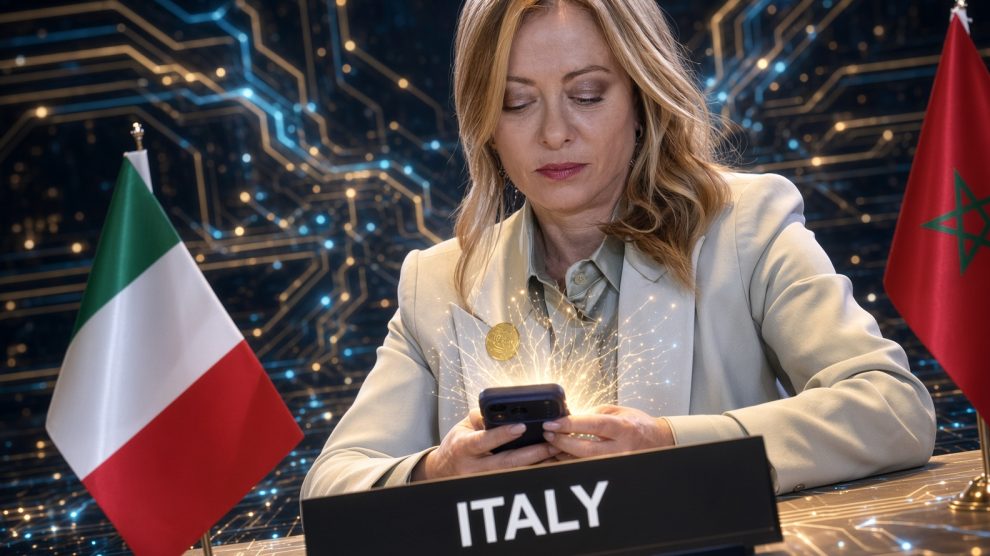
- Nor is this confined to energy. Some dependencies are far less visible to voters but potentially just as consequential for Italy’s economic security. Critical minerals, semiconductors, artificial intelligence and digital infrastructure rarely produce the kind of mainstream emergency generated by a sudden rise in petrol prices — at least until a supply chain breaks. Yet foreign policy matters here too.
This is the terrain of “silica diplomacy”: the construction of diplomatic and industrial networks around the raw materials and technologies that increasingly underpin economic power.
- Italy’s transatlantic positioning therefore carries an economic as well as a strategic significance. Its agreement with Washington on critical minerals, a parallel accord with Argentina and Italy’s involvement in the Lobito Corridor place Rome within the broader Western effort to reorganise strategic supply chains and reduce the most exposed dependencies, particularly those involving China.
- For a manufacturing economy such as Italy’s, access to the materials required for batteries, semiconductors, automotive production, defence systems and emerging technologies ultimately bears on the ability of Italian companies to produce and compete. Decisions that may appear remote from everyday politics — which supply chains to join, which partnerships to privilege, which technological ecosystem to inhabit — can eventually become very concrete questions of domestic prosperity.
A wider economic geography. The same logic helps explain Rome’s growing attention to the Gulf. Meloni is expected in Riyadh at the end of October for the first high-level meeting between the European Union and Gulf countries.
- For Italy, relations with the region increasingly operate along several tracks at once: energy, maritime security, investment and opportunities for Italian companies. The Gulf is becoming part of a broader economic geography in which diplomacy is being used both to mitigate immediate vulnerabilities and to create room for longer-term Italian interests.
- This is where Meloni’s approach acquires a more interesting political dimension. Palazzo Chigi is attempting to convert the diplomatic capital accumulated over the past four years into an instrument of national economic security — and, ultimately, national interest.
There is nothing automatic about that conversion. Nor does the number of international visits undertaken by a prime minister guarantee results. The test comes when a relationship cultivated in Baku, Kuwait City, Tripoli, Oslo or Riyadh can be called upon to deal with pressure that is being felt in Rome.
When foreign policy reaches the voter. The political calendar adds another dimension. Italy is due to return to the polls in 2027, and international affairs are unlikely to remain confined to debates about foreign policy.
- A SWG poll analysed by Decode39 in May found that 56 per cent of Italians gave domestic policy greater weight when assessing political parties, compared with 44 per cent who attached greater importance to foreign policy. International crises can provoke strong reactions without necessarily determining voting behaviour. Even urgent events abroad are often absorbed only intermittently by the broader electorate.
Energy and inflation complicate that distinction. If an international crisis raises the price of petrol, squeezes household disposable income or increases costs for businesses, foreign policy ceases to present itself to voters as a separate dossier. Its consequences become domestic.
That could also shape the political contest ahead of 2027. Italy’s centre-left, for example, continues to display significant differences over international affairs, starting with Russia and the war in Ukraine. The Democratic party and the Five Star Movement have taken different positions on support for Kyiv and, more broadly, on Italy’s international posture.
- But the electoral question may ultimately be less abstract: how effectively can a future governing majority connect foreign policy, national security and Italian economic interests? And, in doing so, which partners will it choose to work with? Alliances — and friendships — matter.
The domestic test of diplomacy. It is on this terrain that the Meloni government appears set to fight part of the final phase of the legislature.
- The relevant measure will not be the number of relationships the prime minister has accumulated, but their quality: whether they can produce tangible results when international shocks reach the Italian economy.
The bottom line: Energy provides the most immediate test because consumers can see the consequences almost in real time. Technology, critical minerals and strategic supply chains offer a quieter version of the same challenge, whose effects may take longer to emerge but could prove just as consequential.
- If diplomacy can help contain energy costs in the months ahead — while reducing Italy’s exposure to the less visible vulnerabilities of the next economic shock — the distinction between foreign and domestic policy will become harder still to sustain.