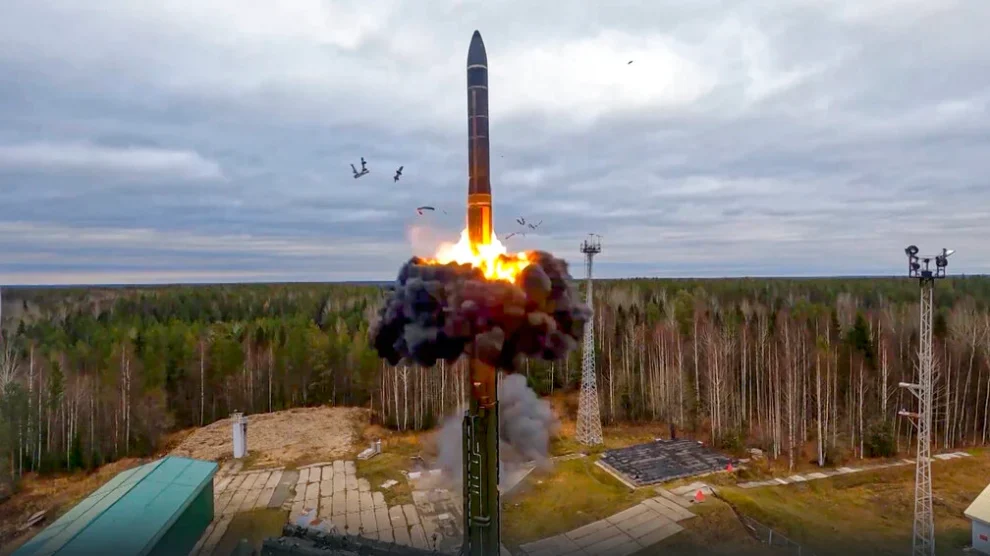
ROME — The Russian Embassy in Italy has accused Italian media of fueling an anti-Russian campaign over Moscow’s warnings about Kaliningrad and the possible use of nuclear weapons. But a closer look at the facts behind those claims tells a different story.
What happened: In a lengthy statement, the Russian Embassy in Rome accused Italian media of presenting Moscow’s recent warnings as threats, rather than as a response to what Russia considers increasingly aggressive European policies.
- According to the embassy, Russia’s statements were “firm and resolute” and intended to bring European countries “back to reality” and cool what Moscow described as growing “revanchist and militarist sentiments.”
- The Russian argument is that European countries themselves are driving the escalation.
- The embassy pointed to calls for Russia’s “strategic defeat,” preparations of European populations for a possible conflict, military exercises allegedly directed against Russia, NATO nuclear-sharing arrangements and discussions about deploying nuclear capabilities closer to Russian territory.
Against this backdrop, Moscow argued, describing the possible consequences of European actions “does not constitute an escalation, nor a threat, let alone a bluff.”
- Russia, the embassy added, is ready to defend its sovereignty and territorial integrity “with the means it deems most effective.”
The Kaliningrad issue. The most immediate point of contention concerns Kaliningrad, the Russian exclave on the Baltic Sea.
- The Russian embassy warned that aggressive action against Kaliningrad would carry a high risk of armed confrontation, including possible preemptive strikes against NATO decision-making centers in the initial phase of a conflict.
- But the military exercises cited in support of this argument tell a more nuanced story.
Lithuania’s Vyčio Skliautas 2026 exercise, running from Sept. 25 to Oct. 3 with Polish participation, is not centered on an offensive operation against Kaliningrad.
- Among the scenarios being tested is the evacuation of Lithuania’s population in the event of an escalation.
- On Sept. 29, Moscow also sent a note to NATO through its embassy in Belgium claiming that allied exercises included simulations aimed at the “isolation” of Kaliningrad.
- There is, however, no NATO decision providing for such an operation. The Alliance responded by reiterating the defensive nature of its activities.
- Moscow nevertheless warned that it could use the “entire arsenal of weapons at its disposal” to defend the exclave and again raised the possibility of preemptive strikes against NATO decision-making centers.
The nuclear issue. There is no question that Russia, like any sovereign country, has the right to defend its sovereignty and territorial integrity.
- The problem lies elsewhere: The Russian embassy’s reasoning treats Moscow’s military preparations as legitimate defensive measures while presenting similar deterrence measures adopted by European countries as inherently escalatory.
- The “joint nuclear missions” cited by the embassy appear to refer primarily to NATO’s nuclear-sharing system, which Moscow routinely describes using that terminology.
- The references to possible nuclear deployments closer to Russia seem instead to concern the “forward deterrence” initiative launched by France in March.
- The French approach extends the European dimension of Paris’ vital interests and allows non-nuclear allies to participate in exercises and deployments. But the decision on the possible use of France’s nuclear arsenal remains exclusively in the hands of the French president.
- These are deterrence mechanisms. Their purpose is to provide an ultimate guarantee in the event of an attack, not to prepare an offensive nuclear operation.
Two different doctrines. There is also a significant difference between French and Russian nuclear doctrine.
- France does not exclude first use of nuclear weapons, but its doctrine links nuclear deterrence to the defense of the country’s vital interests.
- Russia revised its own nuclear doctrine in November 2024, lowering the threshold under which nuclear weapons could potentially be used. The doctrine allows their use in response to a conventional attack that poses a “critical threat” to Russian sovereignty.
The distinction matters: So does the political rhetoric surrounding those doctrines.
- Since Russia launched its full-scale invasion of Ukraine in February 2022, members of the Russian political and security establishment have repeatedly raised, directly or indirectly, the possibility of using nuclear weapons.
- That record provides the context in which the latest warnings over Kaliningrad are being interpreted.
The big picture: One part of the Russian embassy’s argument, however, deserves consideration. Most NATO military exercises are organized around a hypothetical adversary that is not particularly difficult to identify with Russia.
- There are, after all, few countries bordering Europe with armed forces large enough to represent a major conventional military threat to the continent.
- Russia also has a long history of involvement in armed conflicts since the creation of the Russian Federation. But preparing to respond to a potential threat is different from preparing to launch a war.
- That distinction is precisely what deterrence is about: maintaining a balance that prevents weapons from being used and creates the conditions for dialogue.
The bottom line: Seen in this context, the Russian embassy’s statements are part of a broader exercise in strategic signaling and, in their most aggressive form, information warfare.
- Italian media have reported Moscow’s references to nuclear weapons and possible preemptive strikes because those statements carry weight in their own right.
- And, so far, with very few exceptions, they have not allowed themselves to be intimidated by them.