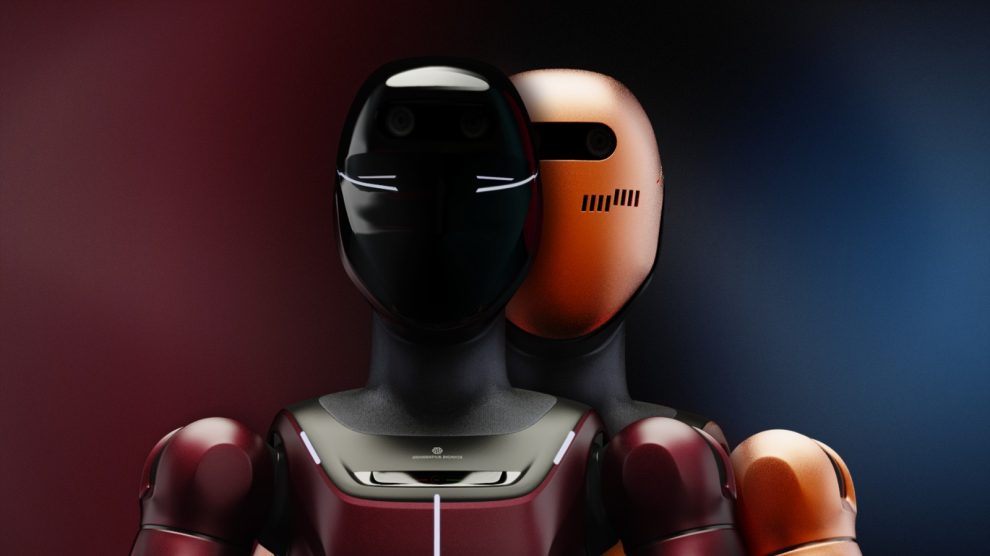
Japan’s government is studying the use of AI-equipped humanoid robots in national defense, according to government sources. The aim is to ease personnel shortages in the Self-Defense Forces, with tasks such as base patrolling, logistics support, reconnaissance and rescue. Combat use has been ruled out, at least for now.
Tokyo is not alone. From Asia to the United States, and with Europe a distant participant, the main military-technological powers see robotics, supercharged by AI, as a possible new revolution in military affairs.
Ground Robots Already at War. The most mature technology is not the humanoid but the unmanned ground vehicle (UGV): remotely operated machines, sometimes no larger than a lawnmower, controlled by radio or fiber optic cable. Ukraine has taken them from experiment to mass production in record time, with tens of thousands of units contracted in the first half of 2026 alone. They carry supplies, evacuate the wounded, inspect minefields and scout terrain, all high-risk jobs.
- Ukraine’s Protector, for instance, can haul up to 700 kilograms over 400 kilometers, at a unit cost of a few thousand dollars. Former Ukrainian defense minister Andriy Zagorodnyuk describes this as part of a broader shift toward “precise, low-cost mass.” The Ukrainian slogan, “let the robots fight,” captures the logic: replace soldiers with expendable machines wherever possible.
China’s Humanoid Ambitions. Humanoid military robots remain at an embryonic stage, and no operational deployment has been reported. Research, however, is moving fast. In August, Beijing hosted the second World Humanoid Robot Games, with more than 2,000 robots competing in sports from athletics to martial arts. Just two days after the event closed, the People’s Liberation Army’s official newspaper, PLA Daily, called for bringing the technology from labs to training grounds to build “robotic combatants.”
- A Reuters investigation found that the Chinese military is already testing humanoids for possible field use. A study by the National University of Defense Technology, which reports to the Central Military Commission, imagines an urban assault platoon of six robots, mixing humanoids, quadrupeds and small vehicles, clearing buildings floor by floor alongside human soldiers. It puts the timeline for the necessary equipment at five to ten years. Another PLA Daily piece went further, floating the idea of robots authorized to fire on targets already identified and verified by a human.
Beijing’s Industrial Edge. China’s advantage is industrial as much as military. By some estimates it produced about 95% of all humanoid robots shipped worldwide in 2025. Unitree’s G1 sells for between $13,500 and $16,000. According to the Center for Strategic and International Studies, China installed nearly 295,000 new industrial robots in 2024, more than the rest of the world combined, and now meets 57% of its own demand in a market worth around $47 billion.
Geography helps. Proximity to the supply chains for motors, sensors and batteries lets Chinese manufacturers source components quickly and cheaply: the materials for a robotic arm cost less than half what they do in the United States. Add a structural preference for vertical integration, the same model used by Chinese electric vehicle and phone makers, and the lead looks durable.
Blurred Civil-Military Lines. The boundary between commercial and military robotics is porous. Unitree pledged publicly in 2022 not to weaponize its robots, yet its quadrupeds have since appeared in Chinese military parades and exercises. Its founder, Wang Xingxing, has been named vice chair of a new national technical committee on humanoid robot standards, placing him inside the state’s standard-setting machinery.
The rest of the field. Other players are pursuing a different path, focused on UGVs and quadrupeds, which are closer to real deployment.
- South Korea is integrating “physical AI” into its armed forces, driven by a shrinking pool of recruits due to falling birth rates. In August, the trade ministry, the Army and Hyundai Motor signed a memorandum to rapidly test privately developed ground robots, while Hyundai Rotem works on voice-controlled multi-unit software and a digital simulator.
- The United States is probably the leader in the software that governs these systems, but lags in scaled production and field testing, partly because of China’s near-monopoly on rare earths.
- Europe has its strengths in UGVs. A Deutz and Arx Robotics joint venture has started serial production of the Gereon in Germany, while Estonia’s Milrem, with its Themis vehicle, is the most commercially mature case, with over 100 units ordered for Ukraine.
- Russia is expanding its range of UGVs, with at least twenty models documented in Ukraine, but shows no notable progress on humanoids.
What it signals: The question is no longer whether robots will enter armed forces, but when, how and to what extent. UGVs are already an expanding operational reality, and unmanned systems are a priority for every modern army.
- Humanoids are a different story. Governments are looking first at the “dirty work” that militaries struggle to staff: patrolling, logistics, ordnance disposal and maintenance. That is a pragmatic choice rather than a doctrinal one, reflecting the software and reliability limits of these machines on a real battlefield.
- But given the progress of physical AI in civilian applications, military use looks like a matter of time, if it is not already under way. The race is still in its early stages, but its direction is clear, and for now Beijing holds the strongest hand.